Clear Sky Science · en
Biodiversity implications of land-intensive carbon dioxide removal
Why saving carbon can threaten saving nature
As the world scrambles to slow climate change, many plans lean heavily on using land to pull carbon dioxide out of the air—by planting vast new forests or growing crops for energy and capturing their emissions. This study asks a simple but crucial question: if we turn huge swaths of land into carbon‑sucking machines, what happens to the wild plants and animals that already depend on those places to survive a warming world?
Climate lifeboats for species
Not all parts of the planet will change equally as the climate warms. Some regions will keep conditions suitable for most of the species that live there today. The authors call these areas “climate refugia”—natural lifeboats where at least three‑quarters of local species can still find a home even in a hotter future. Using detailed global maps for about 135,000 species, the team identified such refuges and overlaid them with computer‑generated pathways that show how governments might meet different warming limits.
Carbon removal that uses a lot of land
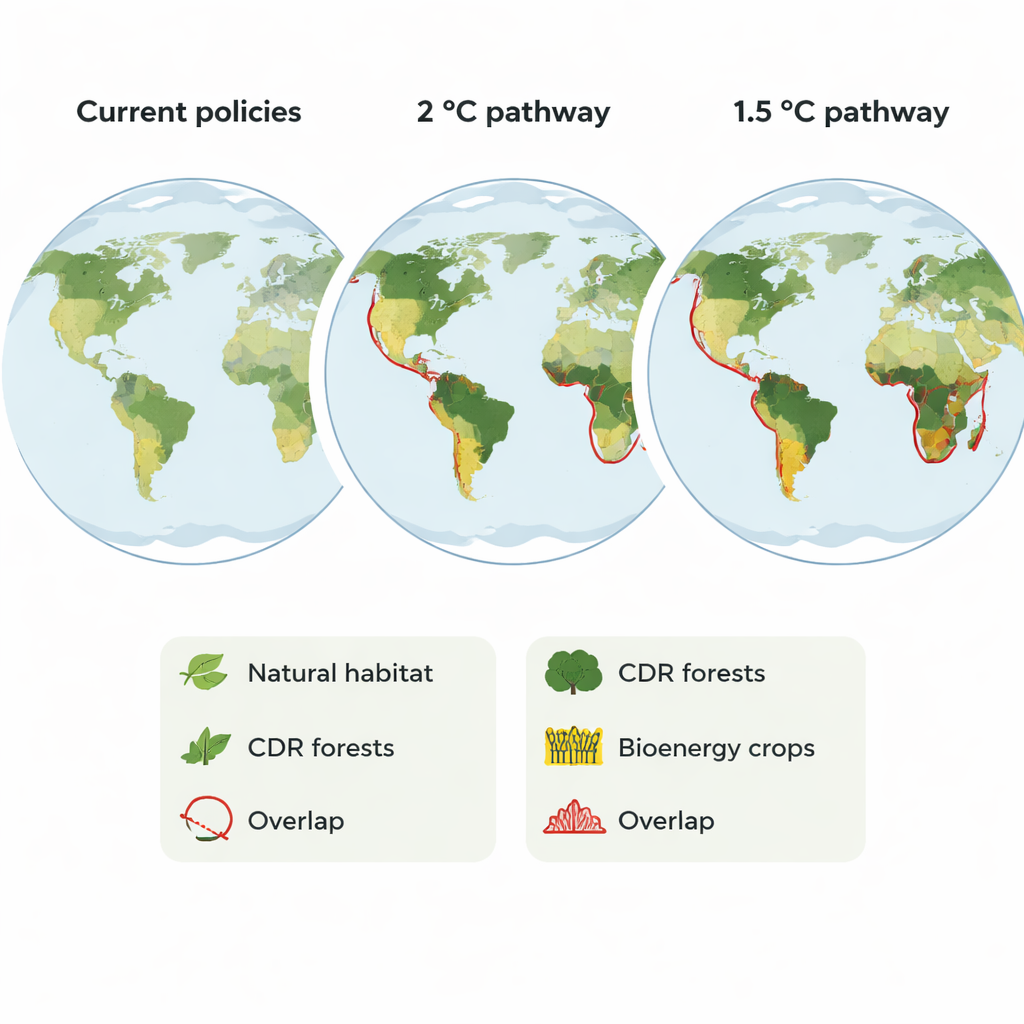
The study focused on two land‑hungry ways to remove carbon dioxide. One is forestation: expanding or restoring forests so they soak up carbon as they grow. The other is bioenergy with carbon capture and storage (BECCS): growing energy crops, burning them to make power, capturing the resulting CO2, and storing it underground. Five major climate‑economy models were used to see where, and how much, land would likely be turned over to these activities under three futures: current policies, a 2 °C world, and a 1.5 °C world.
When climate fixes invade nature’s last strongholds
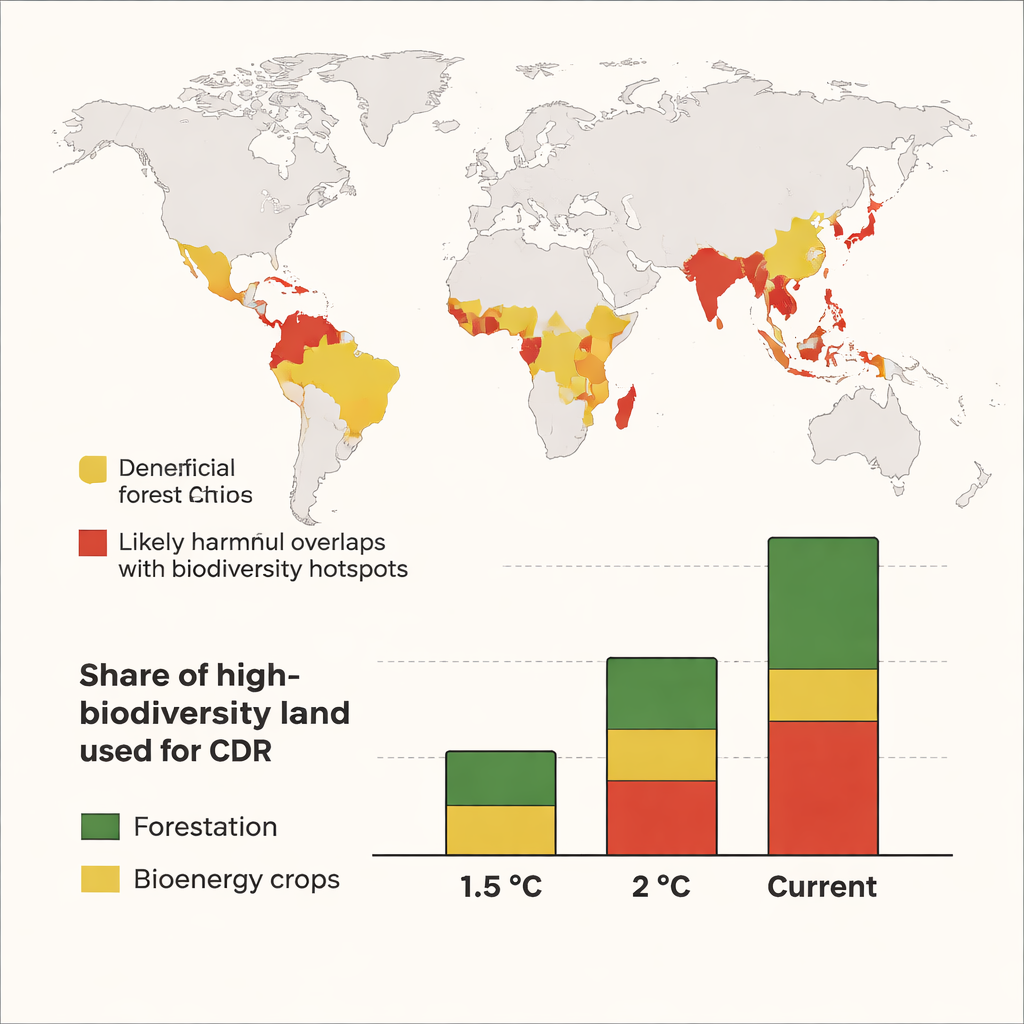
The results reveal a tension between fighting climate change and protecting biodiversity. Under today’s policies, less than 6% of remaining climate refugia would be used for forestation and BECCS. But in scenarios that successfully limit warming to 2 °C, this share rises to about 9%, and in the most ambitious 1.5 °C pathways it reaches around 13%. Most of this overlap comes from forest plantations, which alone could take up to 11% of global climate refugia by 2100, with bioenergy crops adding roughly 4%. These impacts are not spread evenly: low‑ and middle‑income countries, many of which have contributed least to global emissions, are expected to host a much larger share of carbon‑removal forests inside their refugia than wealthier nations.
Winners, losers, and where models agree
Looking in more detail, the authors found that even moderate levels of carbon removal—about six billion tonnes of CO2 per year—can claim sizeable parts of some countries’ refugia. In regions where little refuge land remains, even small absolute changes translate into large fractions of their last safe havens. By comparing all five models, the team highlighted “hotspots of agreement” where multiple models place land‑intensive carbon removal inside important biodiversity areas. These include forestation in eastern China and parts of the United States, and BECCS in West Africa and Indo‑Pacific islands. Many of these locations are judged “likely harmful” because they either lack natural potential for forests or clash with planetary limits meant to safeguard ecosystems. A minority of sites—typically degraded lands where forests once grew—may offer “potentially beneficial” opportunities where restoring native, diverse forests could store carbon and aid wildlife, but only if done with great care.
What if we truly protected nature first?
The authors then asked what would happen if the world lived up to its biodiversity promises, such as the Kunming–Montreal Global Biodiversity Framework, which aims to stop the loss of highly valuable ecosystems by 2030. If current biodiversity hotspots were simply taken off the table for new plantations and energy crops, more than half of the land earmarked for forestation and BECCS in a typical 2 °C scenario would no longer be available by mid‑century—and that constraint would appear as early as the 2030s. In principle, models could compensate by using other, less suitable land, turning to alternative carbon‑removal methods, or cutting emissions faster. But this would likely increase costs and intensify competition with food production and other human needs.
A path toward climate action that works with nature
The study concludes that relying heavily on land‑intensive carbon removal is a risky bet for biodiversity. While these approaches can slow climate change and may even reduce the overall loss of refugia, their large land footprint means they can also damage the very ecosystems we need to protect. The authors argue for a different emphasis: sharply reduce emissions now, limit carbon removal to genuinely critical uses, and prioritize restoring degraded natural ecosystems—especially where forests historically existed and diverse native species can return. Done thoughtfully, such restoration can lock away carbon, shield species from climate shocks, and keep the planet’s remaining lifeboats for life afloat.
Citation: Prütz, R., Rogelj, J., Ganti, G. et al. Biodiversity implications of land-intensive carbon dioxide removal. Nat. Clim. Chang. 16, 155–163 (2026). https://doi.org/10.1038/s41558-026-02557-5
Keywords: carbon dioxide removal, biodiversity, forestation, bioenergy with carbon capture and storage, climate refugia