Clear Sky Science · en
ER remodelling is a feature of ageing and depends on ER-phagy
Why the Cell’s Inner Folds Matter as We Age
The cells in our bodies are filled with a maze-like membrane system called the endoplasmic reticulum, or ER. This structure helps build fats and proteins, manages sugar and calcium, and talks constantly with other cell parts. Because so many vital jobs run through this network, any long-term reshaping of the ER could influence how our tissues age, how resilient they are to stress and, ultimately, how long we stay healthy. This study asks a deceptively simple question: does the ER itself age in a specific, organized way, and if so, is that change harmful wear-and-tear or a built-in protective strategy?
A Hidden Shift in the Cell’s Workbench
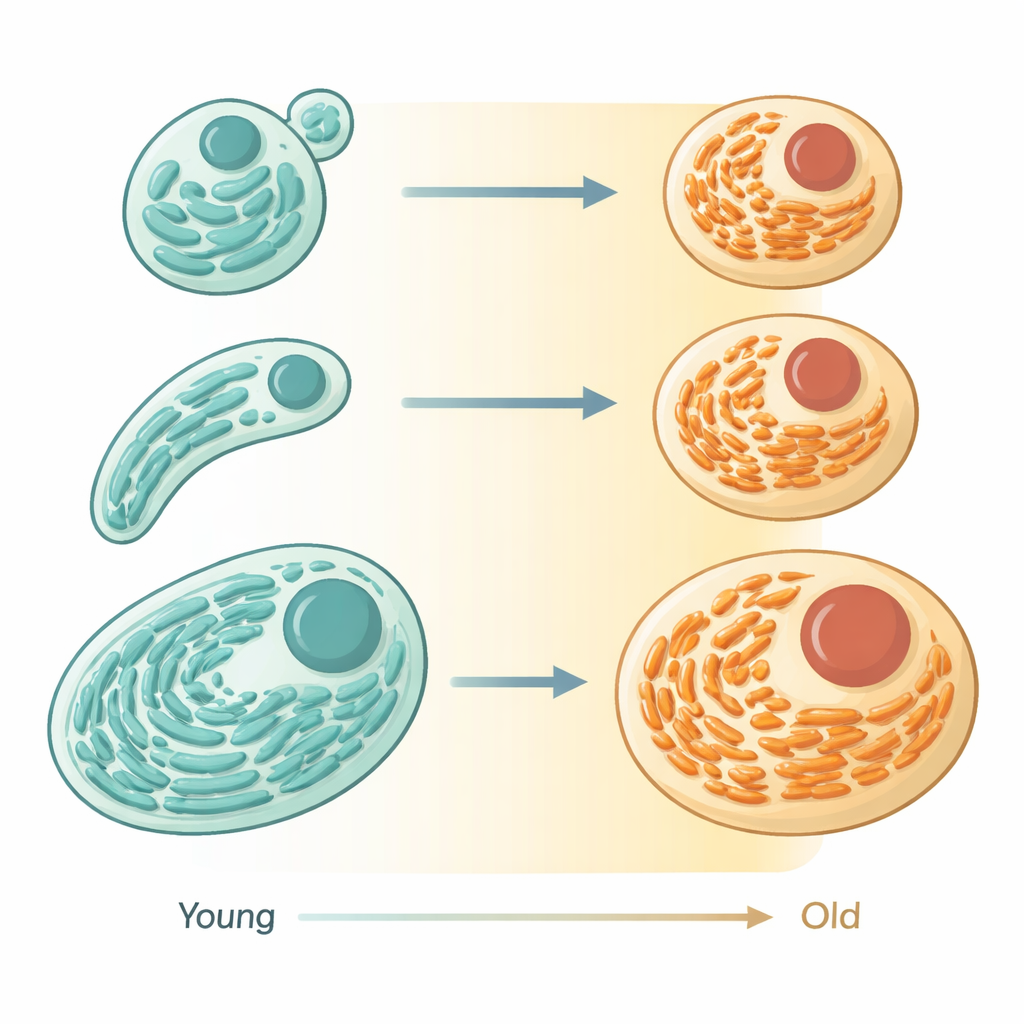
Using advanced microscopes and fluorescent tags in the tiny worm Caenorhabditis elegans, the authors followed the ER inside living animals as they moved from young adulthood into old age. In youthful cells, the ER forms broad, stacked sheets studded with protein-making machinery, resembling neatly arranged factory floors. As the worms age, those sheets shrink in volume and give way to a thinner, more tubular web that takes up less space. Measurements showed that overall ER content drops markedly while its shape changes, indicating not just random damage but a coordinated shrinking and reconfiguration of the organelle.
From Making Proteins to Handling Fats
Shape in biology often signals function, and that proved true here as well. The researchers compared how ER-related proteins change over time across worm tissues. Proteins involved in building, folding and checking other proteins declined with age, in step with the loss of sheet-like ER. In contrast, many ER proteins tied to fat and membrane metabolism stayed constant or even rose. Together, these patterns suggest that aging cells dial down bulk protein production and refocus the ER’s resources toward managing fats and membranes. Strikingly, when the authors examined large datasets from aging mice, they saw a similar story: ER proteins for secretion and protein processing tended to fall, while those involved in lipid metabolism and autophagy were relatively preserved or increased.
A Cellular Recycling Route Behind the Remodeling
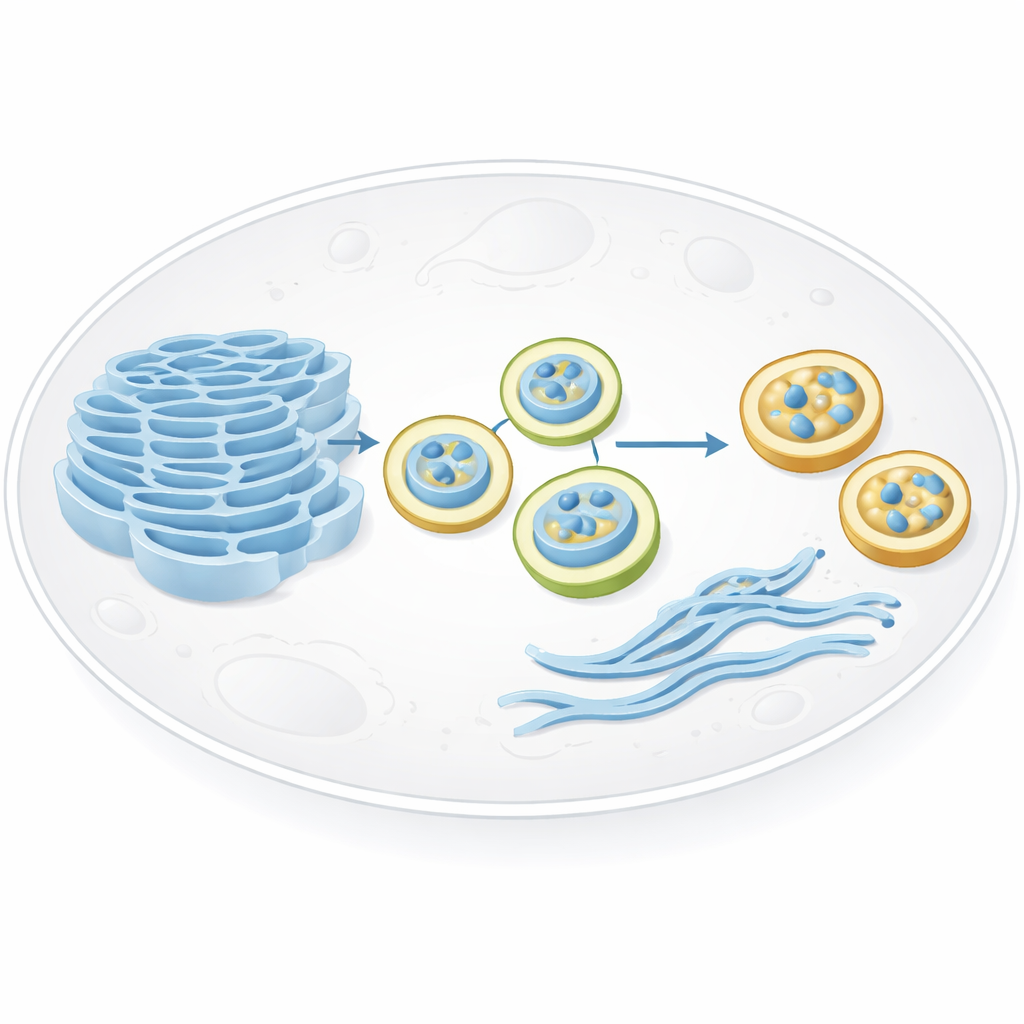
What drives this large-scale reshaping? The team traced the changes to ER-phagy, a form of selective self-eating in which the cell packages pieces of ER into recycling vesicles for breakdown in lysosomes. Blocking core autophagy genes in worms prevented the normal age-related loss of ER mass and the shift from sheets to tubules, showing that this recycling route is not just cleaning up scraps but actively sculpting the organelle. Independent experiments in yeast confirmed that ER components are redirected to the cell’s recycling center as the cells age, again in an autophagy-dependent manner. Electron microscopy revealed ER fragments inside degradative compartments, providing physical evidence that chunks of the network are being purposefully removed.
Tissue-Specific Control of a Common Aging Program
Although ER remodeling was seen in many worm tissues—intestine, skin-like hypodermis, muscle and neurons—the triggers turned out to be tissue-specific. In the hypodermis, a previously little-known membrane protein called TMEM-131 linked ER turnover to collagen handling. When TMEM-131 was reduced, the age-related loss of ER in this tissue was largely prevented, implying that the ER is downsized when its collagen “clients” diminish. In the intestine, by contrast, the key regulator was the IRE-1–XBP-1 arm of the unfolded protein response, a central stress-sensing pathway. Silencing this signaling branch preserved intestinal ER during aging, suggesting that, in this organ, ER stress signaling helps decide when parts of the ER should be sacrificed.
Rewiring the ER for a Longer Life
The study also connects ER remodeling to longevity. In worms, several well-known life-extending interventions—dampening insulin-like signals, lowering mTOR nutrient sensing, removing the germline or slightly slowing protein synthesis—all induced ER downsizing and increased tubular networks early in adulthood, rather than waiting for old age. Importantly, when ER-phagy was disabled, the long lives normally produced by mTOR inhibition in both yeast and worms were sharply reduced or lost. This indicates that carefully managed ER pruning is not just a side effect of aging or treatment, but one of the mechanisms through which cells achieve a more durable state.
What This Means for Healthy Aging
To a lay observer, losing a substantial fraction of a key cell structure during aging might sound purely harmful. The work here paints a more nuanced picture. The ER seems to be actively reshaped—via selective self-eating and tissue-tailored regulators—so that aging cells produce fewer new proteins, invest more in lipid and membrane management and possibly reduce the risk of chronic stress. This remodeling appears to be conserved from yeast to mammals and is required for at least some forms of lifespan extension. Over the long term, however, shrinking the ER may come with trade-offs, influencing how well cells repair other organelles and manage late-life decline. By revealing ER-phagy and ER dynamics as core features of normal and delayed aging, this research highlights a new set of levers that might someday be tuned to promote healthier, more resilient tissues.
Citation: Donahue, E.K.F., Hepowit, N.L., Ruark, E.M. et al. ER remodelling is a feature of ageing and depends on ER-phagy. Nat Cell Biol 28, 449–464 (2026). https://doi.org/10.1038/s41556-025-01860-1
Keywords: endoplasmic reticulum, autophagy, cellular aging, protein homeostasis, lipid metabolism