Clear Sky Science · en
A detection of sulfur-bearing cyclic hydrocarbons in space
Rings of sulfur in the cosmic fog
When we picture the ingredients of life drifting through space, we often imagine simple molecules like water or carbon dioxide. But life on Earth also depends on sulfur, a pungent element found in proteins, vitamins and many industrial chemicals. This study reveals that surprisingly complex sulfur-bearing ring molecules are already being forged in the dark clouds near the center of our Galaxy, hinting that some of life’s more elaborate chemical building blocks may begin their journey long before planets form. 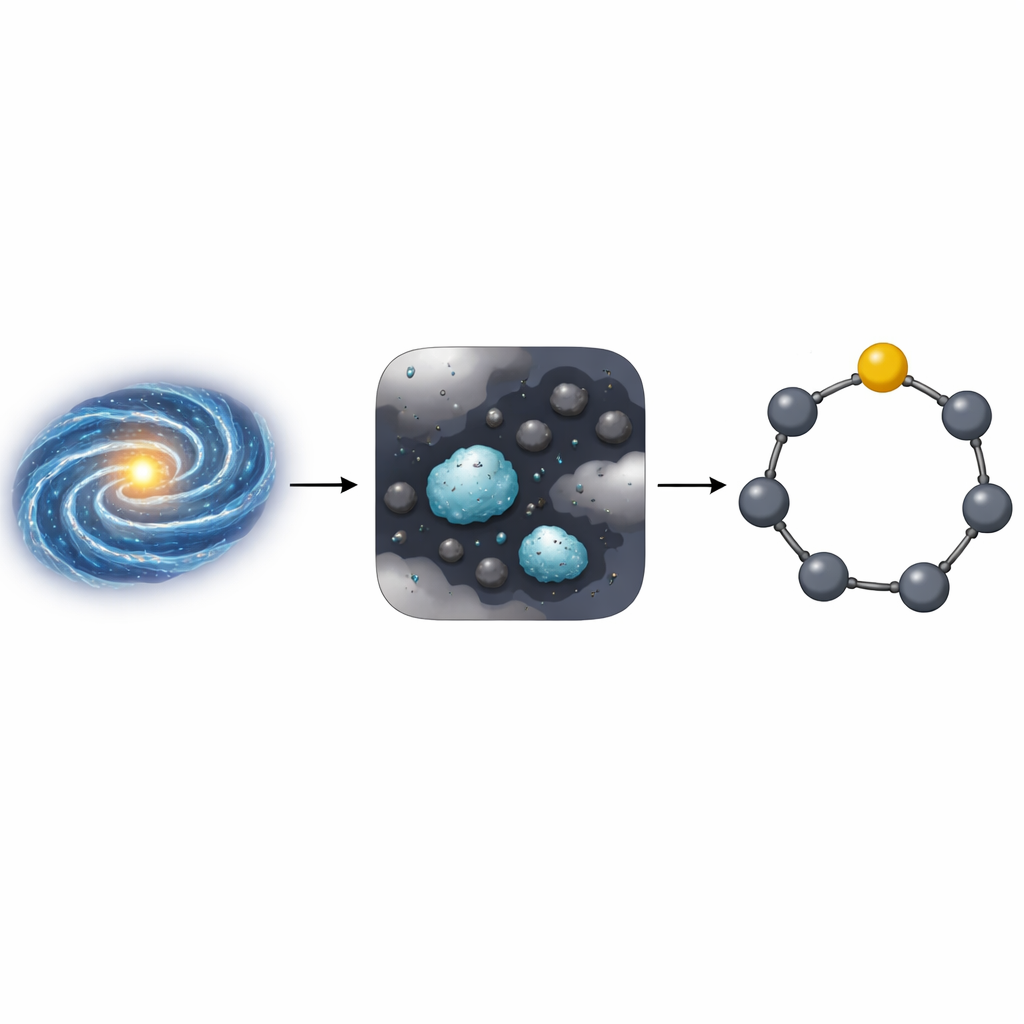
Why sulfur in space matters for life
On Earth, sulfur is woven into essential biological machinery, from the amino acids that make up proteins to key metabolic cofactors. Meteorites and comet samples likewise contain a rich variety of sulfur-bearing organic compounds, including ring-shaped structures. Yet when astronomers survey interstellar space, they usually see only small sulfur molecules, far less than expected from the overall cosmic abundance of sulfur. This long-standing discrepancy suggests that much of the sulfur may be hiding in forms that are difficult to spot, and understanding where it resides is crucial for tracing how life-friendly chemistry travels from interstellar clouds to young planets.
A new sulfur ring spotted in a galactic cloud
The authors focused on a giant molecular cloud called G+0.693, nestled in the Sagittarius B2 complex near the Milky Way’s center. This cloud is a treasure trove of complex organic molecules and is constantly stirred by slow cloud–cloud collisions and bombardment from energetic particles. By combining ultra-sensitive observations from two large radio telescopes in Spain, they combed through a broad range of radio frequencies, looking for faint spectral fingerprints from previously unseen molecules. They report the clear detection of a 13-atom sulfur-bearing ring, 2,5-cyclohexadien-1-thione, a close chemical cousin of a simpler meteorite molecule known as thiophenol. This molecule is now the largest sulfur-containing species ever identified in interstellar gas and the first confirmed example of a sulfur-bearing cyclic hydrocarbon in space.
From laboratory sparks to cosmic fingerprints
Finding such a specific molecule in the sky is only possible if its radio signature is known beforehand. To obtain that fingerprint, the team first created 2,5-cyclohexadien-1-thione in the laboratory. They passed thiophenol gas through an electrical discharge in a supersonic jet and measured the resulting molecules with a high-precision microwave spectrometer. This setup cooled the products to a few degrees above absolute zero, closely mimicking interstellar conditions and allowing extremely sharp rotational lines to be recorded. Dozens of these lines were then fitted with quantum-chemical models to extract the molecule’s rotational constants and predict its emission frequencies with kilohertz accuracy. Armed with this catalog, the astronomers could then match dozens of unblended lines in the G+0.693 survey, ruling out confusion with more than 140 other known molecules in the cloud. 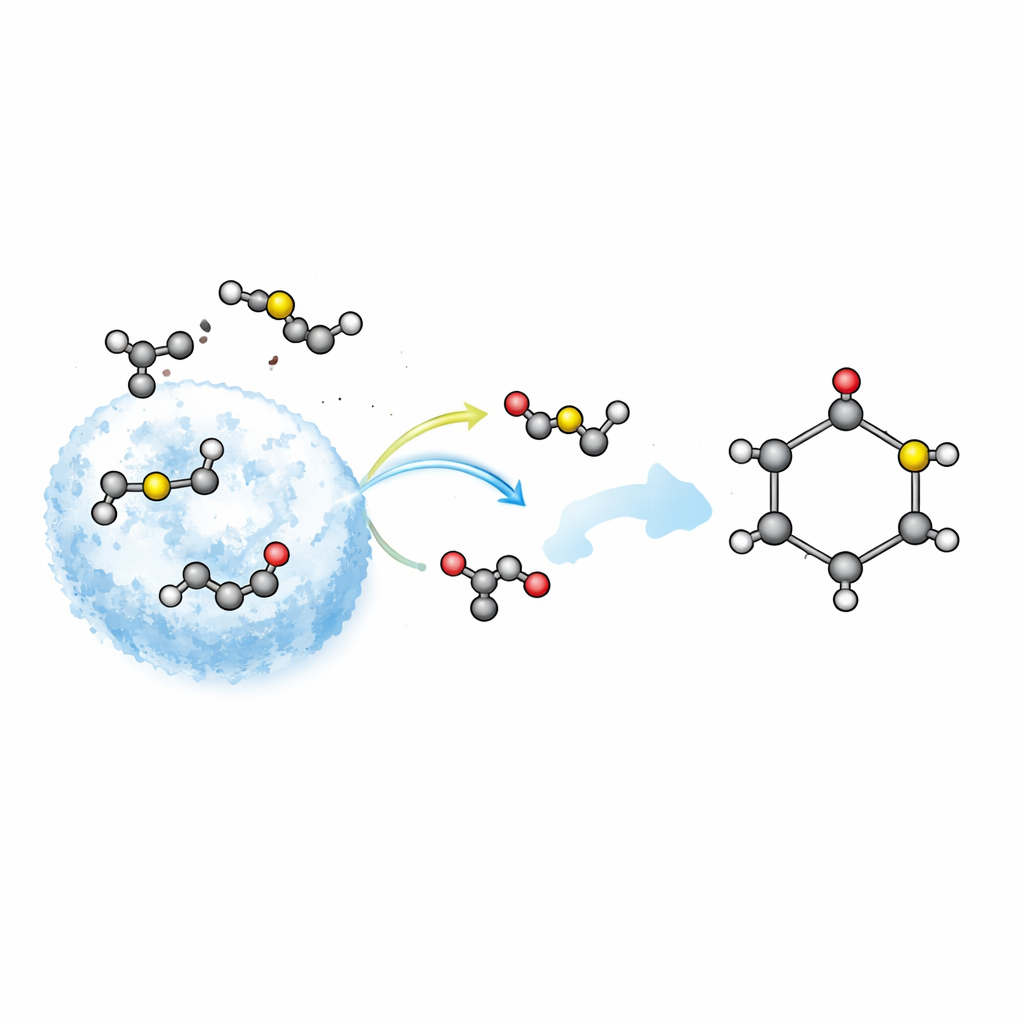
Clues to how sulfur rings are built
Detecting the molecule is only the first step; the next challenge is to understand how it forms. The cloud’s moderate density and low excitation temperature mean that only low-energy transitions are visible, but these still reveal that 2,5-cyclohexadien-1-thione, while rare, is firmly present. The authors compare it with its structural siblings—another ring isomer and thiophenol itself—which are not clearly seen. They argue that the newly detected species is favored because it has a stronger electric polarity, making it easier to detect, but it may also be formed more efficiently. Drawing on experiments and models from related carbon chemistry, they suggest that reactions on the icy surfaces of dust grains, driven by cosmic rays and then released by gentle shocks, could assemble small sulfur–carbon chains into larger rings. However, no detailed laboratory or theoretical pathways have yet been worked out, leaving the exact recipe an open question.
What this means for the missing sulfur puzzle
Although this new sulfur ring makes up only a tiny slice of the sulfur budget in G+0.693, its discovery is likely a sign that many other related molecules are waiting to be found. Just as the first detection of a simple aromatic ring with a cyanide side group opened the door to a whole population of complex carbon rings in space, 2,5-cyclohexadien-1-thione may be the forerunner of a family of sulfur-rich rings and larger polycyclic compounds. These species probably do not solve the entire problem of “missing sulfur” in dense clouds, but they do provide a concrete link between the chemistry of interstellar gas and the sulfur-heavy organics seen in meteorites and cometary material. In this way, the work helps to fill in one more step in the chain connecting the cold, diffuse spaces between stars to the warm, living surfaces of planets.
Citation: Araki, M., Sanz-Novo, M., Endres, C.P. et al. A detection of sulfur-bearing cyclic hydrocarbons in space. Nat Astron 10, 401–409 (2026). https://doi.org/10.1038/s41550-025-02749-7
Keywords: interstellar molecules, sulfur chemistry, astrobiology, molecular clouds, prebiotic organics