Clear Sky Science · en
Spatial variation of energy transport mechanisms within solar flare ribbons
Why Solar Flares Matter to Everyday Life
Solar flares are colossal explosions on the Sun that can disturb satellites, radio signals, navigation systems and even power grids on Earth. To predict and prepare for these space-weather storms, scientists need to understand not just how much energy a flare releases, but exactly how that energy travels through the Sun’s atmosphere. This article explores a surprising discovery: even within a single flare, different parts of the same bright “ribbon” on the Sun can be powered in very different ways.
Bright Ribbons on a Stormy Sun
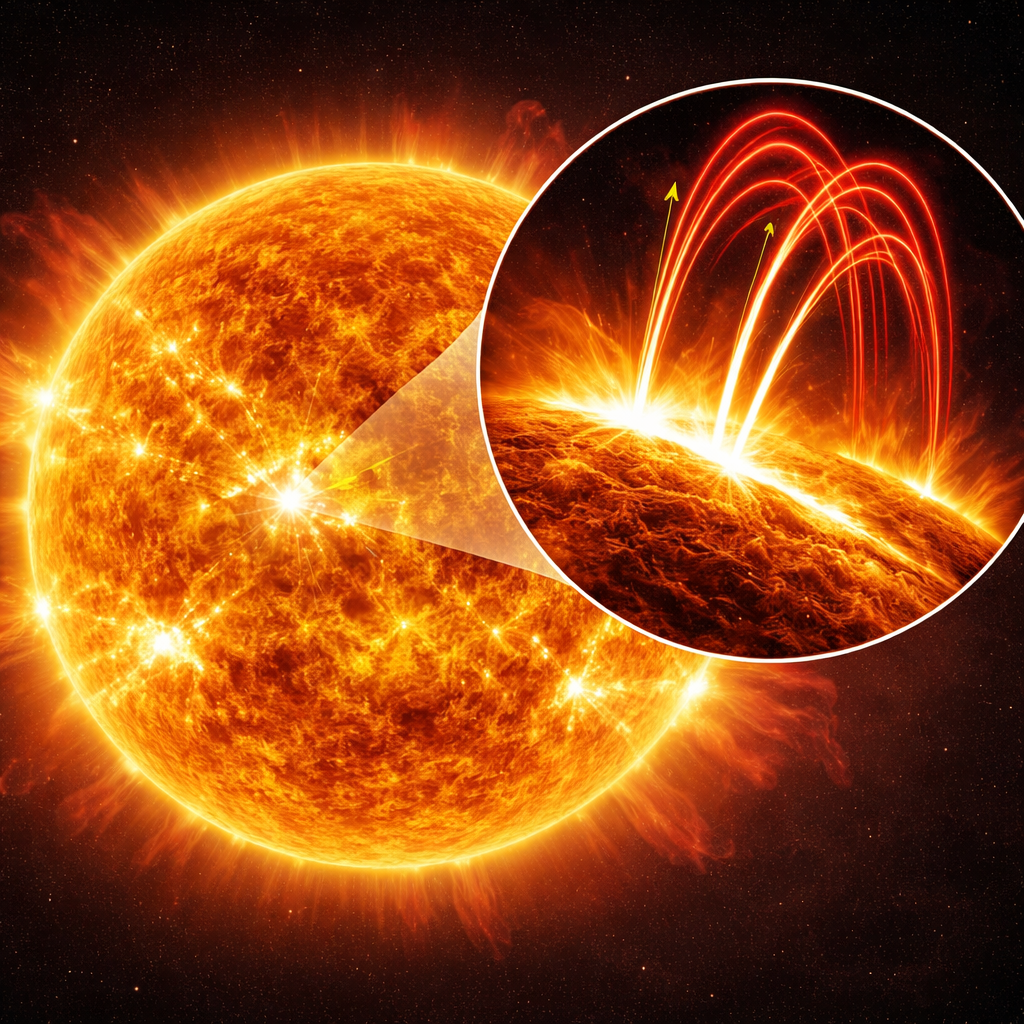
When a solar flare erupts, it releases energy high in the Sun’s outer atmosphere and sends it rushing down magnetic “loops” to the surface. Where those loops touch the Sun, they light up as long, thin bands called flare ribbons. These ribbons are the visible footprints of the flare. Using the Solar Orbiter spacecraft, the team focused on a modest “microflare” that occurred near a much larger flare. An instrument called SPICE stared at the same narrow strip on the Sun’s surface with rapid snapshots every five seconds, catching two separate ribbon footpoints: one bright and intense in the upper ribbon, and one weaker and slower in the lower ribbon.
Listening to the Sun in Hydrogen Light
To work out how energy was moving, the researchers did not just look at how bright the flare was. Instead, they measured the ratio of two ultraviolet fingerprints of hydrogen, known as Lyman beta and Lyman gamma. These spectral lines form in the Sun’s lower atmosphere and are very sensitive to heating. In quiet conditions their intensity ratio stays nearly constant, but during the flare it dipped sharply. At the bright upper footpoint, the ratio plunged quickly to much lower values for only about half a minute before recovering. At the weaker lower footpoint, the ratio dipped more modestly but stayed low for much longer. This contrast suggested that the same flare was heating nearby regions of the Sun in very different ways.
Testing Energy Pathways with Supercomputers
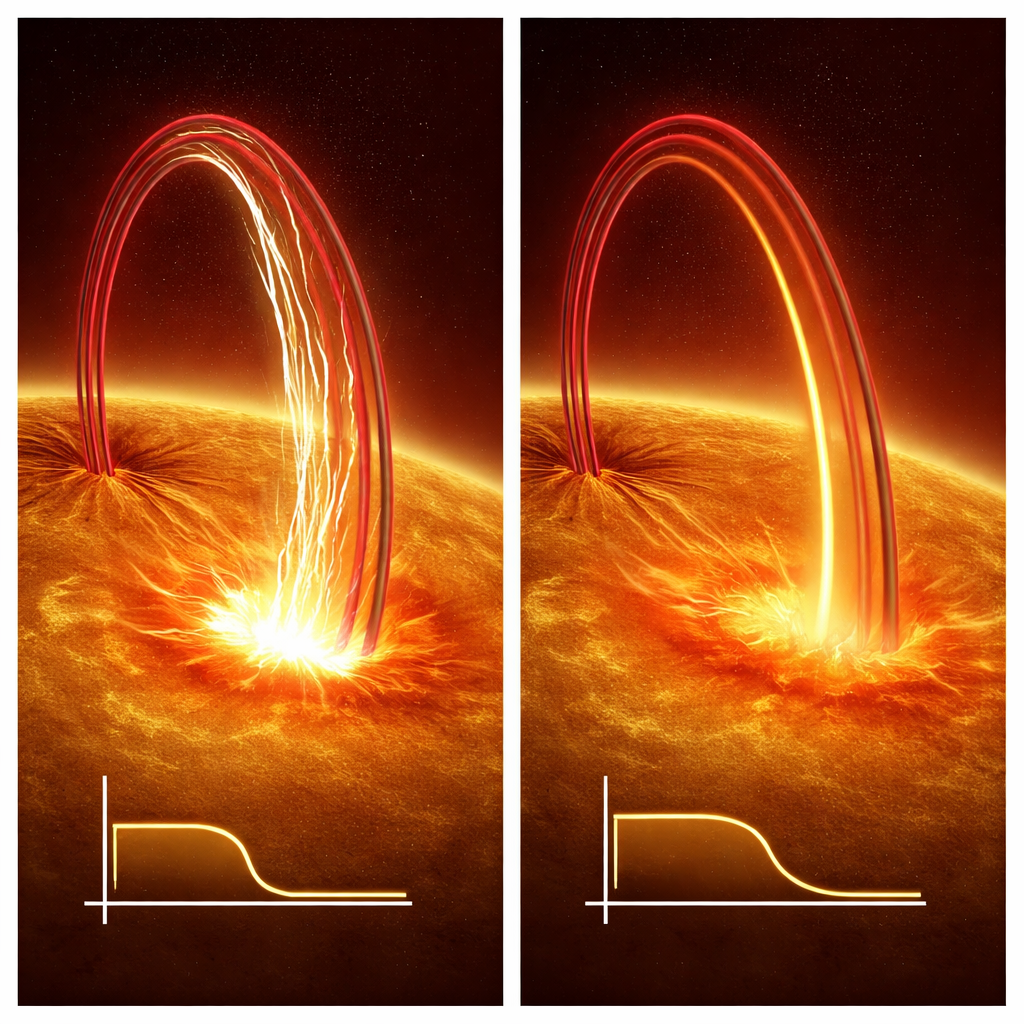
To interpret these changes, the team turned to detailed computer simulations of flare loops that track how gas, light and particles respond to sudden energy input. They explored several scenarios. In some, beams of very fast electrons or protons—often called non-thermal particles—carry energy down the loop and slam into denser layers below. In others, the top of the loop is simply heated, and energy then flows downward as ordinary heat via thermal conduction, like warmth spreading along a metal rod. From each simulation they generated synthetic spectra and calculated what the Lyman beta/gamma ratio should look like to SPICE, including the blurring and noise of the real instrument.
Two Different Engines in One Flare
The comparison was striking. Simulations in which energetic particles bombarded the lower atmosphere produced a rapid, deep drop in the Lyman ratio that closely matched the behaviour of the bright upper footpoint. Models driven mainly by thermal conduction, without strong particle beams, showed only a smaller, more gradual decrease—very similar to the weaker lower footpoint. Additional modelling of a whole arcade of magnetic loops showed that a SPICE-like slit crossing such a structure would indeed see a bright, short-lived source where particles rain down and a dimmer, longer-lived source where heat seeps down more gently. Together, the observations and models imply that one ribbon segment was powered mainly by fast particles, while the neighbouring segment was powered mainly by heat flowing down from above.
Rethinking How Flares Deliver Their Punch
This work challenges the long-held view that beams of energetic electrons dominate energy transport along an entire flare ribbon. Instead, it shows that different mechanisms can take over in different places, even within the same event and only a few thousand kilometres apart. The simple ratio of two hydrogen lines turns out to be a powerful diagnostic for identifying where and when fast particles are present, and how long they act. As new solar telescopes provide sharper and faster views of flare ribbons, these techniques will help scientists map the Sun’s hidden energy pathways in ever finer detail, ultimately improving our ability to forecast the solar storms that affect technology and life on Earth.
Citation: Kerr, G.S., Krucker, S., Allred, J.C. et al. Spatial variation of energy transport mechanisms within solar flare ribbons. Nat Astron 10, 202–213 (2026). https://doi.org/10.1038/s41550-025-02747-9
Keywords: solar flares, flare ribbons, space weather, energy transport, Solar Orbiter