Clear Sky Science · en
A possible challenge for cold and warm dark matter
A cosmic mystery hiding in plain sight
Most of the matter in the Universe is invisible. It does not shine, absorb, or reflect light, yet its gravity sculpts galaxies and galaxy clusters. This paper tells the story of a tiny but extraordinarily dense clump of this "dark matter" found only because it distorted a thin arc of radio light from a distant galaxy. By taking advantage of this natural magnifying glass, the authors probe one of the smallest dark structures ever seen and find that its properties may be hard to reconcile with our standard picture of dark matter.

Seeing the unseen with bent light
When a massive galaxy lies directly between us and a more distant source, its gravity bends the background light into stretched arcs and rings, a phenomenon known as gravitational lensing. In the system studied here, a massive elliptical galaxy about halfway to a distant radio source produces an almost complete ring of near-infrared light and, at radio wavelengths, an extraordinarily thin arc. Earlier work had already revealed a dark clump roughly one hundred million times the mass of the Sun near this ring. More recently, extremely sharp radio observations uncovered a second, much smaller disturbance in the thin arc, hinting at another, far lighter object with no visible stars. The new paper focuses on this second perturbing object and asks a simple question: what kind of thing could it be?
Testing every familiar suspect
To answer this, the team built detailed computer models that directly fit the radio data in their raw form, exploring 23 different possibilities for the mass and structure of the hidden object. They tried shapes that describe ordinary star clusters, compact dwarf galaxies, and the dark clumps predicted by the standard cold dark matter framework and by its warm variant. They also allowed for the object to sit either in the main lens galaxy or anywhere along the line of sight. Using a rigorous statistical comparison, they asked which of these candidates can reproduce the subtle wiggle the object imprints on the thin radio arc.
An object unlike anything we know
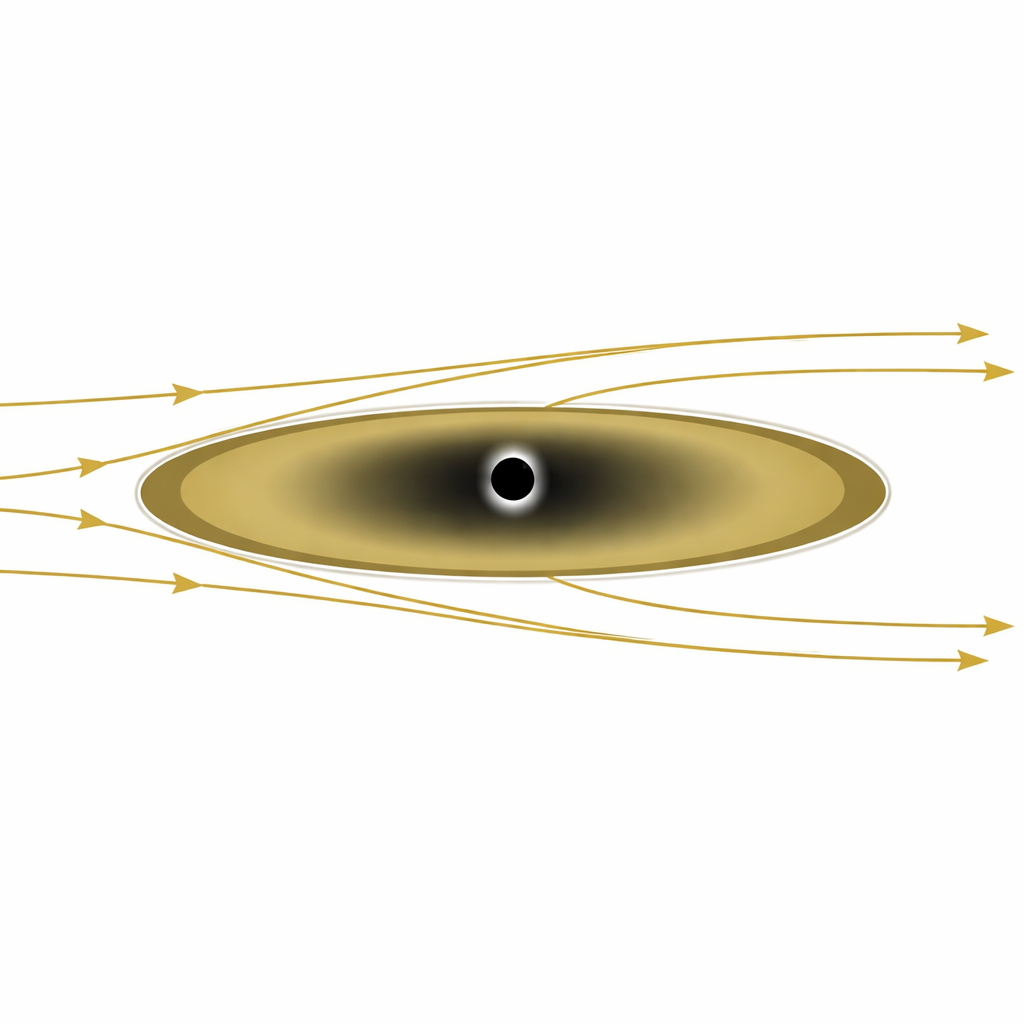
The best-fitting explanation is striking. The data favor an object that combines two components: an unresolved central mass, likely no larger than about ten light-years across, containing roughly one fifth of the total mass, and an extended surrounding region with nearly constant surface density out to about 450 light-years, beyond which the density drops abruptly. This combination behaves a bit like a massive black hole or dense stellar nucleus embedded in a flat-topped disk of matter. Models that treat the object as a single black hole, a normal globular star cluster, or a conventional dark-matter clump all fit the data much more poorly. Even when the authors force their models to follow the standard predictions for cold or warm dark matter, the resulting structures are far too different from what the lensing data demand.
Hints of new dark matter behavior
Because the object is faint or entirely dark in deep near-infrared images, a purely stellar explanation such as a known class of compact galaxy remains possible but not strongly favored by the lensing alone. If instead the object is dominated by dark matter, its dense core and sharp outer edge present a challenge for the usual picture in which dark matter particles hardly ever interact except through gravity. The authors show that such an extreme structure could naturally arise if dark matter particles occasionally collide with one another, allowing the inner region of a small halo to collapse and potentially form a central black hole. In this "self-interacting" scenario, even very small haloes could host massive dark engines without relying on the complicated processes that shape ordinary galaxies.
Why this tiny clump matters
This is only the third time that such a low-mass dark object has been individually mapped using gravitational imaging, and, like the previous cases, it does not neatly match the expectations of the standard cold or warm dark matter models. If future observations confirm that these perturbers are truly dominated by dark matter rather than by stars, they will provide strong evidence that dark matter is not entirely collisionless. That would force cosmologists to revise one of the central assumptions behind the current model of cosmic structure, using rare but telling systems like this thin arc and its hidden companion as laboratories for new physics.
Citation: Vegetti, S., White, S.D.M., McKean, J.P. et al. A possible challenge for cold and warm dark matter. Nat Astron 10, 440–447 (2026). https://doi.org/10.1038/s41550-025-02746-w
Keywords: dark matter, gravitational lensing, self-interacting dark matter, galaxy halos, radio astronomy