Clear Sky Science · en
A solution to the S8 tension through neutrino–dark matter interactions
Why the hidden side of the Universe matters
Most of the matter in the Universe is invisible. It neither shines nor absorbs light, yet its gravity sculpts galaxies and cosmic webs. Another ghostly ingredient, the neutrino, rushes through everything with barely a trace. This article explores an intriguing idea: that these two elusive components, dark matter and neutrinos, may interact with each other in subtle ways. If true, this hidden relationship could solve a long-standing puzzle in cosmology about how quickly cosmic structures grow over time.
A quiet clash in cosmic measurements
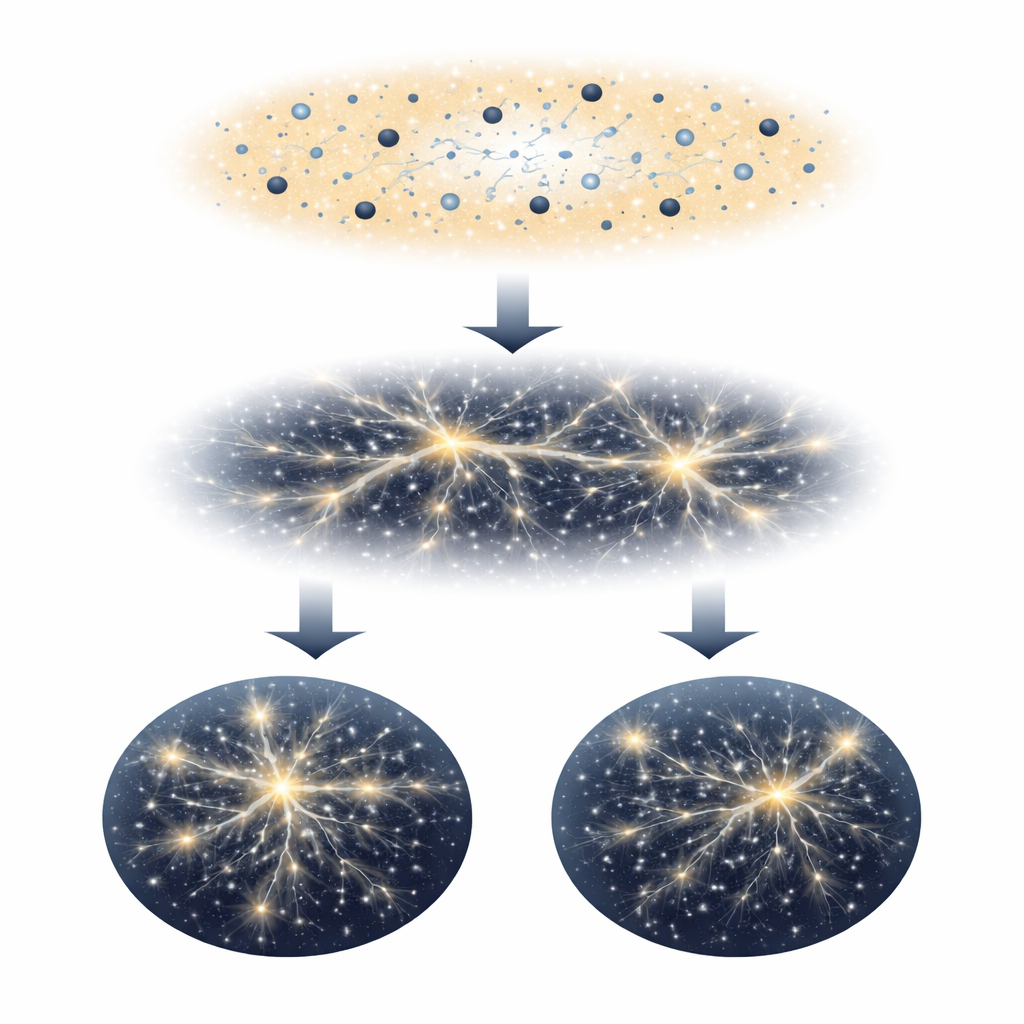
Over the past decade, astronomers have mapped the Universe in two very different eras. The first is the “baby picture” of the cosmos: the cosmic microwave background, a faint afterglow from just 380,000 years after the Big Bang. The second is the modern Universe, where galaxies and clusters have had billions of years to form. From these data, scientists estimate how strongly matter clumps together, summarized by a parameter called S8. The early-Universe observations, especially from the Planck satellite, suggest stronger clumping than what we infer from present-day sky surveys that track how galaxies warp the light of more distant galaxies. This disagreement, known as the S8 tension, hints that our standard cosmological model, called ΛCDM, might be missing a piece.
When dark matter and neutrinos talk
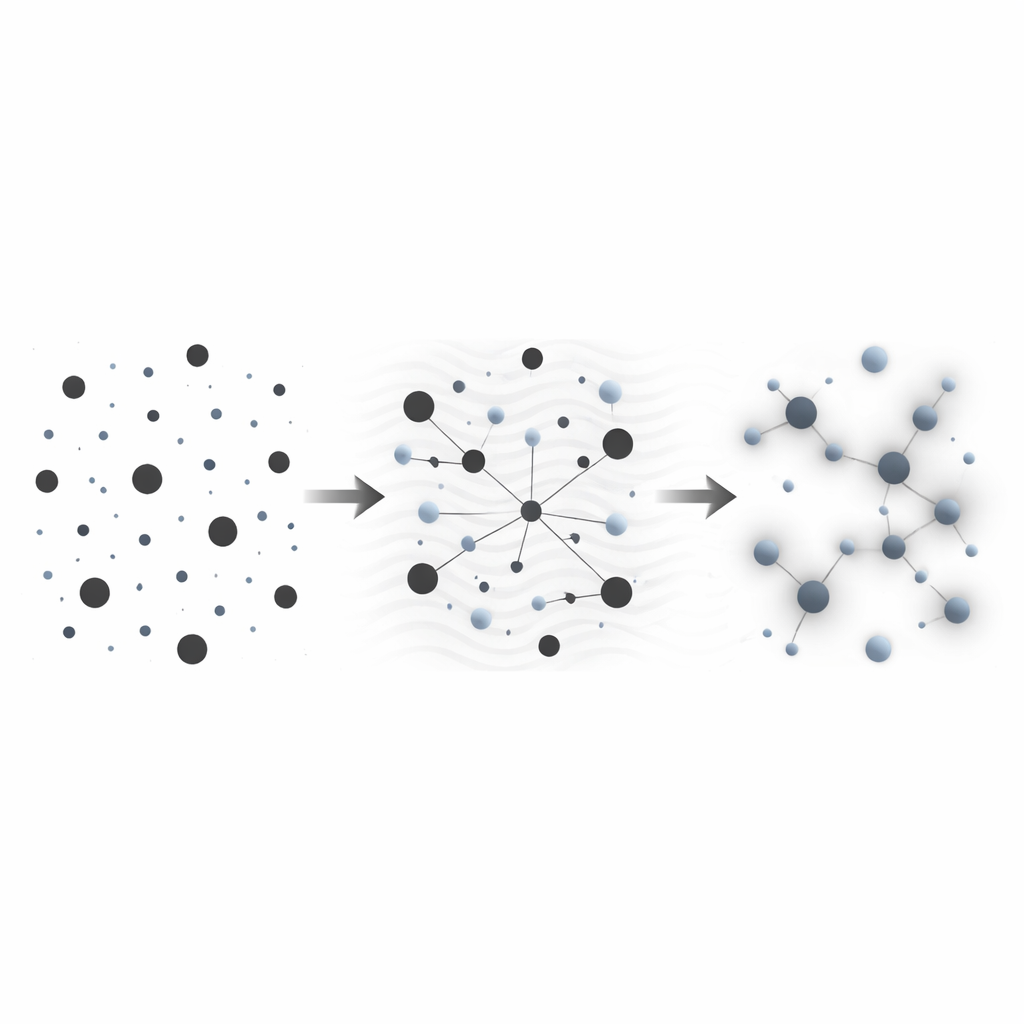
The authors investigate a simple but powerful possibility: that dark matter occasionally scatters off neutrinos. In the early Universe, neutrinos were far more abundant than ordinary matter, so even a weak interaction could gently tug on dark matter, influencing how tiny ripples of density grew. This interaction acts like a kind of drag or friction, damping small-scale clumps and producing “dark acoustic oscillations” in the matter distribution—subtle wiggles in how structure forms on different scales. Instead of rewriting the whole cosmological framework, the researchers add just one new parameter that measures the effective strength of this dark matter–neutrino coupling.
Listening to the cosmic web through weak lensing
To test this idea, the team combines early-Universe measurements with a powerful late-time probe called weak gravitational lensing. Weak lensing does not rely on how galaxies shine, but on how their shapes are slightly stretched by the gravity of intervening matter. Using data from the Dark Energy Survey’s three-year cosmic shear catalog, they compare the observed lensing patterns to detailed simulations of structure growth that include dark matter–neutrino interactions. These simulations track how tiny initial ripples evolve under gravity while incorporating the extra smoothing caused by the proposed interaction. Because small-scale structure becomes nonlinear and complex, the authors employ N-body simulations and an emulator—a fast interpolation tool—to accurately model these effects across many possible cosmological histories.
Bridging the S8 gap
When they fit the data from the cosmic microwave background, baryon acoustic oscillations, the Atacama Cosmology Telescope, and the Dark Energy Survey’s cosmic shear measurements all together, a striking pattern emerges. Both early- and late-time observations consistently favor a nonzero interaction strength corresponding to about one part in ten thousand relative to a familiar scattering process. At this level, the dark matter–neutrino coupling mildly suppresses the growth of structure on the scales probed by weak lensing, nudging the predicted S8 value downward until it lines up with lensing-based estimates. Statistically, the combined data show nearly a three-sigma preference for such an interaction—strong enough to take seriously, though not yet definitive proof of new physics.
What comes next for our cosmic picture
The proposed interaction is not without caveats. Very small-scale probes, such as detailed patterns in intergalactic gas or counts of faint dwarf galaxies, might challenge a constant, time-independent interaction strength, although these observables come with their own astrophysical uncertainties. The authors therefore treat their model as a practical approximation that captures the key signals in current data. Looking ahead, they simulate how upcoming surveys like the Vera C. Rubin Observatory’s deep sky maps and China’s space-based telescope could sharpen the picture. These next-generation weak lensing experiments should either confirm the preferred interaction region or rule it out, providing an order-of-magnitude improvement in sensitivity. In plain terms, this study suggests that a gentle handshake between dark matter and neutrinos may be what keeps our cosmic story consistent from its earliest snapshot to the present-day web of galaxies.
Citation: Zu, L., Giarè, W., Zhang, C. et al. A solution to the S8 tension through neutrino–dark matter interactions. Nat Astron 10, 457–465 (2026). https://doi.org/10.1038/s41550-025-02733-1
Keywords: dark matter, neutrinos, cosmic structure, weak lensing, S8 tension