Clear Sky Science · en
The efficacy of fecal sludge treatment technologies and resource recovery: a systematic review and meta-analysis in Sub-Saharan Africa
Why Toilets Still Matter for Everyone
Across much of the world, what happens after we flush—or use a pit latrine—is largely invisible. Yet poorly handled human waste contaminates rivers, food, and drinking water, spreading disease and fueling inequality. This paper looks at how cities and towns in sub-Saharan Africa are trying to turn a difficult problem—thick, dangerous toilet sludge—into safer water, cleaner neighborhoods, and even useful products like energy and fertilizer.
A Hidden River of Waste
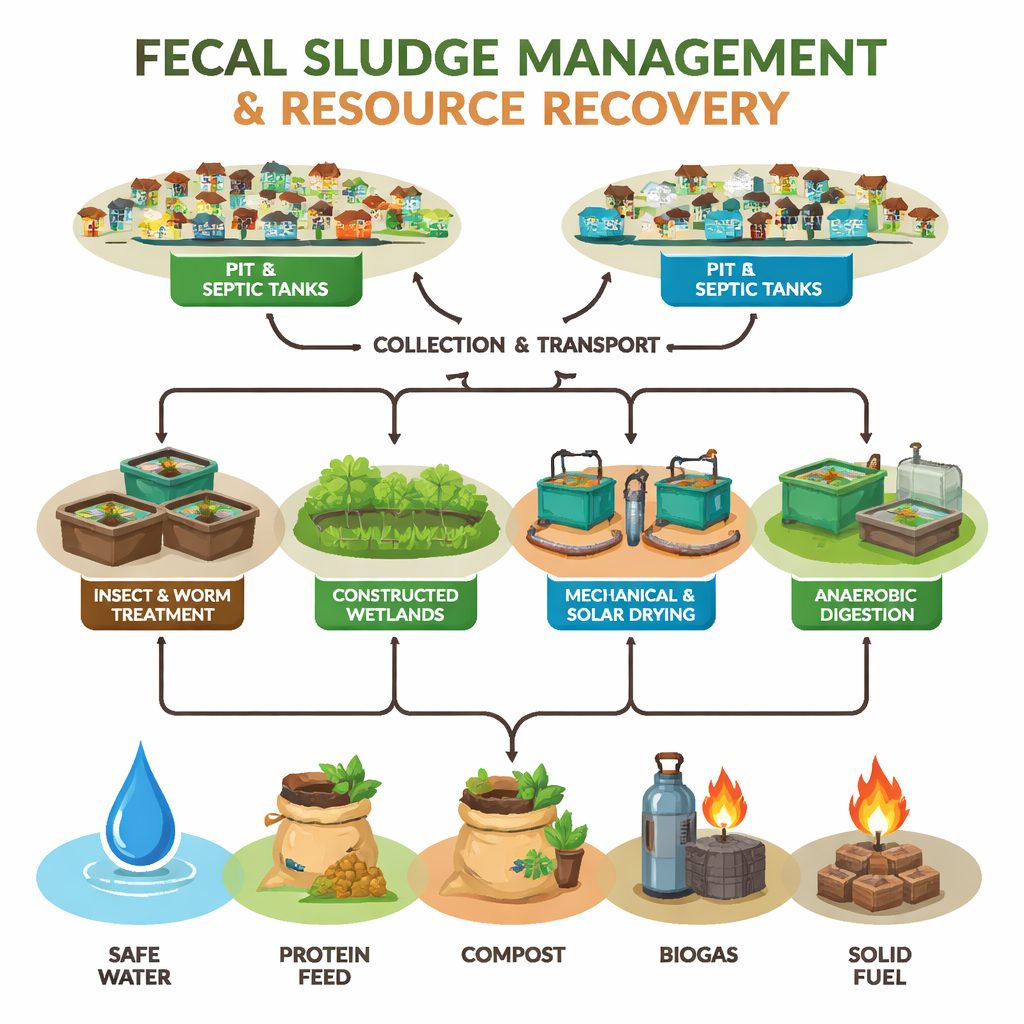
Every year, the world produces hundreds of billions of cubic meters of wastewater, and only a fraction is properly treated. In sub-Saharan Africa, most households are not connected to sewers. Instead, they rely on pit latrines, septic tanks, and other on-site systems that slowly fill up with a concentrated mix called fecal sludge. Nearly half of this sludge is never emptied, and much of what is emptied is simply dumped into the environment. The authors reviewed 93 studies from 12 African countries to ask a simple but pressing question: are today’s sludge treatments actually making waste safe, while also recovering useful resources?
Four Ways to Clean Up the Mess
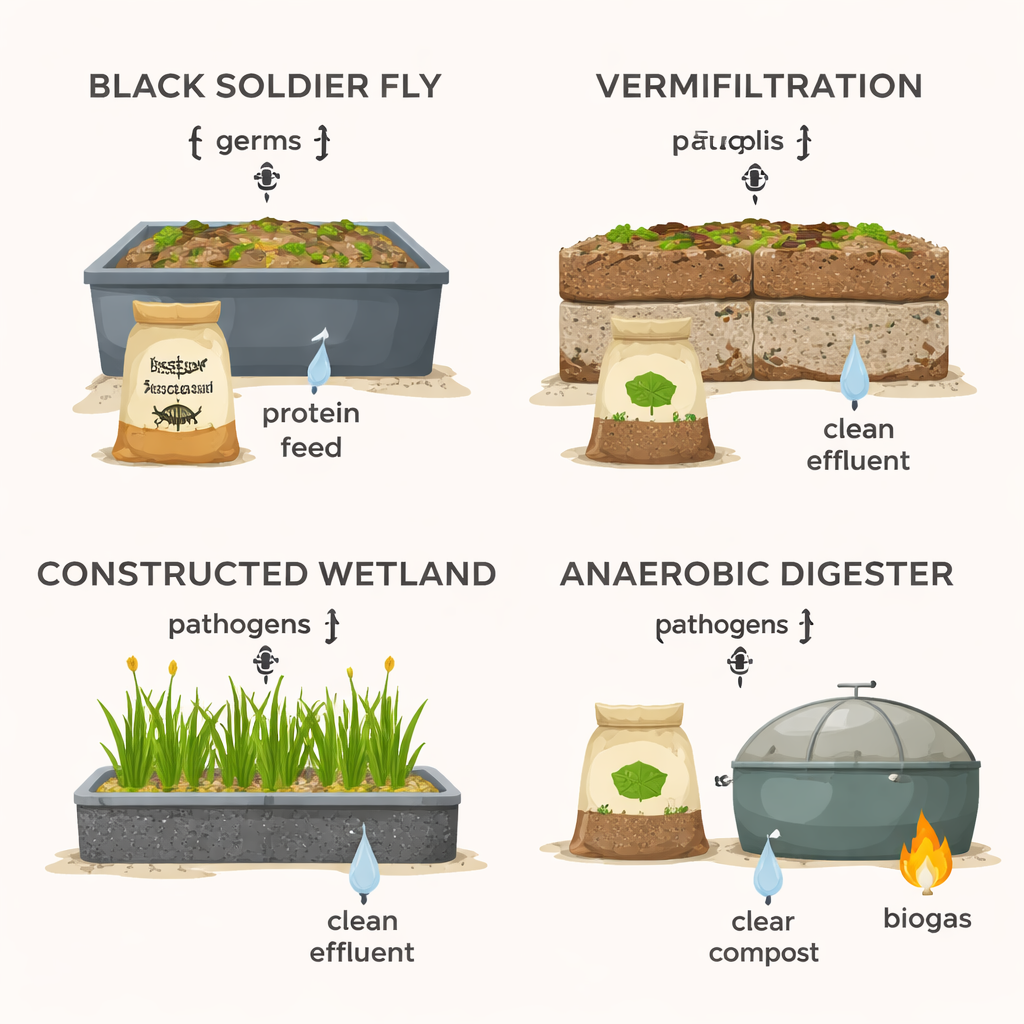
The review groups current technologies into four broad families. First are insect and worm-based systems, where black soldier fly larvae and earthworms feast on sludge, shrinking its volume and killing many germs while producing protein-rich animal feed and compost. Second are plant-based systems such as constructed wetlands and planted drying beds, where reeds, grasses, and bamboo help filter out solids and nutrients as sludge drains and dries. Third are efficiency-focused tools like additives for faster dewatering, solar or microwave drying, and special bacterial mixes to control odors. Finally, integrated “waste-to-resource” systems—such as anaerobic digesters and compost piles—aim to treat sludge and produce biogas, fertilizer, or solid fuels at the same time.
How Well Do These Methods Work?
Across very different settings, many systems showed strong removal of organic pollution and germs. On average, treatments lowered a common gut bacterium, E. coli, by just over one “log unit,” meaning about a tenfold reduction, though performance varied widely. Measures of rotting organic material, like five‑day biochemical oxygen demand, fell sharply, while nutrients such as nitrogen and phosphorus were often captured in forms that plants can use. Some methods stood out: black soldier fly larvae reduced sludge volume by up to 70 percent and slashed bacterial levels, while vermifiltration and vermicomposting removed more than 95 percent of solids and many pathogens. Plant-based wetlands, when matched with hardy species such as certain grasses and bamboo, also achieved very high cleaning rates, but could fail when incoming sludge was too strong.
From Waste to Fuel and Fertilizer
More than half the studies went beyond safety and looked at what valuable products could be made. Anaerobic digestion turned fecal sludge, often mixed with food scraps or animal manure, into biogas suitable for cooking, sometimes doubling methane output compared with treating sludge alone. Composting, when kept hot enough for several weeks, typically destroyed worm eggs and fecal bacteria and produced a stable, nutrient-rich soil amendment that met international guidelines in many cases. Drying and shaping sludge into pellets or briquettes created a solid fuel with an energy content similar to some types of wood, though high ash and smoke remain concerns. At the same time, dried pellets and compost were shown to boost crop yields, including maize and lettuce, matching or approaching mineral fertilizers when applied carefully.
Why Context and Caution Matter
The authors stress that no single “magic” technology fits every town or climate. Biological options like insects, worms, and plants work best in warm, well-managed systems and may struggle with very salty or highly polluted sludge. Fast, hardware-heavy options—microwaves, lime, or gasification—can quickly kill germs and reduce volume but often need follow‑up steps to stabilize the material or limit smoke and metal build‑up. Energy and fertilizer products from sludge can help pay for services, but only if health safeguards are in place. Heavy metals and remaining germs must be monitored so that repeated use on fields does not slowly contaminate soils and food.
What This Means for Everyday Life
For a layperson, the message is that “what happens after the latrine” can either poison communities or power them. The study shows that with the right mix of insects, plants, smart drying, and energy recovery, fecal sludge can be transformed from a smelly hazard into biogas for cooking, compost for farms, and safer water flowing back into the environment. But getting there requires more than clever gadgets: cities must choose technologies that match local conditions, enforce health standards, and invest in long‑term monitoring. Done well, fecal sludge management can become a cornerstone of cleaner streets, safer drinking water, and more resilient, circular economies in sub-Saharan Africa.
Citation: Lamore, Y., Cheng, S. & Li, Z. The efficacy of fecal sludge treatment technologies and resource recovery: a systematic review and meta-analysis in Sub-Saharan Africa. npj Clean Water 9, 22 (2026). https://doi.org/10.1038/s41545-026-00556-9
Keywords: fecal sludge management, sanitation, resource recovery, sub-Saharan Africa, wastewater treatment