Clear Sky Science · en
Desalination and the Middle East: research, practices, implications, and prospects
Why Turning Seawater into Drinking Water Matters
For people living in the Middle East, running water from the tap is increasingly likely to have started its life in the sea. This region has some of the driest climates on Earth, fast-growing cities, and limited rivers and lakes. The article explains how the Middle East has become the world’s largest user and developer of desalination—technologies that strip salt from seawater—and what that means for water security, the environment, and future innovation.
A Dry Region Leaning on the Sea
The Middle East holds about 6% of the world’s population but no more than 2% of its renewable freshwater. Many countries there already use more than 80% of their naturally renewed water each year. Climate change is making droughts longer and rainfall more erratic, while growing populations and economies push demand ever higher. The study shows that the Middle East now runs nearly 42% of the planet’s operating desalination capacity and produces more than half of the world’s salty waste stream, or brine. Countries treat desalination as a pillar of national security, using it to keep taps flowing in big coastal cities and industrial hubs even when nature falls short. 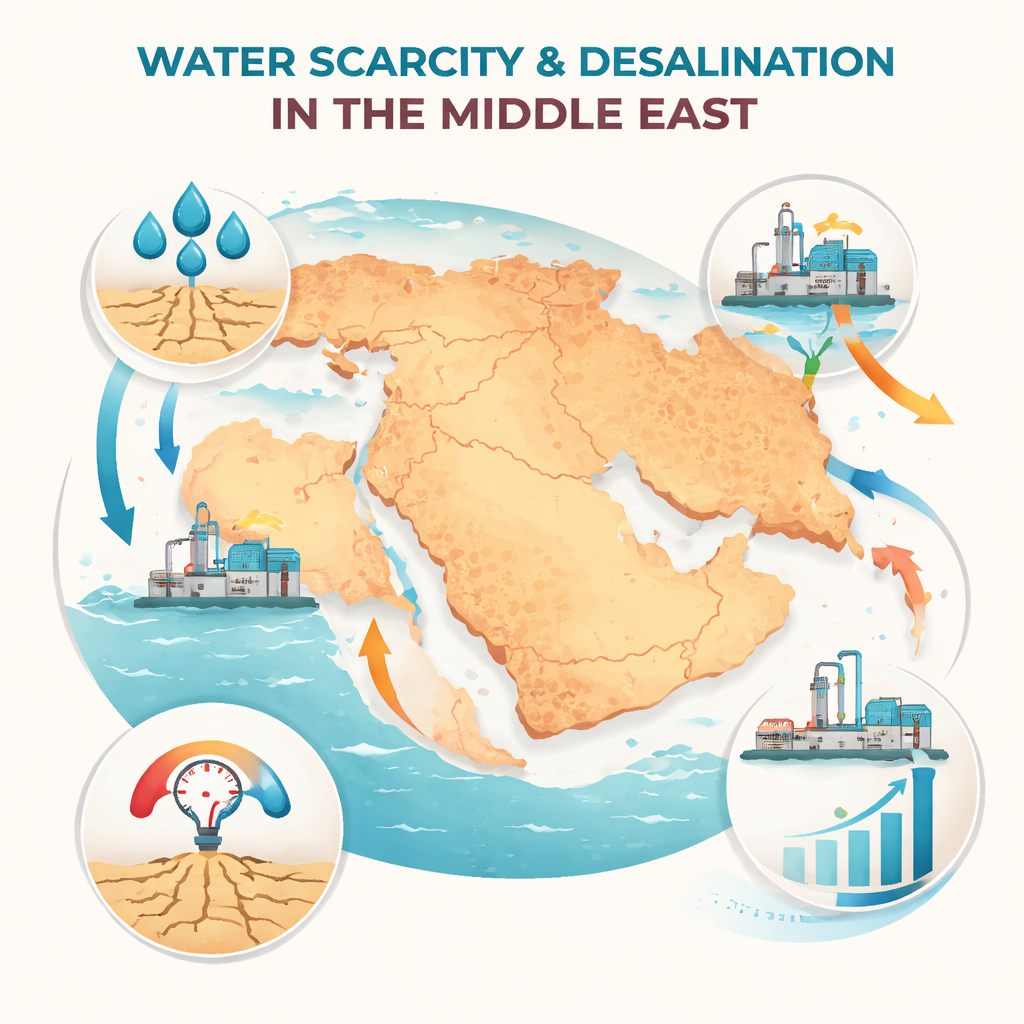
From Early Experiments to Mega-Plants
Desalination in the region began over a century ago with simple distillers in Saudi Arabia. After the 1950s, countries built ever larger thermal plants, which boil seawater and condense the steam. These systems are robust but energy-hungry. Over time, a more efficient method—reverse osmosis, which pushes seawater through fine membranes to separate salt—started to dominate. Today, membrane-based plants provide most of the region’s new capacity, often in huge facilities that can each supply a million cubic meters of water a day. Costs have fallen sharply: in the past decade, the average price of desalinated water in the Middle East dropped to about 0.59 US dollars per cubic meter, slightly below the global average, thanks to better membranes, smarter plant design, and economies of scale.
Rising Costs, Risks, and Environmental Questions
Keeping this lifeline running is expensive. Between 2006 and 2024, Middle Eastern countries spent more than 50 billion US dollars building desalination plants and a similar amount operating them, and they plan tens of billions more by 2028. Most of the water goes to city water systems and industry, with only a smaller share used for farming or tourism. Alongside the benefits, there are drawbacks. Desalination uses a lot of energy, ties water supplies to fuel prices and power grids, and produces concentrated brine that must be disposed of safely. In the Gulf and Red Sea—warm, salty, and only weakly connected to the open ocean—discharge can create local “hot spots” of high salinity and temperature that stress marine life. Rare events such as massive algal blooms can clog plant intakes, forcing temporary shutdowns.
What Happens to the Salty Leftovers?
Most plants in the region still pipe brine back into the sea, sometimes mixing it with cooling water or treated wastewater to dilute it. On land, some smaller inland plants rely on evaporation ponds, which need large areas and careful lining to prevent soil damage. Researchers and companies are now exploring a different vision: treating brine as a resource. Pilot projects in Kuwait and Saudi Arabia suggest that metals and salts like lithium, magnesium, and bromine could be recovered and sold, and even linked to processes that capture carbon dioxide. But today these schemes are mostly at lab or pilot scale. The valuable elements are present only in tiny amounts, so extracting them requires extra energy, complex equipment, and careful chemical handling, which can cost more than the minerals are worth.
Policies, Sunlight, and a Push for Innovation
Because desalination is tightly woven into daily life and national economies, government policy shapes how it grows. Many Gulf states keep water prices low through subsidies, making desalinated water widely affordable but sometimes encouraging waste. Some, like Oman, are starting to raise tariffs to reflect true costs and nudge conservation. At the same time, countries are testing ways to power plants with renewable energy, mainly solar. Projects in Saudi Arabia, the United Arab Emirates, Oman, Israel, Egypt, Gaza, and Yemen pair large solar farms with reverse osmosis plants, cutting emissions while keeping water production steady. The article also tracks a surge in regional research: around 3,000 patents and 17,000 scientific papers from Middle Eastern institutions cover everything from smarter membranes and solar-driven distillation to advanced monitoring and mineral recovery. 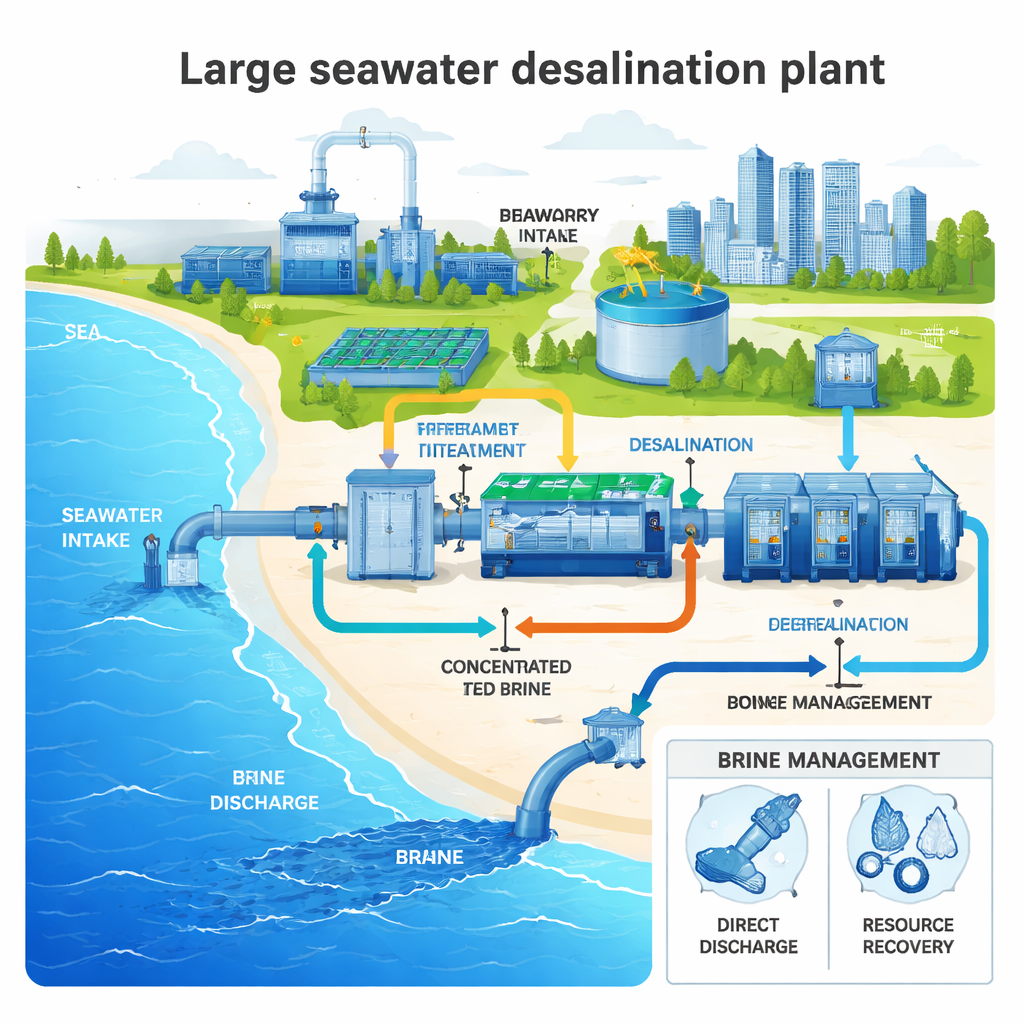
What It All Means for People and the Planet
The authors conclude that desalination is no longer a backup option for the Middle East—it is a backbone of water supply. It has helped many countries move closer to the global goal of safe water for all, even under extreme aridity. Yet making this lifeline truly sustainable will require cleaner energy, better handling of brine, and continued innovation in technology and policy. For the average person, the message is that turning seawater into drinking water can secure taps in a hotter, drier future, but only if societies are willing to invest not just in bigger plants, but also in smarter, greener ways of running them.
Citation: Khanzada, N.K., Al-Juboori, R.A., Ibrahim, Y. et al. Desalination and the Middle East: research, practices, implications, and prospects. npj Clean Water 9, 21 (2026). https://doi.org/10.1038/s41545-026-00554-x
Keywords: desalination, Middle East water, brine management, solar-powered desalination, water security