Clear Sky Science · en
Exploring CHO cell stability during prolonged passaging via eXplainable AI driven flux balance analysis
Why factory cells can lose their edge
Many modern medicines, including blockbuster antibody drugs, are made by Chinese hamster ovary (CHO) cells growing in giant steel tanks. These cells are expanded for many generations before they ever see a factory, and over time they can mysteriously slow down or change the quality of the medicines they make. This study asks a simple but crucial question: as CHO cells are passaged again and again, how does their internal metabolism shift—and can we use artificial intelligence to see what goes wrong and how to fix it?
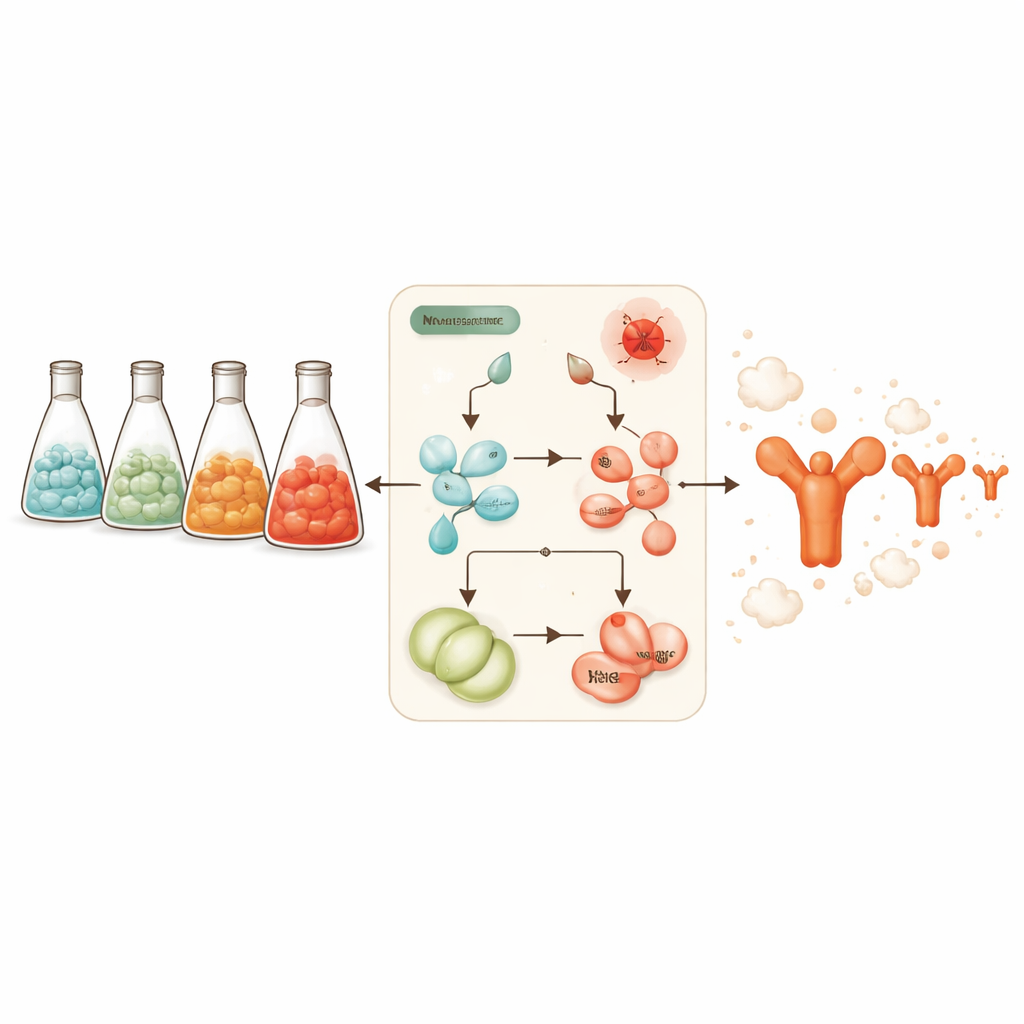
Early and late generations of the same cell line
The researchers started with a single antibody-producing CHO cell line and followed it through more than 30 rounds of passaging, much like repeatedly replanting cuttings from the same plant. From this long journey they created two working groups: “early passage” cells taken after only a few rounds of growth, and “late passage” cells taken after many more. When grown under identical conditions, both groups reached similar peak cell numbers, and the late cells actually divided a bit faster. Yet the late cells produced about 35% less antibody and built up higher levels of unwanted waste molecules, especially lactate and ammonia, which are known to stress cells and interfere with production.
Tracking nutrients and waste to find the turning point
To understand when and how the cells began to diverge, the team monitored the nutrients and byproducts in the culture medium over two weeks, focusing on glucose and 20 amino acids. Using multivariate statistics, they showed that the biggest metabolic differences between early and late passage cells emerged during the rapid growth phase, especially between days 2–6 of culture. Certain amino acids—such as glycine, proline, methionine, and aspartate—were used or secreted in strikingly different ways between the two groups. These changes pointed to shifts in pathways that connect amino acid breakdown, energy production, and waste generation, hinting that late passage cells were rewiring how they fuel themselves and manage nitrogen and redox (oxidation–reduction) balance.

Peering inside metabolism with explainable AI
Because cell metabolism involves thousands of interconnected reactions, the authors turned to a genome-scale metabolic model of CHO cells combined with flux balance analysis, a method that estimates how strongly each reaction flows. They constrained this model with real measurements from their cultures and then used an “enzyme-capacity” version of the method that accounts for how efficient each enzyme is. This produced many possible internal flux patterns consistent with the data. To make sense of this high-dimensional output, they trained a machine-learning model to tell early from late passage flux patterns and then applied explainable AI—specifically SHapley Additive exPlanations (SHAP)—to rank which reactions and metabolites most strongly distinguished the two states.
From building mode to self-protection mode
The explainable AI analysis pointed to a clear storyline. In early passage cells, carbon from nutrients was funneled through pyruvate into acetyl-CoA and then heavily into fatty acid synthesis, supporting membrane building and rapid growth. In late passage cells, more acetyl-CoA was pushed through the central energy cycle to maintain energy under stress, while key reactions in the “trans-sulfuration” pathway shifted the cells from importing cysteine to making it internally. That newly made cysteine was channeled toward glutathione, a major antioxidant that helps mop up damaging reactive oxygen species. This self-protection came at a cost: the same cysteine is also needed to form stable bonds in antibodies, and its diversion, along with extra ammonia released by these pathways, likely contributed to poorer antibody yields and more toxic waste.
How this helps keep medicine factories stable
To a non-specialist, the message is that CHO cells gradually switch priorities as they are passaged: early on they are in “builder” mode, efficiently turning nutrients into new cells and therapeutic proteins; later they flip into “survivor” mode, spending more resources defending themselves from oxidative stress, even if that means making fewer medicines and more waste. By combining detailed cell culture measurements, large-scale metabolic models, and explainable AI, the authors were able to pinpoint the cysteine–glutathione axis and related pathways as levers that control this shift. Adjusting media formulations—for example by adding alternative antioxidants or compounds that spare cysteine—could help keep cells in a more productive state for longer, improving the reliability and efficiency of biologic drug manufacturing.
Citation: Choi, DH., Kim, SJ., Song, J. et al. Exploring CHO cell stability during prolonged passaging via eXplainable AI driven flux balance analysis. npj Syst Biol Appl 12, 36 (2026). https://doi.org/10.1038/s41540-026-00660-z
Keywords: CHO cells, antibody production, cell line stability, metabolic modeling, explainable AI