Clear Sky Science · en
Effects of videos with whole-body movements on young children’s geography learning
Why Moving While Learning Matters for Kids
Parents and teachers are constantly searching for ways to make screen time more meaningful. One promising idea is to get children out of their chairs and moving their whole bodies while they watch and learn. This study asked a simple but important question: if young children act out animal movements while watching short geography videos, do they remember more than children who just sit and watch—while still having fun?
A Simple Museum Game With a Big Question
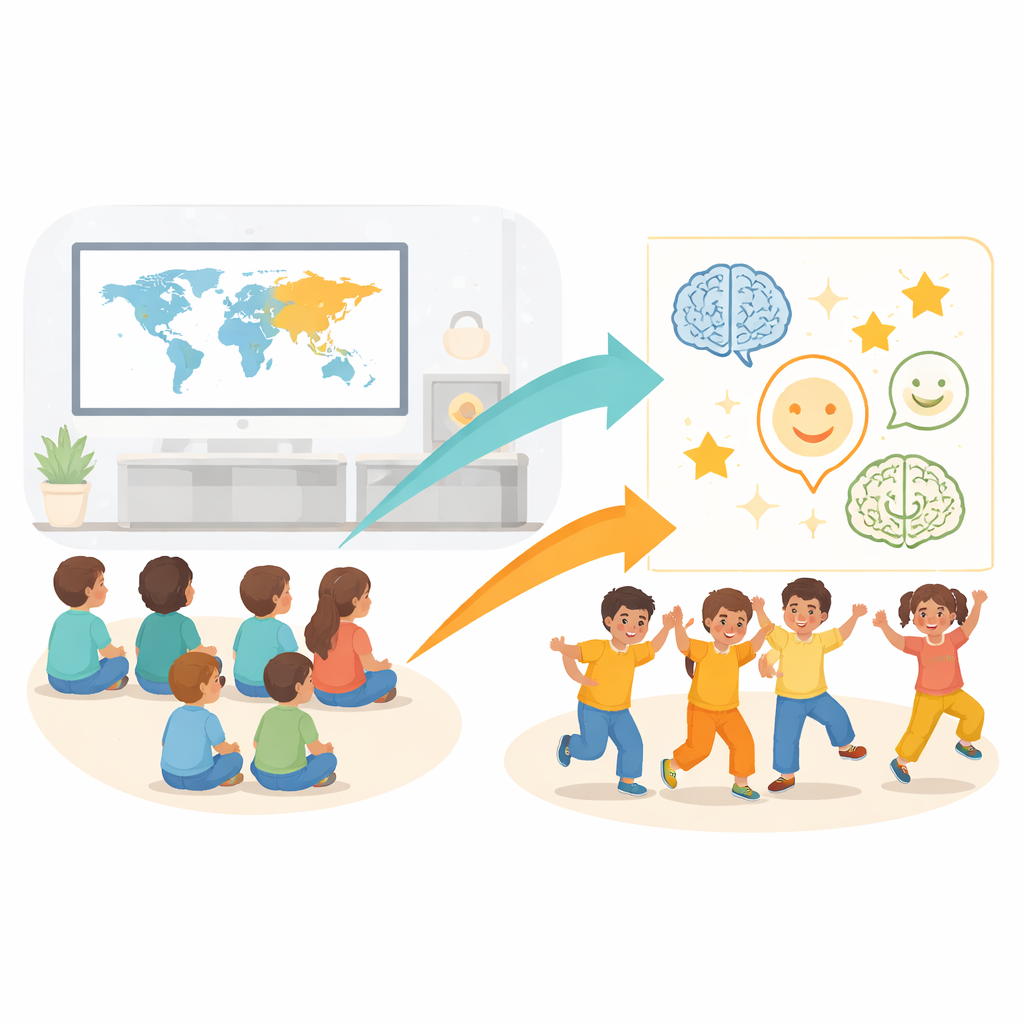
The researchers invited seventy-five children, roughly five to six years old, to take part in a brief learning game during a visit to a children’s science museum. All the children watched short videos that showed a world map, three continents, and cartoon animals that live in each place—for example, a kangaroo for Oceania and an elephant for Asia. The videos also mentioned simple facts such as the animals’ favorite foods and the local climate. The goal was to help children link each continent’s name, position on the map, and a memorable animal.
Two Ways to Learn From the Same Video
Children were randomly placed into one of two groups. In the movement group, the children watched the videos and were asked to copy the animals’ full-body actions—jumping like a kangaroo, stomping like an elephant, or running on the spot like a raccoon—while “traveling” between continents on a large map. In the seated group, the children watched the very same videos in the same order and for the same amount of time, but stayed sitting and only spoke the continent names. Each five-minute video was played twice so that all children had a chance to see and rehearse the content without turning the session into a long lesson.
Testing Memory and Enjoyment
To find out what the children actually learned, the team gave them short tests before and right after the videos. First, the children were asked to name any continents and associated animals they already knew, which confirmed that most started with very little geography knowledge. After the activity, the children completed two kinds of tasks. In a “free recall” task, they named continents and animals from memory. In a “cued recall” task, they worked with a printed map and small animal toys, placing each animal on the right continent and following simple spoken directions across the map. The researchers also asked the children how much they enjoyed the activity and whether they would like to learn this way again, using a smiley-face rating scale.
What Happened When Kids Moved
Contrary to what many might expect, the children who moved their whole bodies did not score higher on the geography tests than those who remained seated. Both groups improved from their low starting point, and their final scores on remembering continent–animal pairs and matching animals to places on the map were very similar. The enjoyment ratings also did not differ: children in both conditions reported that they liked the game a lot and would be happy to do something like it in the future. The researchers suggest that the brief, single session, the relatively simple material, and the fact that children were working in small groups may have made it harder to see any advantage of adding movement.
Balancing Bodies, Brains, and Screens
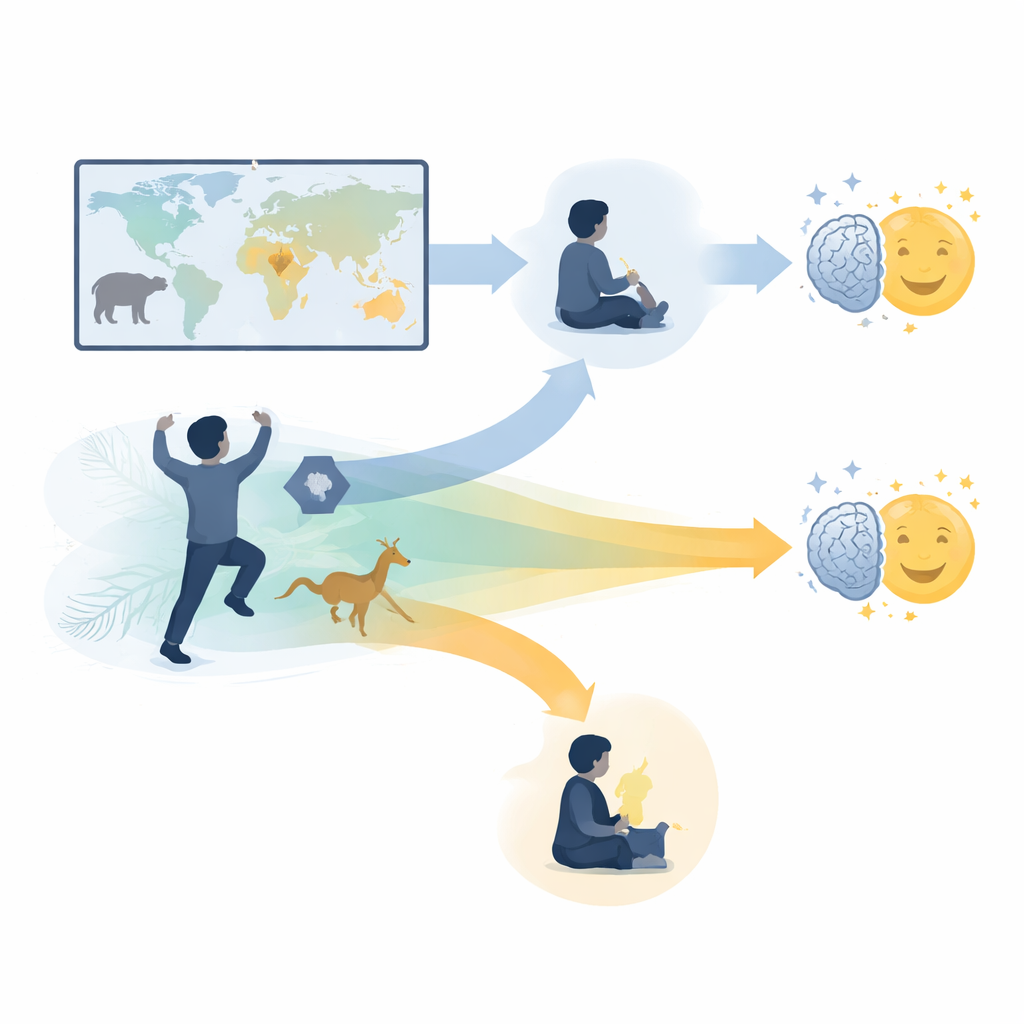
These results do not mean that movement has no place in digital learning. Instead, they highlight how important it is to balance what the body is doing with what the mind must keep track of. In this study, copying playful actions while watching fast-moving video may have turned the task into a kind of mental and physical “double duty,” adding complexity rather than easing it. The authors argue that future programs should carefully tune how challenging the movements are, how closely they relate to the lesson, and how long the learning period lasts. As young children spend more hours with screens, thoughtfully designed activities that weave together motion, maps, and meaningful content may still offer a way to turn passive viewing into active exploration—but this study shows that simply adding movement is not a magic shortcut to better learning.
Citation: Mavilidi, M.F., Paas, F., Zou, L. et al. Effects of videos with whole-body movements on young children’s geography learning. npj Sci. Learn. 11, 18 (2026). https://doi.org/10.1038/s41539-026-00408-8
Keywords: movement-based learning, early childhood education, digital learning, geography for children, screen time and learning