Clear Sky Science · en
Both individual and peer growth mindsets matter for academic resilience
Why some students beat the odds
In classrooms around the world, some teenagers grow up with fewer resources, crowded homes, and limited access to books or tutoring—yet still manage to earn top marks. This paper asks a deceptively simple question: what helps these young people “beat the odds”? Focusing on a popular idea in education—the belief that intelligence can grow with effort—the researchers show that both a student’s own beliefs and the beliefs of their classmates matter for academic resilience, especially for those from poorer families. 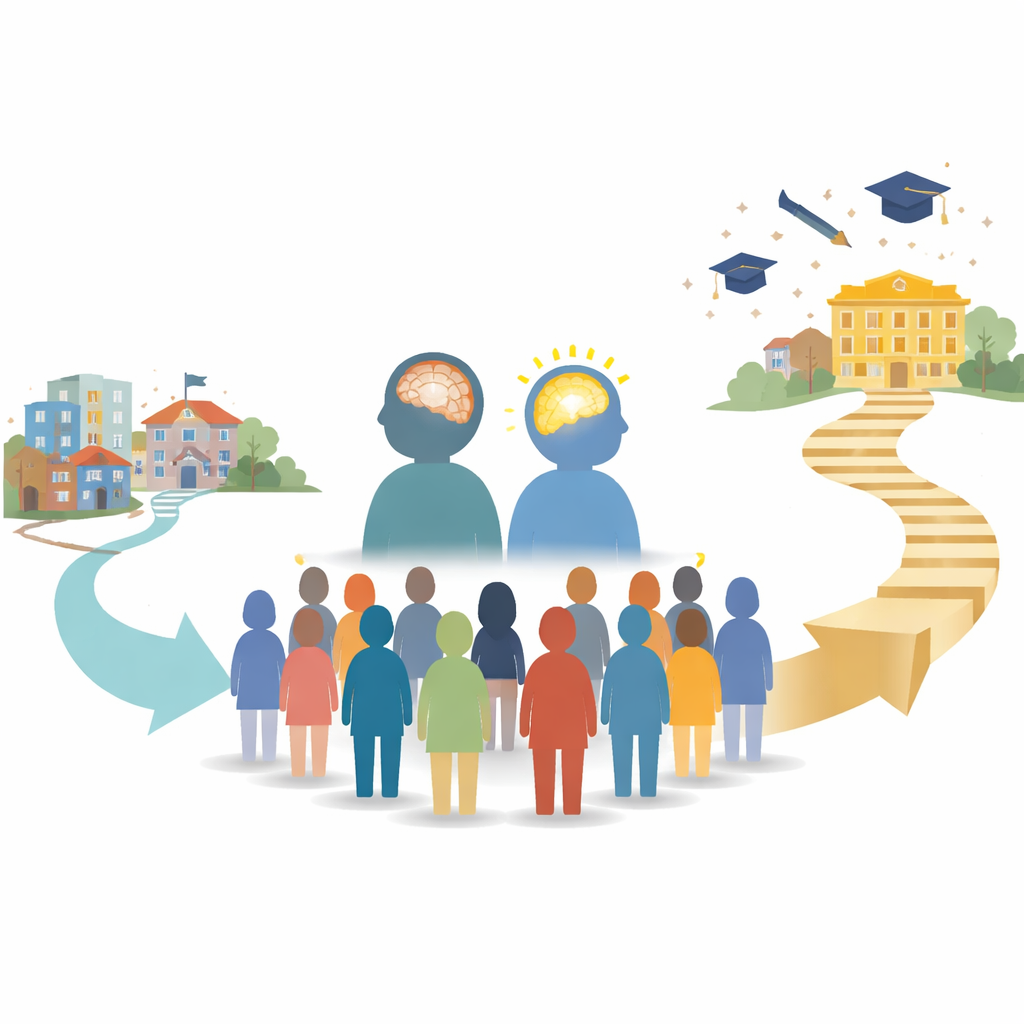
Believing that abilities can grow
The study centers on “growth mindset,” the belief that abilities such as intelligence are not fixed at birth but can be developed through practice, good strategies, and help from others. Its opposite, a fixed mindset, treats intelligence as something you either have or you don’t. Earlier research suggested that a growth mindset helps students persevere, embrace challenges, and recover from setbacks, but findings were mixed, especially for students from low-income families. Many studies also looked only at test scores, without asking whether disadvantaged students actually reach the same high achievement levels as their more privileged peers.
Looking at resilience on a global scale
To tackle these gaps, the authors analyzed data from more than 600,000 15-year-olds in 79 countries who took part in the 2018 PISA assessment, a major international test of reading, math, and science. They defined “academically resilient” students in a strict way: teenagers who came from the lowest quarter of families by socioeconomic status in their own country, yet scored in the top quarter on the PISA tests. Using this definition, only about one in nine students facing economic hardship qualified as resilient. The researchers then examined how each student’s own mindset—and the average mindset of students in their school—related to the chances of landing in this resilient group.
How classmates’ beliefs shape success
The findings reveal that it is not only what a student believes about their own intelligence that matters, but also what their peers believe. Students who personally endorsed a growth mindset were more likely to be academically resilient, even after taking into account their family background, gender, school wealth, country income level, and broader national mindset norms. Just as striking, students attending schools where classmates as a group were more growth-oriented also had higher odds of resilience. In other words, growth mindset behaves like a feature of the school climate: when many students believe abilities can improve, it becomes normal to persist, learn from mistakes, and support one another’s efforts. 
When personal belief meets a supportive crowd
The most powerful pattern appeared when the researchers looked at the combination of individual and peer beliefs. Students who personally believed in growth and were surrounded by peers who shared that belief had the highest likelihood of beating the odds. A growth-minded teenager in a fixed-minded school had some advantage, but not as much as one in a growth-oriented peer group. This supports the idea that mindset is like a “seed” that needs the right “soil.” A supportive peer culture—where working hard is admired and setbacks are seen as part of learning—helps students from low-income families act on their own optimistic beliefs, reinforcing resilience in everyday classroom life.
Limits and practical lessons
The study has limitations: it is based on one survey question about mindset, it looks at one moment in time rather than tracking students over years, and it cannot prove cause and effect. Still, the results hold across dozens of countries and after accounting for many background factors, suggesting the patterns are robust. The authors caution that mindset is not a magic cure for inequality; structural barriers such as underfunded schools and social inequality remain powerful forces. Yet the findings point to practical steps: teachers and school leaders can foster growth-oriented peer cultures by modeling persistence, praising effort and strategy rather than talent, and framing mistakes as opportunities to learn. At its heart, the paper’s message to a lay reader is clear: disadvantaged students are more likely to thrive when both they and their classmates believe that ability is not destiny—and when their daily school environment consistently reinforces that hopeful view.
Citation: King, R.B., Li, J. & Wang, Y. Both individual and peer growth mindsets matter for academic resilience. npj Sci. Learn. 11, 17 (2026). https://doi.org/10.1038/s41539-026-00403-z
Keywords: growth mindset, academic resilience, socioeconomic disadvantage, peer influence, PISA 2018