Clear Sky Science · en
Modulating sleep: slow oscillation and spindle stimulation effects on physiology and memory
Why sleep science matters for everyday memory
We often hear that a good night’s sleep helps us remember what we learned during the day—from people’s names to new skills like playing an instrument. Scientists suspect that specific brain rhythms during deep sleep help stabilize memories, but it has been surprisingly hard to prove this cause-and-effect relationship. This study tested whether precisely timed sounds played to sleeping people could strengthen different kinds of memories by nudging those brain rhythms, and what happened when the timing of those nudges was changed.
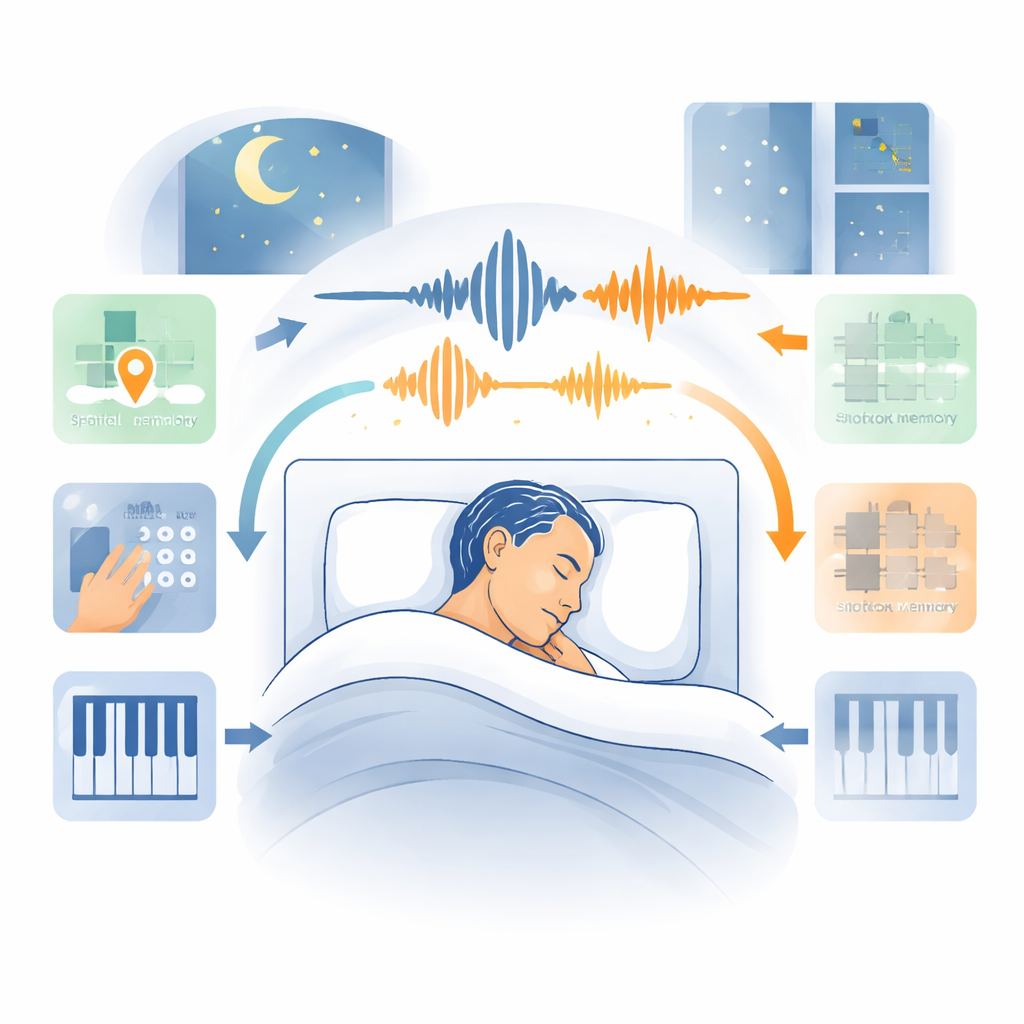
Different kinds of memory, one afternoon nap
The researchers recruited 102 healthy young adults for a tightly controlled afternoon experiment. Before a two-hour nap or quiet wake period, participants practiced three tasks designed to tap different forms of memory: a grid game that tested memory for picture locations (similar to remembering where you parked your car), a finger-tapping sequence that measured motor skill learning, and a left-hand piano exercise that combined precise notes and timing, mimicking real-world skill learning. After the break, everyone repeated the same tasks so the team could see how performance changed over time.
Listening in on the sleeping brain
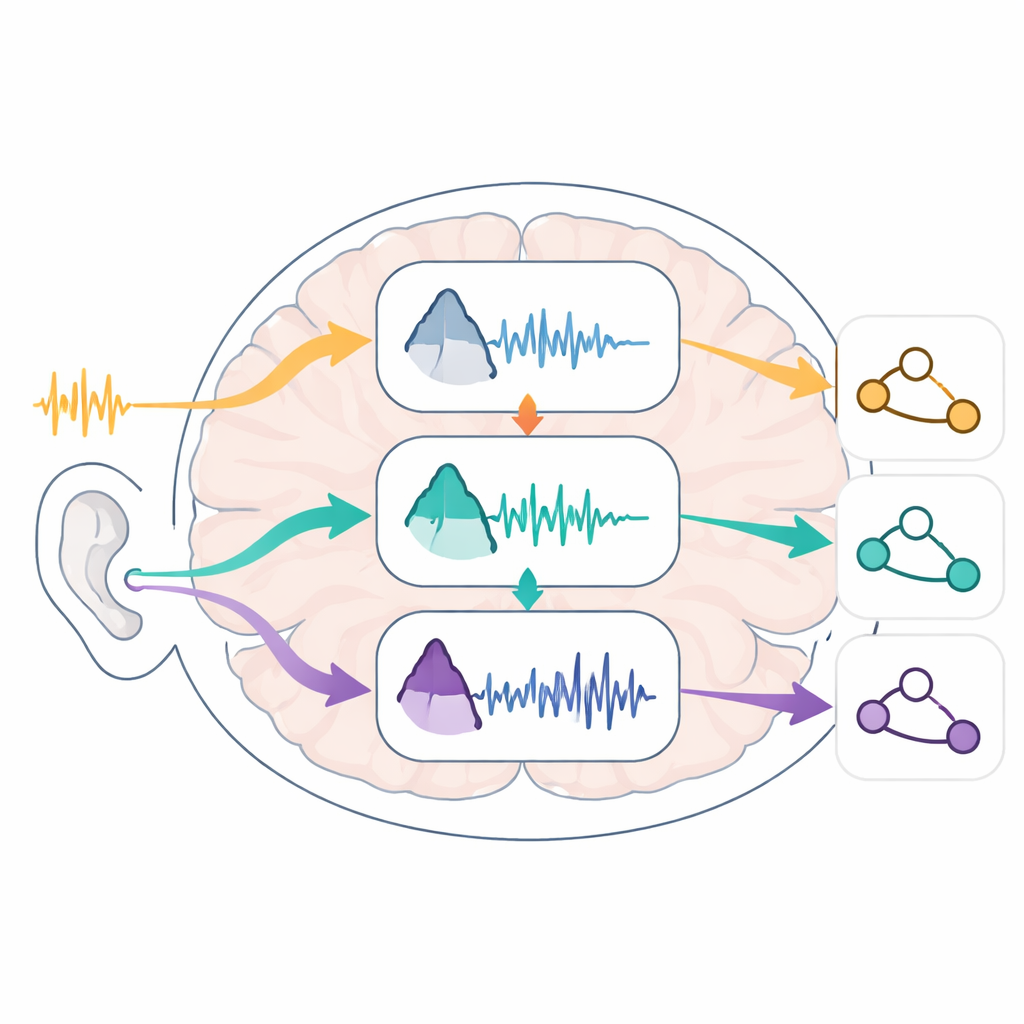
While some participants simply slept undisturbed or stayed awake, others slept with a headband that monitored their brain activity in real time and played very soft, brief bursts of noise at carefully chosen moments. In one condition, sounds were delivered during the “up” phase of very slow brain waves that sweep across the cortex in deep sleep. In two other conditions, sounds were timed to short, faster bursts of activity called sleep spindles—either right when a spindle began or almost half a second later. Using custom hardware and algorithms, the team achieved unusually precise targeting of individual spindles, a technical leap beyond most earlier work.
Brain rhythms respond, but behavior barely budges
The sounds had strong and reliable effects on sleeping brain activity. When the researchers targeted slow waves, they evoked larger slow oscillations followed by increased spindle activity, closely matching earlier reports. Sounds delivered during or shortly after spindles also boosted spindle-band power, and sounds given right at spindle onset even appeared to cut those natural spindles short. Delayed sounds, in contrast, tended to prolong spindle-like activity. In other words, the brain’s electrical rhythms were clearly being reshaped by the stimulation, and the timing of the sounds mattered for how those rhythms unfolded.
The story was very different at the behavioral level. Across all groups—stimulated sleep, undisturbed sleep, and wake—participants showed the same broad pattern: memory for picture locations got worse, motor sequence performance improved, and piano playing showed mixed results, with rhythm improving modestly and note accuracy staying about the same. No stimulation condition clearly outperformed the others, and simply sleeping versus staying awake also failed to produce strong, consistent benefits for these tasks during the short nap window. Correlations between how strongly a person’s brain responded to the sounds and how much their performance changed were mostly weak or absent, with only tentative links for some aspects of piano performance.
What this tells us about sleep and learning
To a lay observer, it might seem puzzling that scientists could so powerfully shift sleeping brain rhythms without reliably boosting memory. The results suggest that it is not enough to simply make more slow waves or spindles; the precise pattern, timing, and coordination between these rhythms—and perhaps a longer or differently structured sleep period—may be crucial for turning neural ripples into lasting learning. The study shows that we can steer the sleeping brain in real time, but also highlights that the relationship between sleep and memory is more complex and fragile than once thought, especially during short daytime naps. Future work will need to refine when and where to stimulate, and which natural sleep patterns truly mark the moments when the brain is cementing our experiences into durable memories.
Citation: Jourde, H.R., Sita, K.Z., Eyqvelle, Z. et al. Modulating sleep: slow oscillation and spindle stimulation effects on physiology and memory. npj Sci. Learn. 11, 14 (2026). https://doi.org/10.1038/s41539-025-00383-6
Keywords: sleep and memory, sleep spindles, slow wave sleep, auditory brain stimulation, memory consolidation