Clear Sky Science · en
A small molecule strategy with forskolin and p38 inhibitor for serum-free muscle stem cell expansion
Growing Meat Without Animals
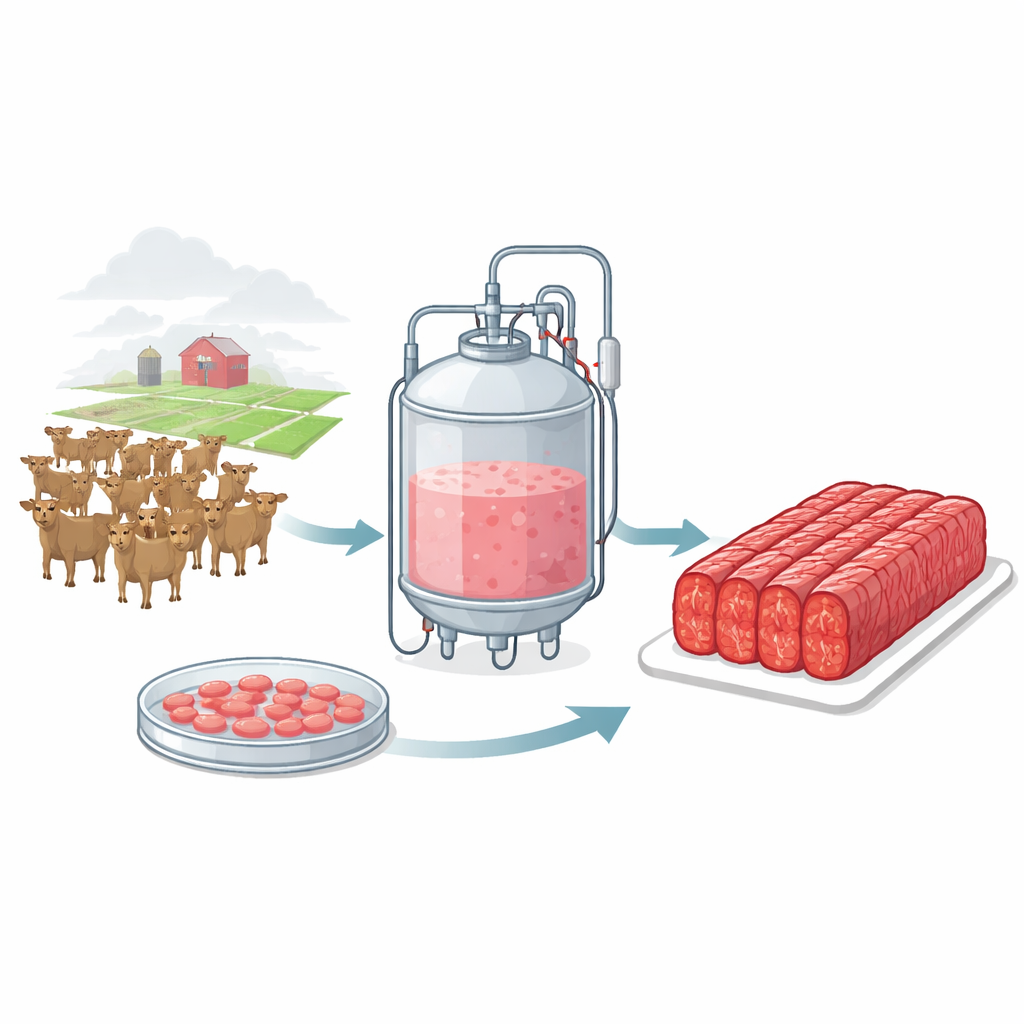
Imagine enjoying a juicy steak that never came from a slaughtered cow. Cultured meat aims to grow real animal muscle cells in steel tanks instead of on the farm, promising big cuts in land use, emissions, and animal suffering. But one major roadblock has been how to feed these cells in a way that is affordable, consistent, and free of animal blood products. This study presents a new recipe that uses just two carefully chosen small molecules to help young bovine muscle cells multiply robustly in a completely serum-free liquid, moving cultured beef a step closer to large‑scale reality.
Why Replacing Blood Serum Matters
Today, most animal cells used for research or food prototypes are grown in liquid mixtures enriched with fetal bovine serum, a component harvested from unborn calves. Serum is powerful but problematic: it is expensive, variable from batch to batch, can carry pathogens, and raises serious ethical concerns. Researchers have begun building serum‑free media that replace serum with precisely defined ingredients, but these mixes are often still costly and do not yet match serum’s ability to drive fast, long‑term cell growth. For cultured meat to compete with conventional beef, scientists need a simpler, cheaper way to keep muscle stem cells dividing without sacrificing their ability to turn into mature muscle fibers.
A Smart Shortcut Using Tiny Helper Molecules
In this work, the team focused on bovine muscle stem cells—the building blocks that can both self‑renew and form new muscle. They started from an existing serum‑free base medium for these cells and screened 24 different small molecules known to influence how cells grow, divide, or specialize. After short‑term and repeated‑passage tests, one candidate stood out: forskolin, a plant‑derived compound that boosts an internal cell messenger called cAMP. At a carefully tuned low dose, forskolin allowed the cells to keep their typical rounded stem‑cell shape, increased the activity of myogenic genes that mark muscle identity, and, importantly, made the cells divide faster over many rounds of culture. The researchers named this forskolin‑supplemented medium “Beefy‑F.” Over six passages, Beefy‑F produced nearly twice as many cells as the original serum‑free recipe and reached yields comparable to traditional serum cultures, while preserving the cells’ capacity to fuse into muscle‑like fibers.
Adding a Second Boost for Even Faster Growth
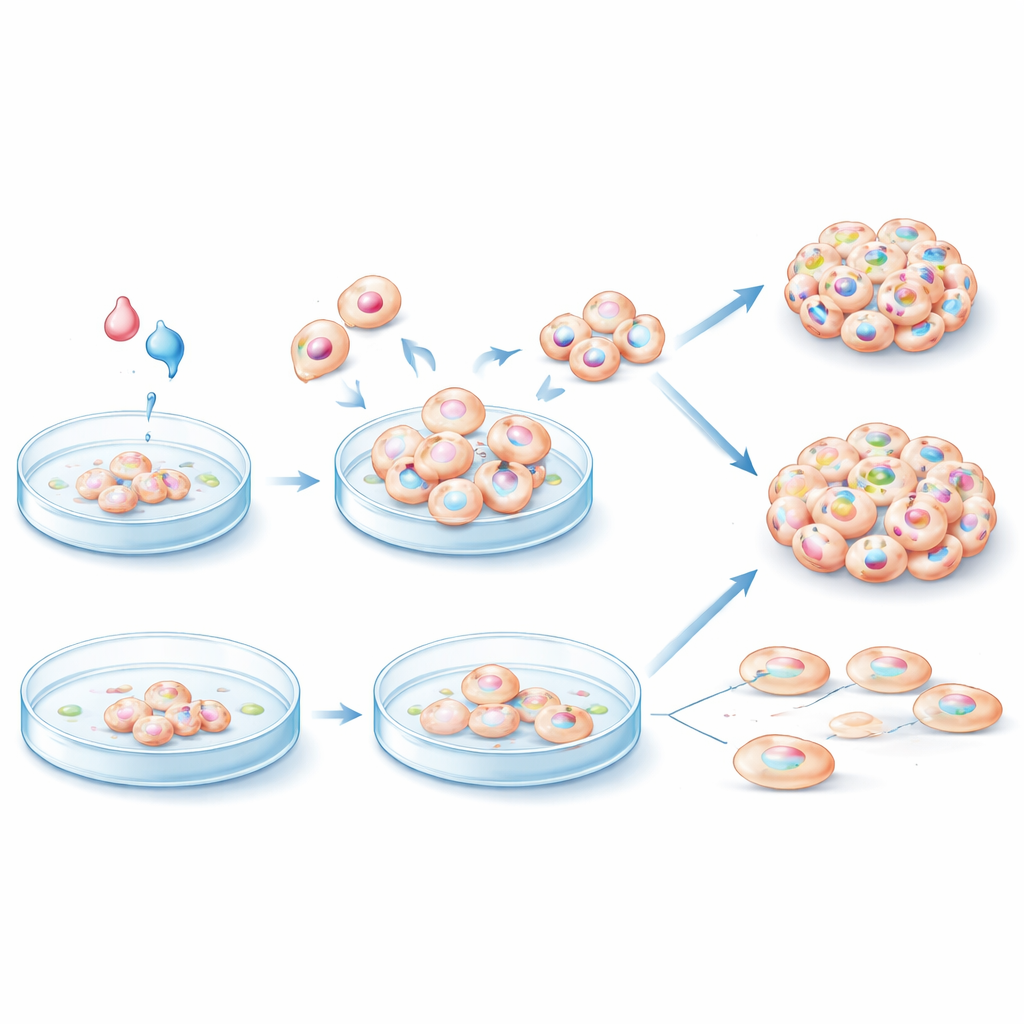
Having identified a promising base, the researchers then asked whether any additional compounds could work together with forskolin to push growth even further. They tested several inhibitors of signaling pathways that normally slow down or steer cell behavior, including two that block a stress‑responsive route known as p38 MAPK. One of these, SB202190, emerged as the best partner. When 1 micromolar SB202190 was added to Beefy‑F, forming the “Beefy‑F + S” medium, bovine muscle stem cells expanded much more rapidly than in any of the other mixes. After three passages, Beefy‑F + S produced about 60 percent more cells than the original serum‑free control and roughly 30 percent more than either forskolin alone or the p38 inhibitor alone. The cells remained healthy and compact, showed higher levels of PAX7, a marker of stemness, and still formed abundant, well‑organized muscle fibers in several different serum‑free differentiation conditions.
Looking Under the Hood of the Cells
To understand what was changing inside the cells, the team compared gene activity across five culture conditions: standard serum, the base serum‑free medium, forskolin alone, p38 inhibition alone, and the combined Beefy‑F + S system. Genome‑wide RNA sequencing revealed that serum‑free media, particularly those containing forskolin, preserved strong expression of genes that define muscle identity. At the same time, the p38 inhibitor strongly boosted genes involved in the cell cycle, helping cells pass through division more readily. Together, in Beefy‑F + S, these two effects combined: muscle‑identity genes stayed high while cell‑division programs were turned up. The cells also remodeled their surroundings by dialing down several collagen genes and increasing factors that help break down excess matrix, hinting that they were creating a more flexible microenvironment better suited to continual growth.
What This Means for Future Cultured Meat
In plain terms, this study shows that a simple, two‑ingredient strategy can largely replace animal serum for growing bovine muscle stem cells. Forskolin keeps the cells “remembering” that they are muscle precursors, while the p38 inhibitor encourages them to multiply quickly and adjust how they interact with their surroundings. The resulting Beefy‑F + S medium is relatively inexpensive to make, boosts cell yield by more than one and a half times over previous serum‑free options, and maintains the cells’ ability to form muscle tissue—an essential property for turning them into edible meat. Although further work is needed to swap in fully food‑grade components and test more animal donors, this small‑molecule approach offers a practical blueprint for scaling up serum‑free cell growth, bringing cultivated beef closer to supermarket shelves.
Citation: Lu, H., Liu, Z., Liu, X. et al. A small molecule strategy with forskolin and p38 inhibitor for serum-free muscle stem cell expansion. npj Sci Food 10, 81 (2026). https://doi.org/10.1038/s41538-026-00732-8
Keywords: cultured meat, serum-free medium, muscle stem cells, forskolin, p38 inhibitor