Clear Sky Science · en
Food–medicine homology nanostructures: self-assembly, sustained release, and extended anti-inflammatory effects of Eucommia ulmoides nanoparticles
How a Traditional Leaf Tea Hides Tiny Helpers
Many people turn to herbal teas and traditional remedies to soothe chronic aches or support overall health, but it is often unclear how these plants actually work inside the body. This study looks at Eucommia ulmoides, a tree long used in Asian medicine and food, and discovers that when its leaves are boiled into a decoction, they naturally build their own tiny nanosized delivery vehicles. These invisible particles help protect and slowly release the plant’s helpful compounds, leading to longer-lasting anti-inflammatory effects in immune cells.
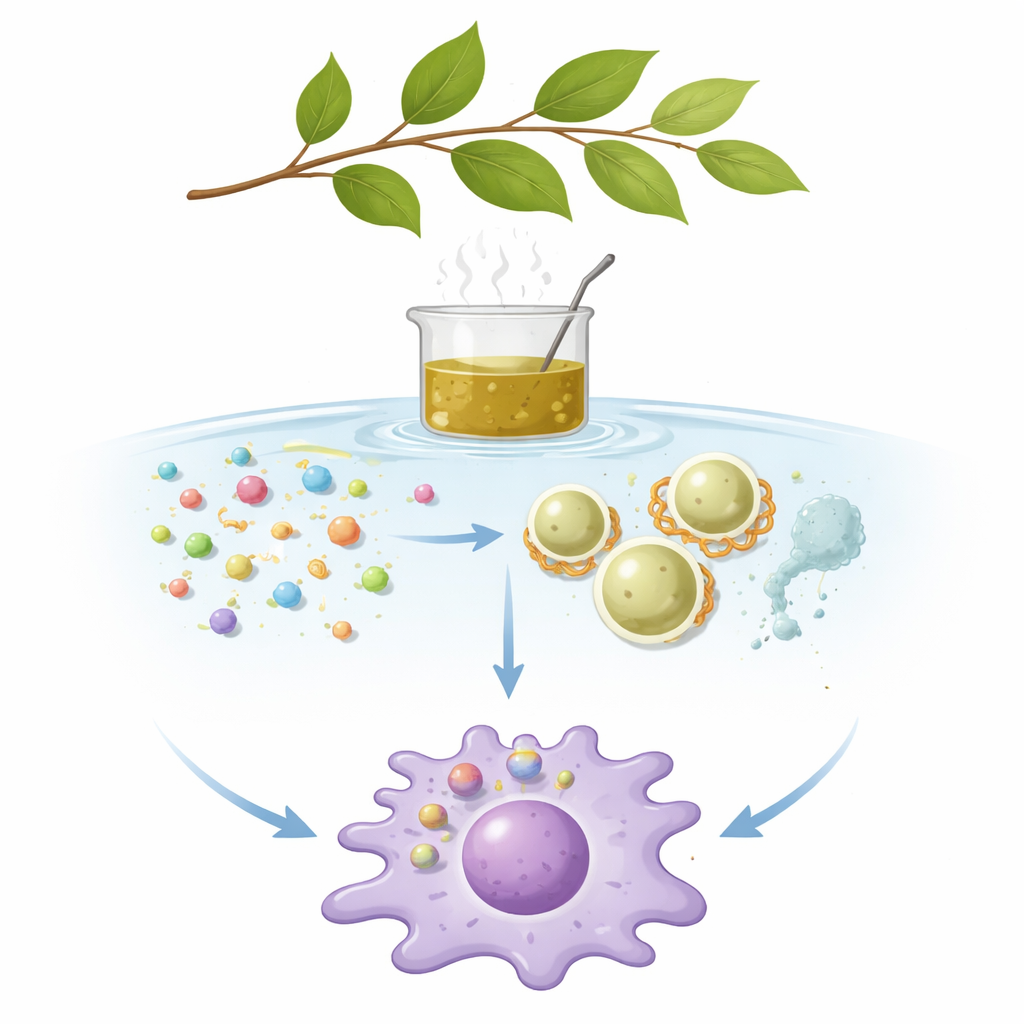
Tiny Structures Born in a Boiling Pot
When Eucommia leaves are simmered in water, the brew does more than simply extract flavor and color. The researchers watched how particles formed over time and found a clear three-stage process: at first only small, scattered fragments appear, then within about 10 minutes they rapidly grow into larger, stable nanoparticles, and finally they settle into a steady state. By filtering and concentrating the decoction, the team isolated these particles, which averaged about 300 nanometers across—far too small to see with the naked eye, but clearly visible under an electron microscope as smooth, compact spheres. This shows that traditional boiling, without any modern additives, can drive plant molecules to self-organize into stable nanostructures.
What These Natural Nanoparticles Are Made Of
Analysis of the particles, called EUPs, revealed they are mostly built from long sugar chains known as polysaccharides, which act like a structural scaffold. Nestled within this framework are hundreds of different polyphenols—plant chemicals renowned for their antioxidant and anti-inflammatory properties—as well as small amounts of protein. The polyphenols do not float freely; instead, they tuck into the polysaccharide network through gentle, reversible forces such as hydrogen bonding and water-repelling interactions. Experiments that selectively disturbed these forces showed that some polyphenols sit near the particle surface and are loosely held, while others are buried deeper in more water-resistant pockets. This layered arrangement turns the particle into a kind of multi-level reservoir for bioactive compounds.
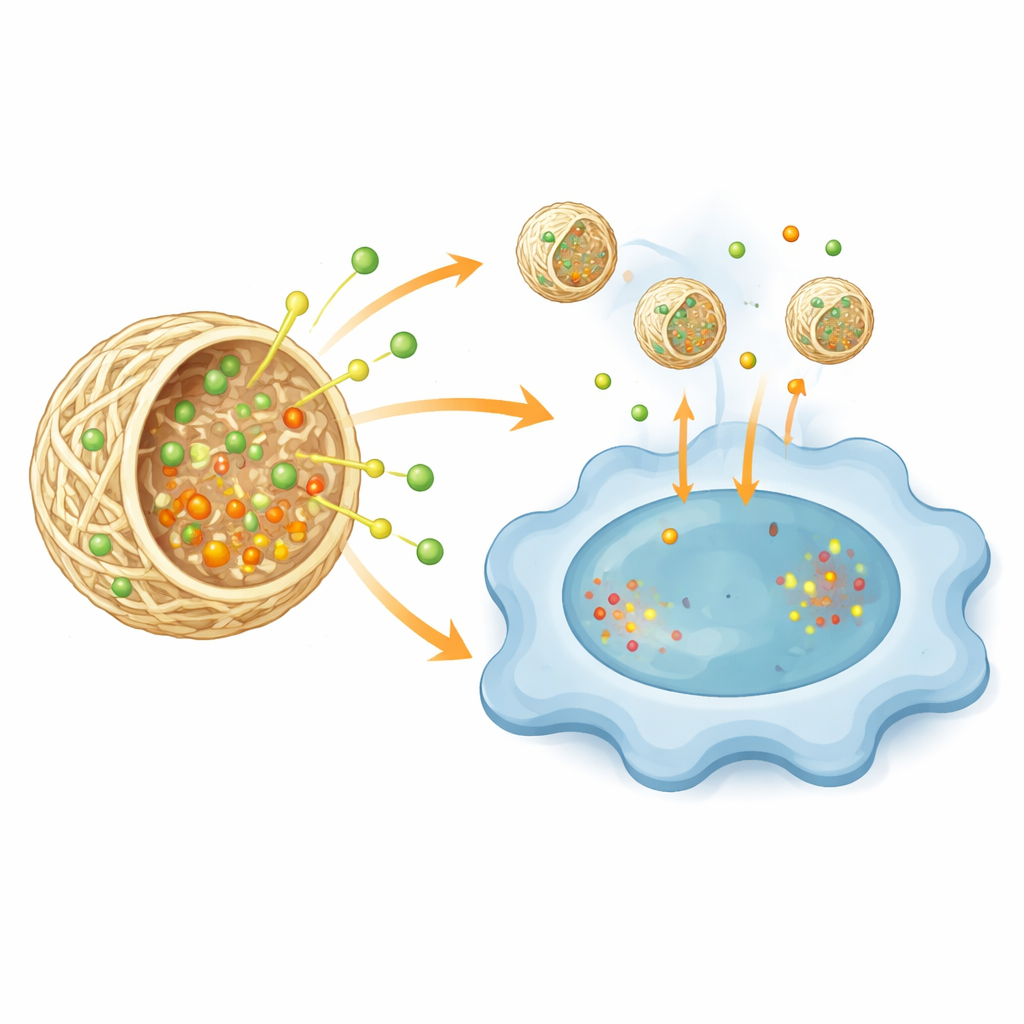
Slow Release and Temperature-Sensitive Behavior
The team then asked how these particles release their cargo compared with polyphenols alone. When polyphenols were extracted out of the particles and placed in a simple solution, most of them leapt into the surrounding fluid within a couple of hours, a classic burst release that fades quickly. In contrast, intact EUPs released their polyphenols slowly over two days, and the rate increased with temperature—from very little at refrigerator conditions to almost half of the load at body temperature. This suggests that warmth gently loosens the interactions between polyphenols and the polysaccharide shell, allowing a controlled trickle instead of a sudden flood. Spectroscopy measurements confirmed that as temperature rises, polyphenols gradually detach while the sugar network rearranges and strengthens, keeping the particle intact even as it hands off its cargo.
Gentler, Longer-Lasting Calming of Immune Cells
To see what this means biologically, the researchers tested EUPs on mouse immune cells known as macrophages that had been pushed into an inflammatory state. At doses that were safe and even slightly growth-promoting for the cells, EUPs strongly reduced key inflammatory signals, including nitric oxide and the messenger proteins TNF-α and IL-6. Importantly, this calming effect stayed high for at least 48 hours. When the scientists used only the polyphenol fraction at an equivalent level, the initial anti-inflammatory effect was similar but dropped off sharply over time, and higher doses started to harm cell viability. The polysaccharide portion on its own showed only modest benefits. Together, these results indicate that the nanostructure itself—polyphenols gradually released from a protective sugar shell—is what turns short-lived chemical signals into a steadier, more sustained anti-inflammatory response.
Why This Matters for Food and Medicine
By showing that a familiar herbal decoction naturally generates its own nanoscale carriers, this work helps explain why whole-plant preparations can differ from purified supplements. In Eucommia leaf tea, polysaccharides and polyphenols spontaneously join forces to form tiny particles that protect sensitive compounds, release them slowly at body temperature, and extend their soothing effects on immune cells. For everyday drinkers, this suggests that a traditional cup of Eucommia decoction delivers more than a simple mix of molecules—it provides a built-in delivery system. For scientists and product developers, these findings point to food-grade, self-assembled nanoparticles as promising natural vehicles for functional foods and oral therapies that aim to tame chronic inflammation.
Citation: Yu, Z., Lu, T., Luo, S. et al. Food–medicine homology nanostructures: self-assembly, sustained release, and extended anti-inflammatory effects of Eucommia ulmoides nanoparticles. npj Sci Food 10, 103 (2026). https://doi.org/10.1038/s41538-026-00726-6
Keywords: Eucommia ulmoides, plant nanoparticles, polyphenols, anti-inflammatory, functional foods