Clear Sky Science · en
Computational-experimental study reveals direct target and bioactives of Ajania fruticulosa against NAFLD via TLR2/NF-κB/PPAR-γ signaling
Why a Wild Herb Matters for Fatty Liver
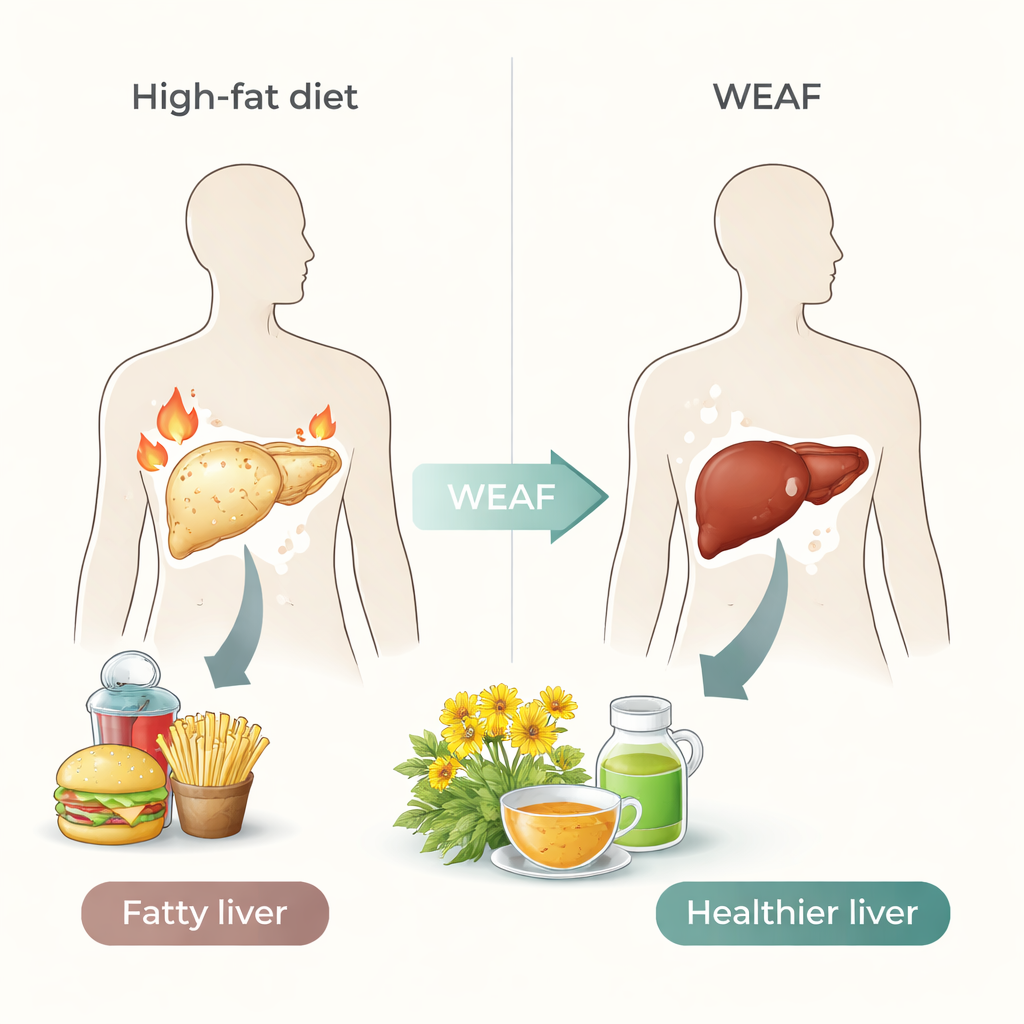
Non-alcoholic fatty liver disease, or NAFLD, is quietly becoming one of the most common liver problems worldwide, closely linked to obesity and modern high-fat diets. Yet current drugs can bring side effects that many patients would rather avoid. This study explores an unexpected ally from traditional Chinese medicine: a wild herb called Ajania fruticulosa. By turning it into a simple water extract, researchers asked whether this plant could safely ease fatty liver and inflammation in lab-grown human liver cells and in obese mice.
A Common Disease with Few Comfortable Options
NAFLD occurs when fat builds up inside liver cells in people who drink little or no alcohol. It can start as a quiet fat buildup but may progress to liver scarring, cirrhosis, or even liver cancer. The disease now affects roughly one in three adults in many regions. A few new medicines have been approved, but they can cause problems such as liver strain or digestive issues. That leaves a major gap for gentler treatments that could be used long term, especially ones that improve both weight control and liver health.
A Traditional Herb Put to the Test
Ajania fruticulosa is a plant used in northwestern China to “clear heat,” ease coughs, and reduce pain and inflammation. The team prepared a water extract, dubbed WEAF, similar in spirit to a strong herbal tea. First, they tested it on human liver cancer–derived HepG2 cells overloaded with fatty acids to mimic NAFLD. WEAF did not harm the cells, even at relatively high doses, but it clearly lowered fat and cholesterol stored inside them and reduced the number and size of visible fat droplets. The researchers then moved to a mouse model, feeding animals a high-fat diet to trigger obesity and fatty liver, and adding WEAF to see whether it could reverse the damage.
From Obese Mice to Calmer, Leaner Livers
In the high-fat diet mice, livers turned pale and greasy, body weight and belly fat rose, and blood markers of liver injury climbed. When WEAF was added, mice gained less weight and had smaller fat pads without eating less food, hinting that metabolism itself had shifted. Their livers looked healthier—redder and smoother—and under the microscope showed fewer fat vacuoles, less inflammation, and reduced fibrous scarring. Chemical analysis of the extract revealed 20 main compounds, among them three standouts: 3,4-dihydroxyphenylpropionic acid, glycitein, and isorhapontigenin. These three, when tested alone on liver cells, reduced fat buildup and toned down pro-inflammatory signals.
How the Herb Signals the Liver to Calm Down
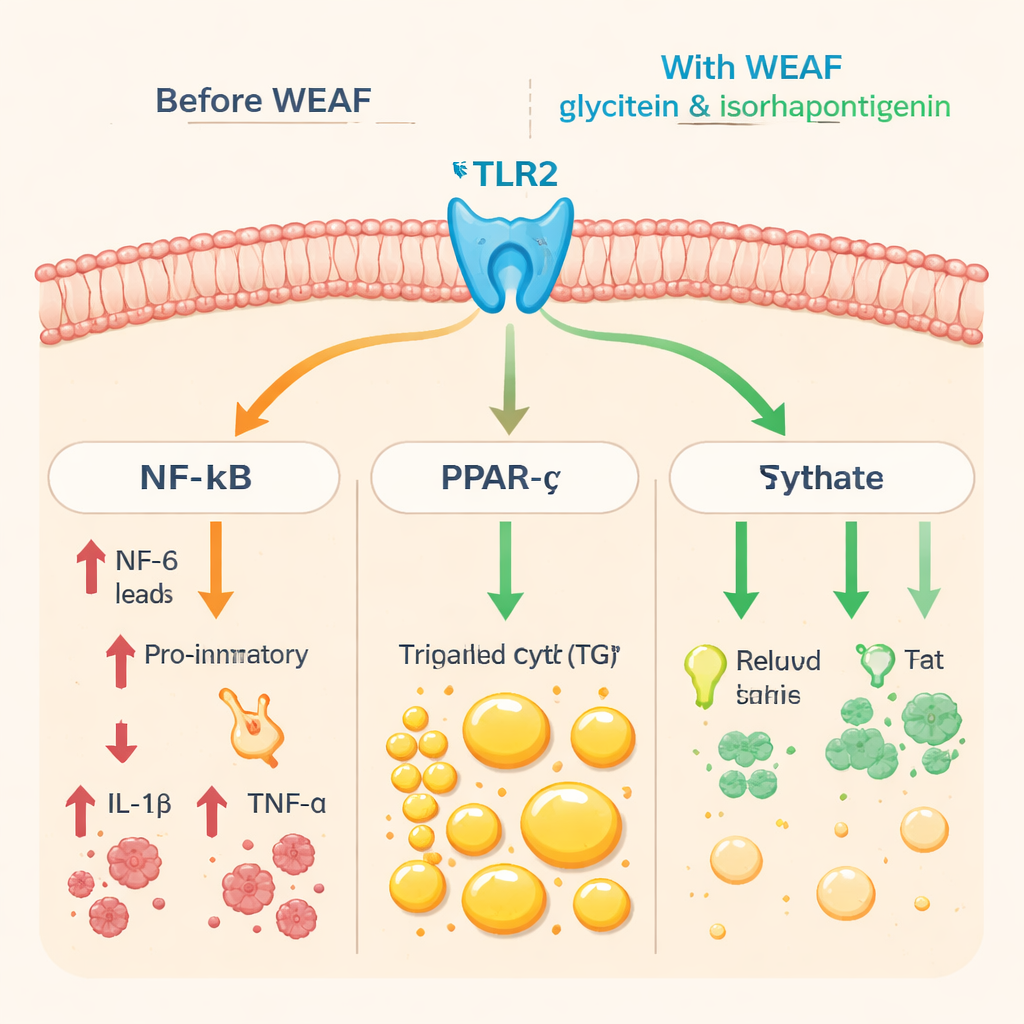
The authors dug into how WEAF and its key molecules do their work. They focused on a surface sensor on liver cells called TLR2 that helps kick off inflammation. When this sensor is overactive, it feeds into an internal alarm system involving proteins known as NF-κB and PPAR-γ, which promote inflammatory chemicals and new fat production. Using computer simulations and laboratory binding tests, the team showed that glycitein and isorhapontigenin latch directly onto TLR2 and stabilize it in a way that dampens its activity. In both cells and mice, WEAF and these compounds lowered TLR2 levels, reduced the downstream NF-κB and PPAR-γ signals, and cut production of inflammatory messengers like IL-6, IL‑1β, and TNF‑α, as well as enzymes that drive fatty acid and triglyceride synthesis.
Proof That the Target Really Matters
To confirm that TLR2 is the critical switch, the researchers used a chemical that specifically turns TLR2 back on. In liver cells overloaded with fat, WEAF, glycitein, and isorhapontigenin all decreased fat and inflammatory genes—until the TLR2 activator was added, which largely erased those benefits. This “rescue” experiment, together with the detailed binding studies, supports the idea that these plant-derived molecules protect the liver primarily by turning down TLR2-driven inflammatory and fat-building pathways.
What This Means for People with Fatty Liver
For non-specialists, the takeaway is straightforward: a water-based extract of a traditional herb, and two compounds inside it, helped overweight mice and stressed liver cells shed fat, calm inflammation, and limit early scarring. They do this by acting like tiny keys that fit into the TLR2 sensor on liver cells and silence an internal cascade that otherwise encourages both swelling and fat storage. While much more work, including human studies, is needed before such an extract could be recommended as a treatment, the study offers a carefully mapped blueprint of how a natural product might one day complement lifestyle changes and conventional drugs in the fight against fatty liver disease.
Citation: Chen, C., Ma, L., Dawuti, A. et al. Computational-experimental study reveals direct target and bioactives of Ajania fruticulosa against NAFLD via TLR2/NF-κB/PPAR-γ signaling. npj Sci Food 10, 73 (2026). https://doi.org/10.1038/s41538-026-00722-w
Keywords: non-alcoholic fatty liver disease, Ajania fruticulosa, herbal extract, liver inflammation, metabolic health