Clear Sky Science · en
Honey as a bioindicator of microplastic pollution: insights from industrial and special honey types
Why tiny plastics in honey matter to you
Honey is often seen as one of nature’s purest foods, yet scientists are now finding microscopic plastic pieces—microplastics—in many foods, including honey. This matters not only because we eat honey, but because bees travel through our environment and bring back whatever they encounter. By looking at the plastics that end up in honey, researchers can learn both how clean our food is and how polluted our surroundings have become.
Bees as wandering environmental samplers
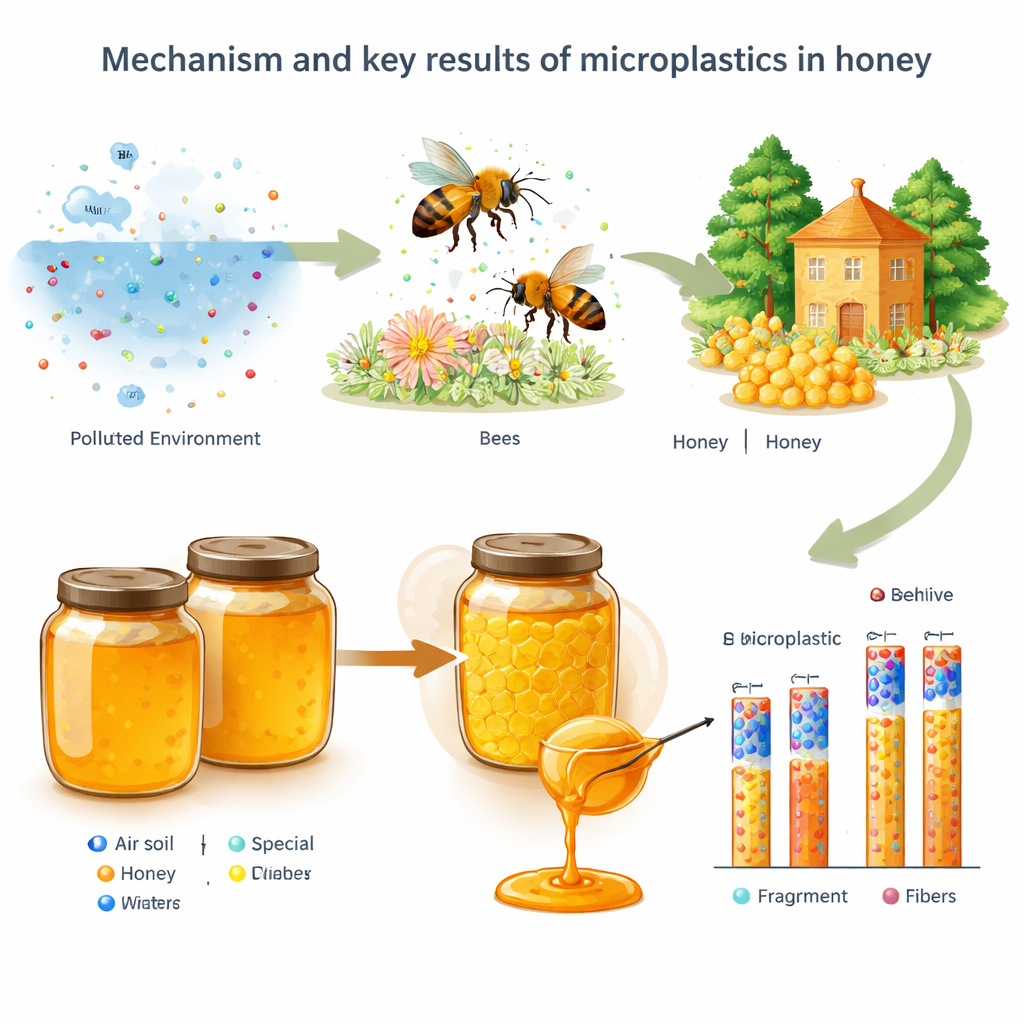
Modern life produces enormous amounts of plastic, and over time larger bits break down into tiny fragments and fibers called microplastics, smaller than a grain of sand. These bits float in the air, settle on soil and water, and can be carried long distances. Honey bees, constantly flying through this invisible haze while collecting nectar and pollen, act like moving sensors. Their honey reflects not just what flowers they visit, but also what kinds of pollution they encounter in fields, forests, towns, and industrial areas.
Testing everyday and “special” honeys
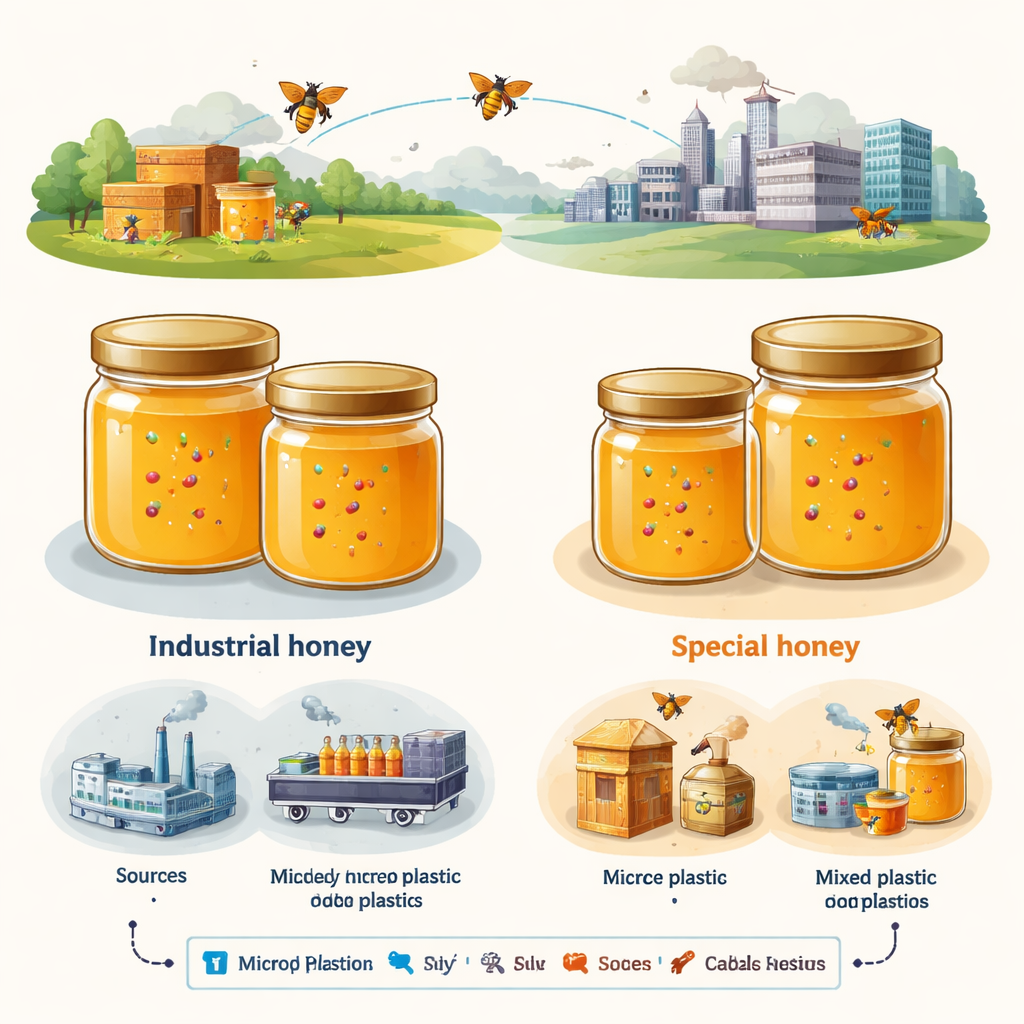
In this study, scientists in Türkiye collected 15 jars of honey: eight common supermarket brands produced in factories and seven “special” honeys bought directly from beekeepers. They carefully filtered each sample, examined the caught particles under a microscope, and then used infrared light to confirm which ones were actually plastic. The team also compared the shapes, sizes, colors, and types of plastic, and combined these measurements with simple risk scores that reflect how hazardous different plastics may be.
More plastic in artisanal honey than factory honey
Microplastics showed up in 93% of the samples. On average, special honeys contained more than twice as many particles as industrial honeys—about 11 versus 5 pieces per sample. Most of the particles were jagged fragments rather than threadlike fibers, and their sizes ranged from roughly the width of a human hair to about a millimeter. Blue and colorless pieces were most common, and five main plastic types dominated: EVA and PET, widely used in food packaging; PE, another common packaging plastic; polyamide (nylon-like materials); and a group of halogen-free flame-retardant plastics. These patterns point strongly to plastic equipment, containers, and packaging as major sources of contamination, especially in smaller-scale, less standardized operations.
What this means for your exposure
Using typical honey consumption in Türkiye—about a teaspoon a day—the researchers estimated how many particles people might swallow. Someone who regularly eats industrial honey would ingest roughly 0.16 microplastic particles per day from honey alone, while a fan of special honey would consume about 0.38 particles per day. Over a 70-year lifetime, this adds up to roughly 4,000 to 10,000 particles. That is less than the amounts expected from drinking water or seafood, but it adds to the total “plastic dose” coming from many foods and from the air we breathe. Risk scores based on plastic type placed both honey categories in a moderate hazard range, and most samples were rated as moderately to very highly contaminated compared with the cleanest honeys.
Honey as a window into our plastic world
The authors conclude that honey is not a major source of microplastics in the diet, but it is a reliable warning signal. Because bees gather pollutants from the landscape and because honey processing can introduce plastics, the tiny particles in honey mirror both environmental pollution and how much plastic we use in food production. The study suggests that switching to glass or stainless-steel tools and reducing plastic packaging—especially in artisanal settings—could cut contamination. More broadly, tracking microplastics in honey around the world could offer a simple way to watch how deeply plastics have seeped into our everyday environment.
Citation: Bilecen, S., Altunışık, A. Honey as a bioindicator of microplastic pollution: insights from industrial and special honey types. npj Sci Food 10, 70 (2026). https://doi.org/10.1038/s41538-026-00720-y
Keywords: microplastics, honey, food safety, environmental pollution, bees