Clear Sky Science · en
Natural deep eutectic solvents as a sustainable alternative for multi-class pesticide extraction in food safety analysis
Why this matters for your dinner plate
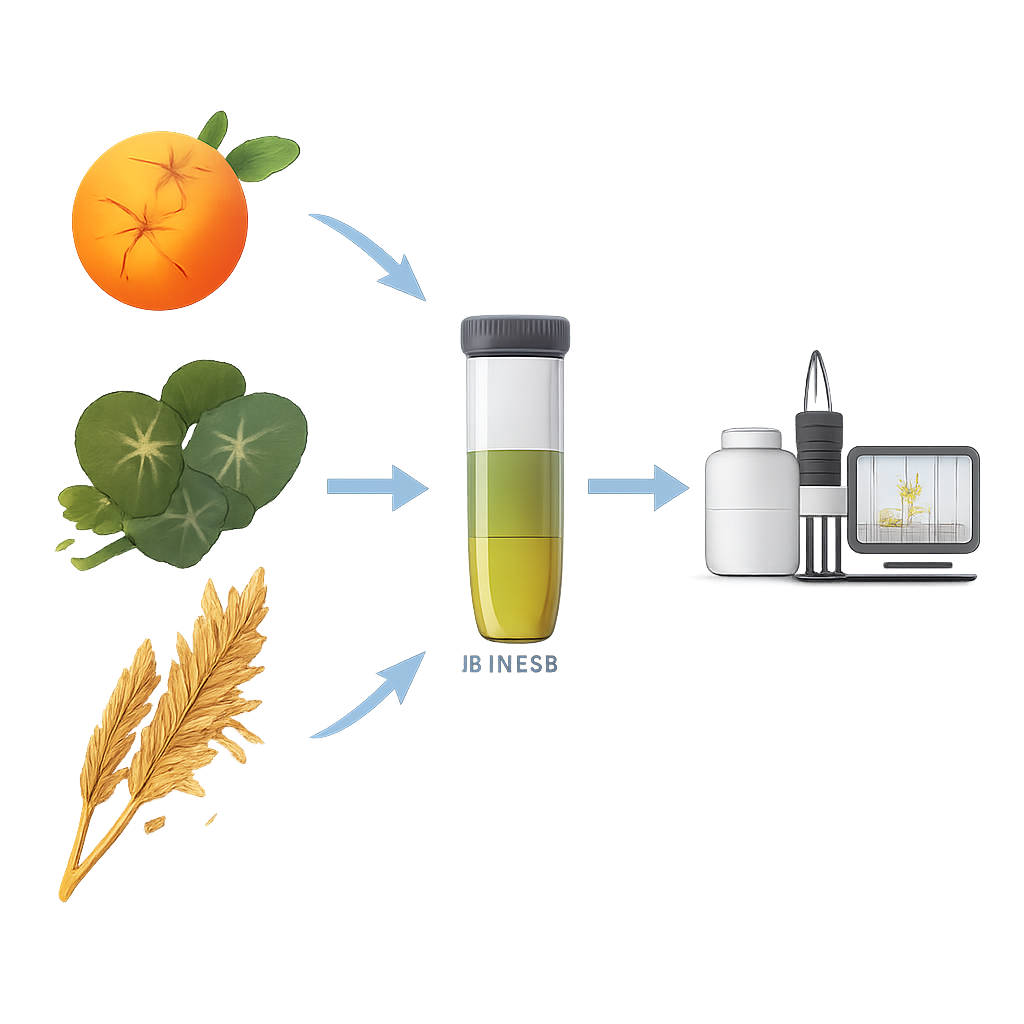
Many fruits, vegetables, and grains are tested for pesticide residues before they reach the supermarket. Today, those tests often rely on large amounts of harsh, toxic solvents, which are bad for lab workers and the environment. This study explores a new, plant-inspired type of liquid called natural deep eutectic solvents (NADES) as a cleaner way to pull pesticides out of foods like oranges, spinach, and wheat so they can be measured accurately and safely.
A new kind of "green" liquid
NADES are mixtures of common natural substances such as plant acids, sugars, and small alcohols. When combined in the right ratios, these solid ingredients form a stable liquid at room temperature. Because they are made from simple, biodegradable building blocks and are non-volatile, they are far gentler than traditional petroleum-derived solvents like acetonitrile, which can harm the nervous system and create hazardous waste. The authors asked whether these natural mixtures could replace standard solvents in one of the most demanding jobs in food labs: extracting hundreds of different pesticides, ranging from very water-loving to very oily, from real food samples.
Testing the new solvents on real foods
To find out, the team chose three everyday foods that represent very different types of produce: juicy, acidic oranges; leafy, water-rich spinach; and dry, starchy wheat. They first selected eleven pesticides that span a wide range of chemical behaviors, then later expanded to a full set of 313 pesticides commonly checked in routine monitoring. Five different NADES recipes, both water-loving and water-repelling, were tried as extraction liquids in a simple solid–liquid mixing step. The scientists measured how much of each pesticide could be pulled out and how cleanly it could be detected by a high-precision instrument called liquid chromatography–tandem mass spectrometry.
Finding the best recipe and fine-tuning the process
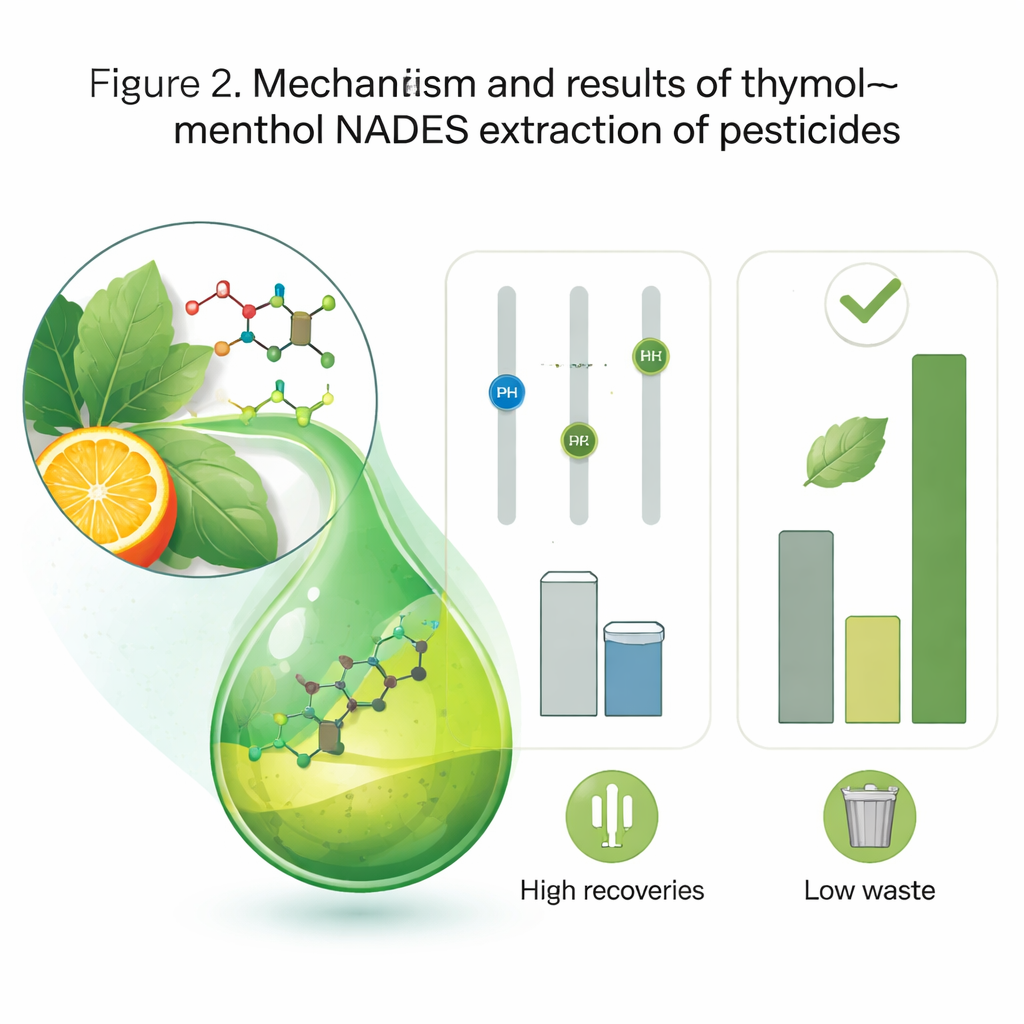
Among the tested mixtures, a combination of thymol and menthol in equal amounts worked best overall. This hydrophobic (water-repelling) NADES captured both relatively polar and very oily pesticides and gave sharp, well-shaped signals in the instrument. The researchers then fine-tuned the extraction conditions: how much NADES to use, how much water to add to the food, the acidity (pH) of the sample, and how long to shake. Slightly basic conditions helped recover tricky pesticides such as propamocarb and some large, oily compounds. With just 2 milliliters of the thymol–menthol solvent and about 10 minutes of mixing, the method delivered good recoveries for the test pesticides across all three foods.
Checking performance and environmental footprint
Once optimized, the NADES-based method was pushed to a real-world scale: 313 pesticides were extracted and measured in oranges, spinach, and wheat. For most compounds, recoveries fell within accepted ranges and measurement repeatability was high, meaning the method is reliable enough for regulatory work. The team also evaluated how much the food plus solvent interfered with the readings and corrected for these effects using matrix-matched calibration. To judge environmental performance and day-to-day practicality, they applied established scoring tools (AGREEprep for “greenness” and BAGI for method usability). The thymol–menthol method scored higher on sustainability than the widely used QuEChERS protocol, even in its miniaturized form, while still being simple and fast enough for routine lab use.
What this means for safer and greener food testing
In plain terms, this study shows that a solvent made from two familiar, plant-derived ingredients—thymol and menthol—can replace a large portion of the toxic chemicals normally used to check our food for pesticides. The method pulls out hundreds of different pesticides from common foods with good accuracy, keeps the special green solvent stable throughout the process, and cuts down on hazardous waste. If adopted more widely, NADES-based extraction could help food testing labs protect both consumer health and the environment, moving pesticide monitoring closer to truly “green” chemistry without sacrificing safety or reliability.
Citation: Carbonell-Rozas, L., Aloisi, I., Garrido Frenich, A. et al. Natural deep eutectic solvents as a sustainable alternative for multi-class pesticide extraction in food safety analysis. npj Sci Food 10, 67 (2026). https://doi.org/10.1038/s41538-026-00717-7
Keywords: pesticide residues, green solvents, food safety, natural deep eutectic solvents, LC-MS analysis