Clear Sky Science · en
Functional evaluation of wax-based oleogels as solid fat replacers for designing low saturated fat plant-based meat analogues
Why the Fat in Fake Meat Matters
Plant-based burgers promise a kinder, greener alternative to beef, but many of them still lean on the same kind of fat doctors tell us to cut back on. Coconut and palm oils, common in these products, are packed with saturated fat, which is linked to heart disease. This study explores whether a different kind of fat structure—called a wax-based oleogel—can make plant-based meat juicier and more stable while shifting its fat profile in a healthier direction.
Turning Liquid Oil into Solid-Like Fat
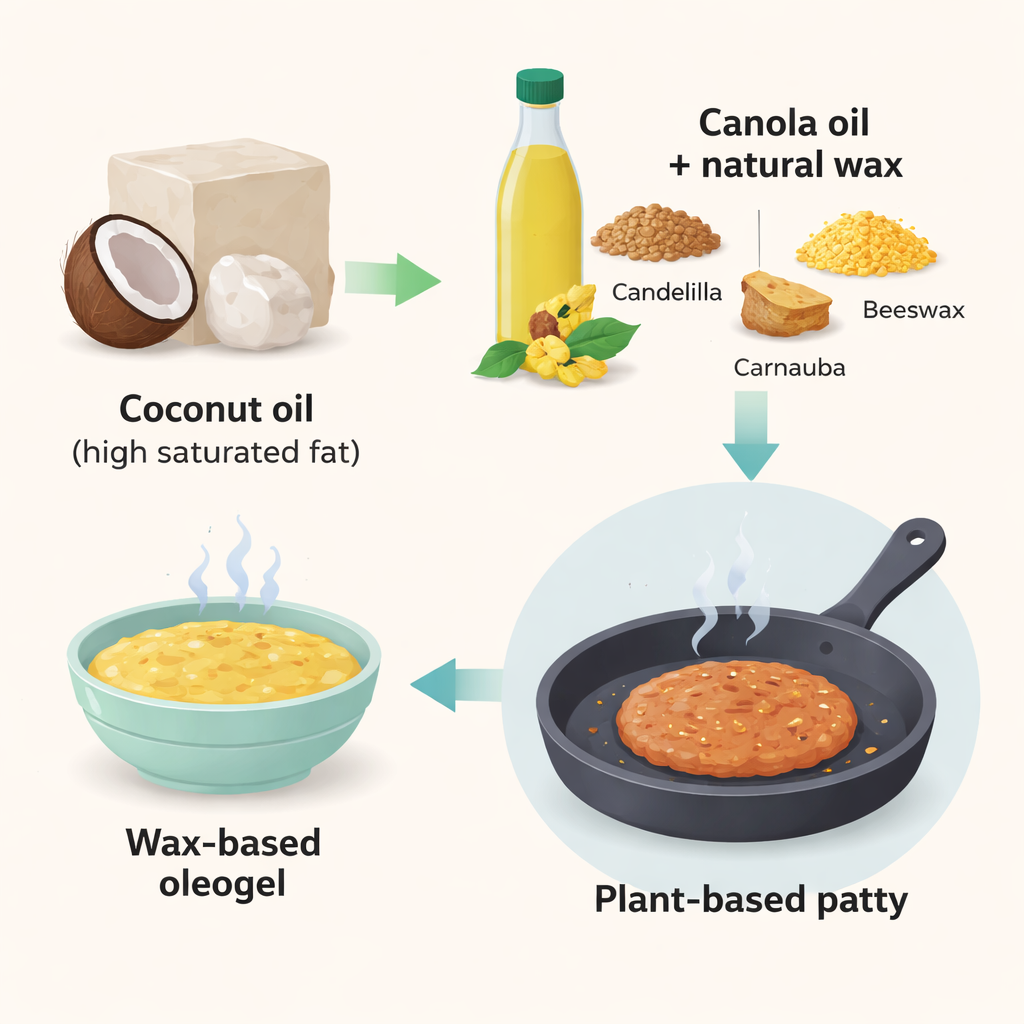
At the heart of the research is a simple challenge: how do you get the solid, marbled feel of animal fat using healthier liquid oils? The team worked with canola oil, which is naturally rich in unsaturated ("good") fats, and used tiny amounts of natural food-grade waxes—candelilla, carnauba, and beeswax—to turn it into a spoonable, solid-like gel known as an oleogel. Unlike traditional processes that chemically harden oils, this method relies on the waxes forming a fine crystal network that traps the oil. The result behaves like solid fat at room temperature but keeps the heart-health advantages of liquid oil.
How the New Fat Stands Up to Heat
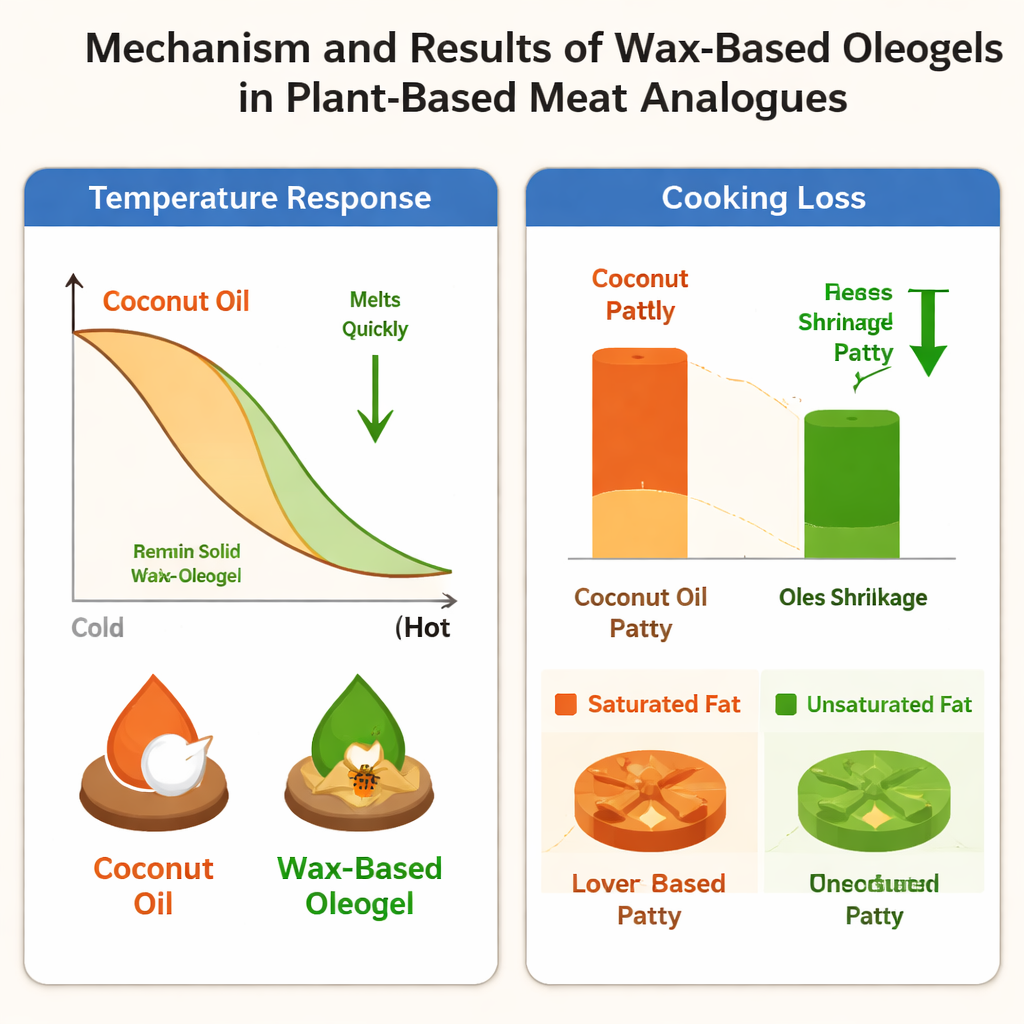
The researchers first compared these wax-based oleogels with coconut oil on the lab bench. Coconut oil stayed mostly solid only up to about 20 °C, then melted quickly by 30 °C. By contrast, the wax-based oleogels held their structure over a much wider range. Carnauba wax gels in particular remained solid up to around 40 °C and thinned only slowly as temperatures rose, showing high resistance to melting and flow. Candelilla wax produced the hardest gel at room temperature, while beeswax gave the softest. When fully melted, carnauba wax oleogels were the thickest and most sensitive to temperature changes, meaning they stayed relatively viscous as they warmed, rather than turning into a runny oil right away.
From Test Tube to Plant-Based Burger
Next, the team swapped coconut oil entirely for each oleogel in a simple plant-based patty made from textured vegetable protein and a common gelling agent. Visually, the raw and cooked patties with oleogels looked much like those made with coconut oil—no obvious trade-off in appearance or handling. The big differences showed up during cooking. Patties made with any oleogel lost less weight in the pan than the coconut oil version, meaning they held onto more water and fat. Those with carnauba wax performed best, cutting cooking loss by about a third. This likely reflects carnauba’s higher melting point and thicker texture when hot, which help keep juices from escaping as the patty fries.
Texture and Bite for Everyday Eating
Texture testing revealed that fat structure carries over directly into how the patties feel when bitten. Candelilla wax oleogels, the firmest at room temperature, produced the hardest patties, while beeswax led to the softest. Overall, oleogel patties were less springy and cohesive but more adhesive than the coconut oil version, suggesting a slightly softer, less bouncy bite with a bit more stickiness. The hardness of the original fat or gel was strongly linked to patty firmness, so manufacturers could fine-tune texture by choosing and blending waxes. Although this study did not include taste tests, earlier work with cookies and cakes has shown that, at reasonable levels, wax-based oleogels can be used without hurting consumer acceptance.
Healthier Fat without Losing the Sizzle
The most striking result lies in the fatty acid profile. Patties made with coconut oil were dominated by saturated fats—around 94% of their total fat—leaving only about 6% as unsaturated. Replacing coconut oil with wax-based oleogels flipped that pattern: in the new patties, only about 7–16% of the fat was saturated, while more than 84% was unsaturated, closely matching canola oil itself. This slashed the saturated-to-unsaturated fat ratio from roughly 16 to about 0.08. In plain terms, the study shows that carefully structured wax–oil gels can keep plant-based burgers juicy, stable, and appealing while making their fat profile look much more like a heart-healthy cooking oil than a block of tropical fat.
Citation: Park, Y.S., Jeong, S. & Lee, S. Functional evaluation of wax-based oleogels as solid fat replacers for designing low saturated fat plant-based meat analogues. npj Sci Food 10, 63 (2026). https://doi.org/10.1038/s41538-026-00713-x
Keywords: plant-based meat, oleogels, saturated fat, canola oil, food structure