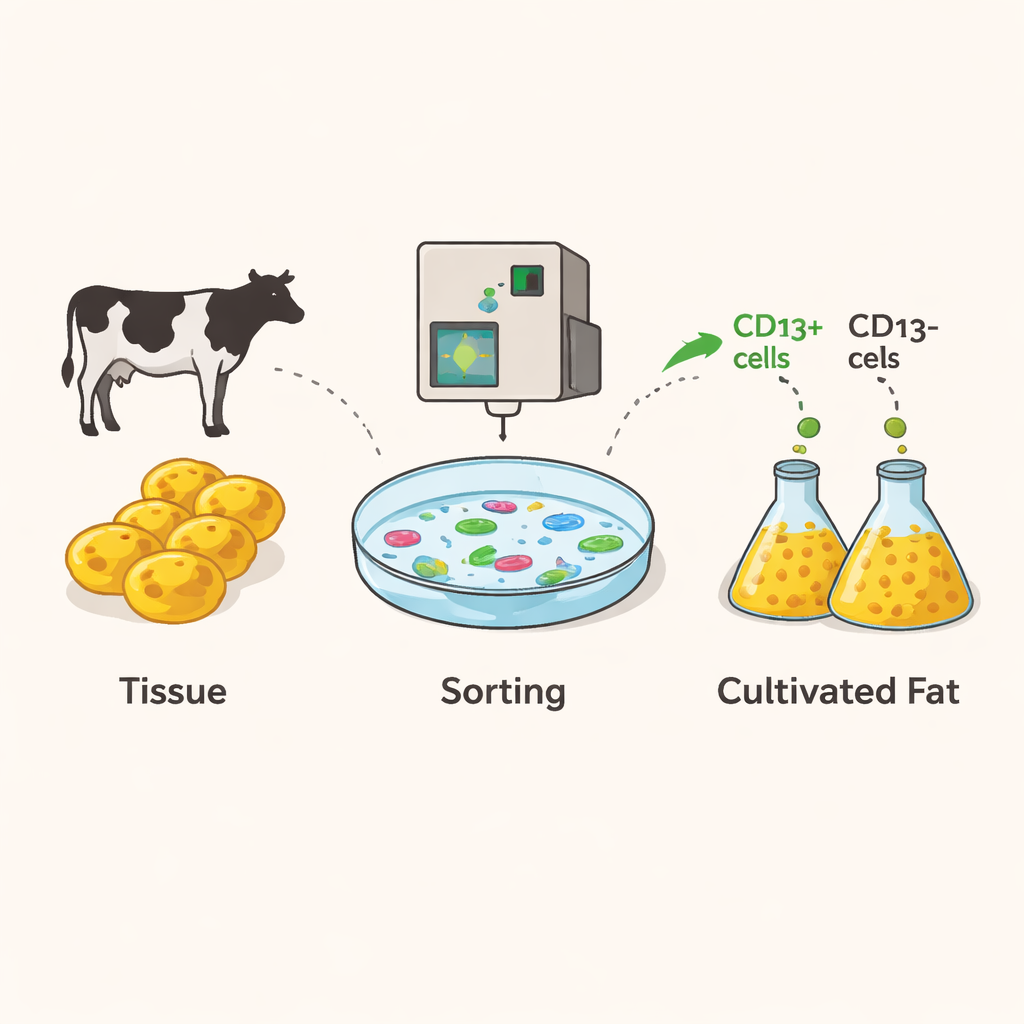
Fat is a big part of why food tastes good: it carries flavor, gives meat its juiciness, and provides energy. As companies race to make "cultivated meat"—meat grown from cells instead of animals—they also need convincing fat to mix into burgers, sausages, and hybrid plant-based foods. But making fat from cells is still slow and inefficient. This study asks a simple, practical question: can we pick out, in advance, the rare cells that are truly good at turning into fat, so that growing cultured fat becomes faster, cheaper, and easier to scale?
Hidden specialists inside a mixed cell crowd
To make fat in the lab today, scientists usually start with mesenchymal stem/stromal cells (MSCs) taken from animal fat tissue. These cells can stick to plastic dishes and multiply, but they are a mixed crowd. Only a minority are real "pre-adipocytes"—cells already primed to become fat. Most others are less committed or follow different fates, which wastes time, space, and nutrients in bioreactors. The researchers wanted a simple surface marker—something on the cell’s outer membrane—that reliably flags the true fat precursors in cattle, a key species for future beef-style cultured products.
Cloning cells to find the best fat makers Figure 1.
The team began by isolating MSCs from the fat of young calves and then sorting them into single cells that were grown into hundreds of individual clones. Each clone was tested to see whether it could repeatedly turn into fat cells under the right cocktail of signals. Only about one in five clones produced visible oil-filled fat droplets, and an even smaller fraction did so consistently over time. These high-performing "adipogenic" clones tended to grow more slowly and had larger, flatter cells than their non-adipogenic counterparts, hinting that they were more specialized and less stem-like.
Reading gene activity to spot a reliable marker
Next, the scientists compared gene activity across the best fat-forming clones and the non-fat-forming ones using RNA sequencing. Thousands of genes differed between the two groups, including many known drivers of fat development. Among the genes that code for recognizable cell-surface proteins, one stood out: CD13. Several other candidate markers either showed weaker differences or were present on very few cells. When the team used flow cytometry to measure these proteins on bulk MSC cultures, CD13 was found on a substantial fraction of cells, while other candidates were almost absent. That combination—strong association with fat potential and reasonable abundance—made CD13 a promising handle for sorting.
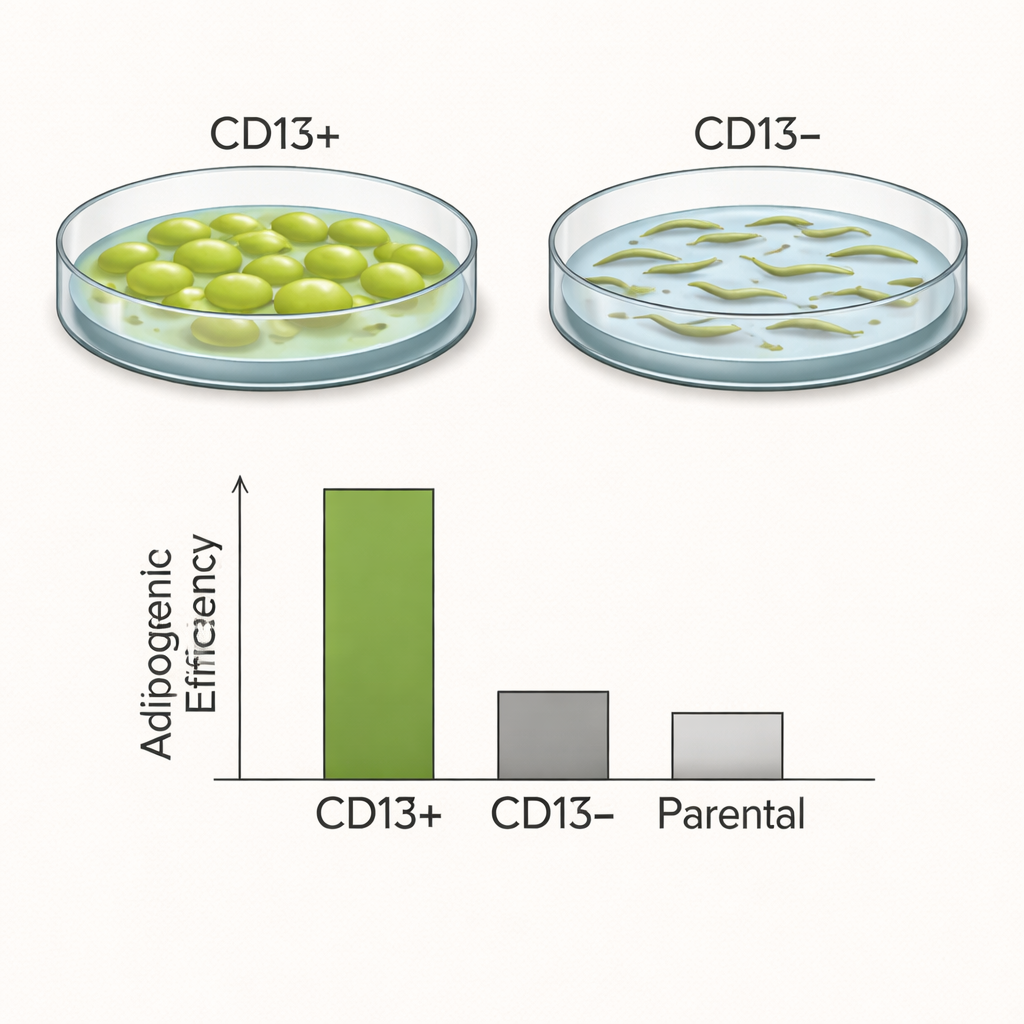
Separating the fat-ready cells from the rest Figure 2.
Using fluorescence-activated cell sorting (FACS), the researchers split MSCs into CD13-positive and CD13-negative fractions. The CD13-positive cells were larger, grew more slowly, and showed higher levels of master fat-control genes, but they did not lose their ability to also become bone or cartilage, reflecting a "lineage-primed" rather than fully locked-in state. When both fractions were pushed to become fat, the differences were striking: CD13-positive cells produced many more mature fat cells—on average more than ten times as many as the CD13-negative group, and roughly three times more than the unsorted starting population. In the best case from a particular animal, up to 80 percent of cells in the CD13-positive fraction became fat cells.
From marker discovery to practical cultivated fat
For non-specialists, the key message is that CD13 functions as a practical tag to fish out fat-ready cells from a mixed bovine stem cell culture. Using this single marker, producers could start cultures with a much higher proportion of cells that efficiently form fat, helping make cultivated fat more predictable and scalable. The study also highlights that the original animal donor still matters—some animals yield better-performing cells than others—and that further work is needed to translate FACS-based sorting into industrially friendly methods. Nonetheless, CD13 now stands as a bona-fide, experimentally validated signpost for bovine pre-adipocytes, bringing the vision of realistic, animal-free beef fat a step closer to reality.
Citation: Lee, S., Thrower, T., Riley, S.E. et al. CD13 is a bona-fide marker of bovine pre-adipocytes with potential in cultivated fat applications.
npj Sci Food10, 61 (2026). https://doi.org/10.1038/s41538-026-00711-z