Clear Sky Science · en
Fabrication of stabilized pickering emulsions via crosslinking modified soy protein: focused on fat substitution strategies
Why a New Kind of Cream Matters
Whipped cream and rich sauces are delicious, but they pack a lot of fat and calories. Food scientists are searching for ways to keep the indulgent texture we love while cutting back on fat and relying more on healthier ingredients like proteins from plants and milk. This study explores a new way to build stable, creamy mixtures that can even be used as "inks" for 3D-printed foods, opening the door to desserts and toppings that are both fun and better for you.
Turning Proteins into Tiny Cream Builders
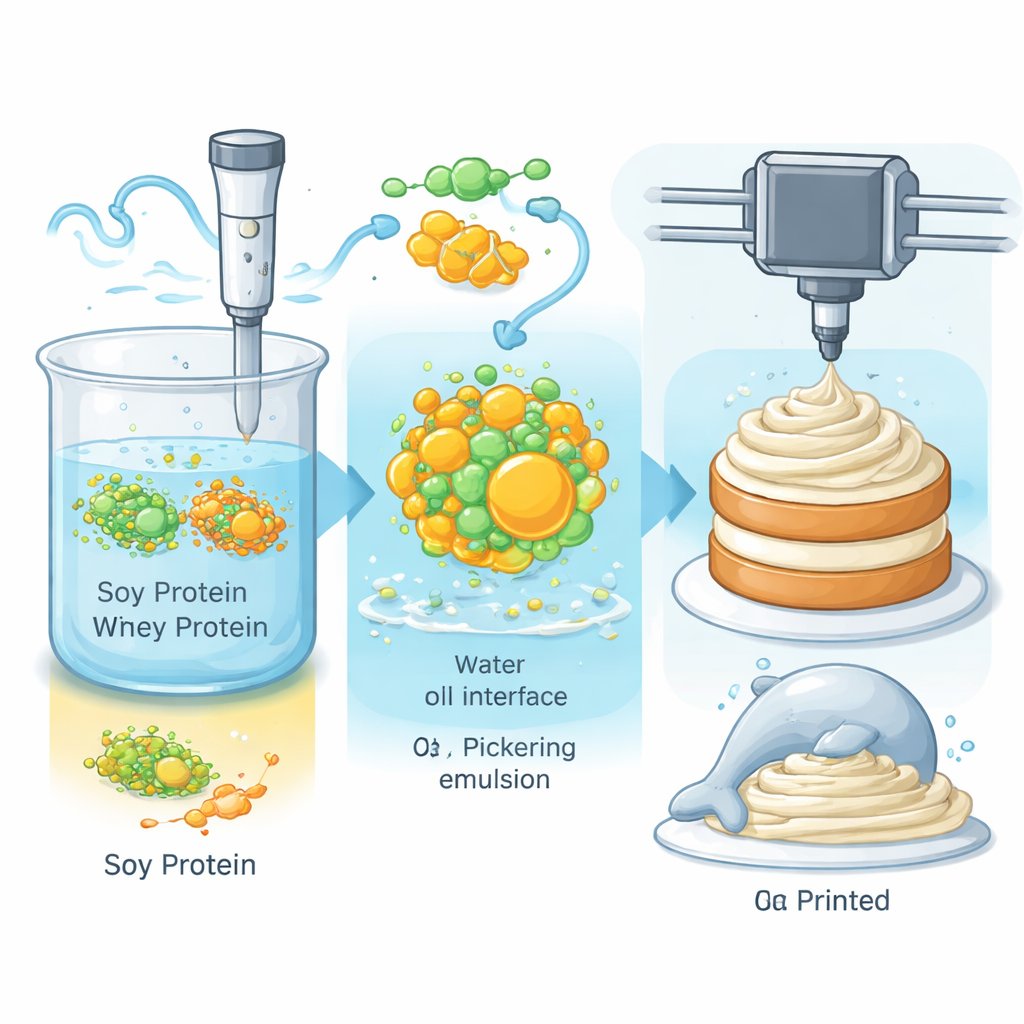
The researchers focused on two common food proteins: soy protein isolate from plants and whey protein isolate from milk. On their own, soy particles do not form very stable emulsions, the mixtures of oil and water that lie behind creams, dressings, and sauces. To improve this, the team first gently "opened up" the soy proteins using ultrasound and an enzyme, so that they could more easily link together. They then mixed these treated soy proteins with whey proteins in equal amounts, creating new composite protein particles. At this 1:1 ratio, the particles became smaller, more uniform, and carried more electrical charge, all signs that they would behave well in liquid mixtures.
How the New Particles Grip Oil Droplets
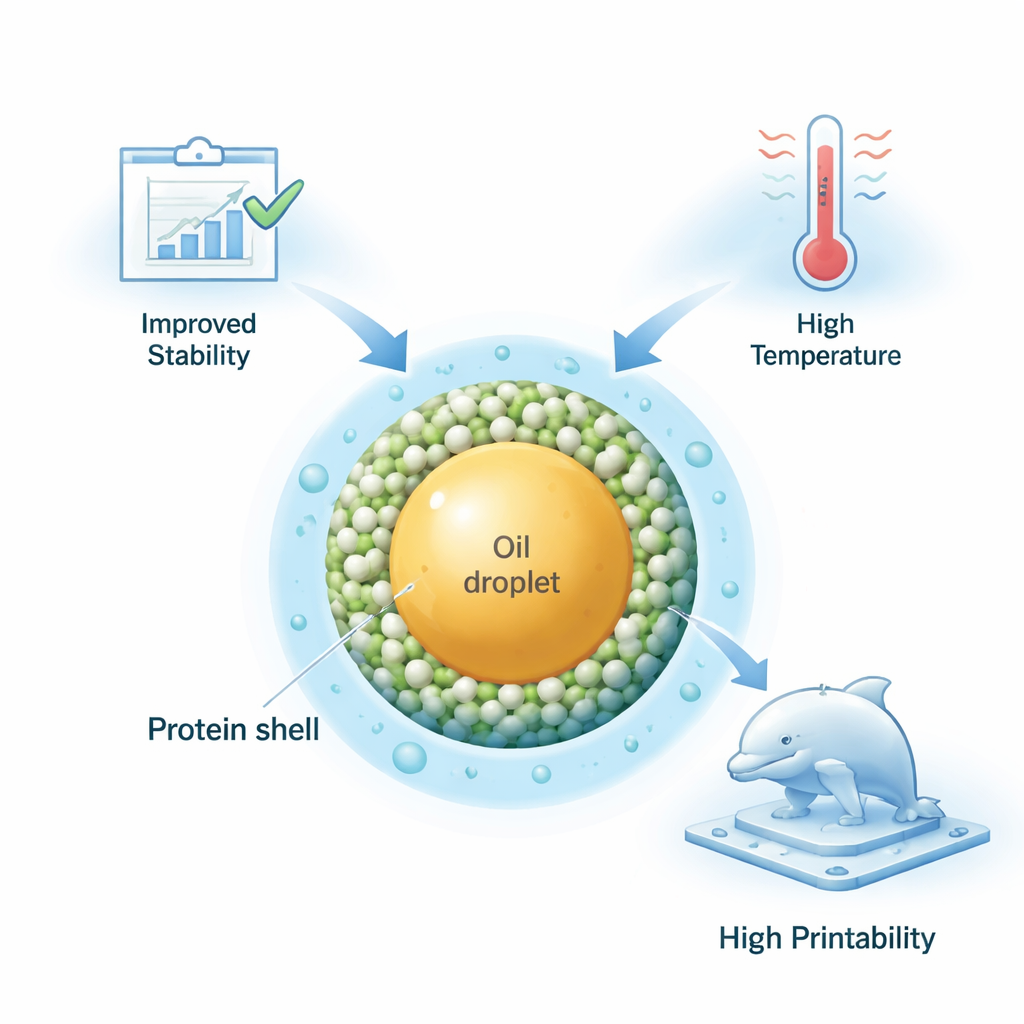
These protein particles were designed to act as solid lifeguards at the border between oil and water, creating what is called a Pickering emulsion. Using a suite of tests, including light, electron, and fluorescence microscopy, the researchers showed that the soy–whey particles migrate to the oil–water boundary and form a tight shell around each oil droplet. One particular treatment, labeled SW3, where soy proteins were ultrasonically treated at 300 watts before being linked with whey, stood out. SW3 particles were just the right size, had strong internal bonding, and spread out evenly on the oil surface, lowering the tension between oil and water and forming a thick, soft yet sturdy film around droplets.
Staying Smooth Under Heat, Salt, and Storage
To see if these emulsions could survive real-world conditions, the team tested how they responded to heating, salt, spinning, and time in the fridge. Emulsions stabilized with the SW3 particles kept very small, evenly sized droplets, even when heated to boiling temperatures or exposed to salt. They showed very little separation during cold storage over nine days, and resisted breaking apart under centrifugation. Detailed measurements with a quartz crystal sensor confirmed that SW3 built a relatively thick, viscoelastic layer around oil droplets, which acts like a cushion that stops them from clumping and separating out of the cream.
From Lab Beaker to Whipped Cream and 3D Shapes
Next, the scientists replaced much of the fat in a standard whipped cream recipe with the new Pickering emulsion. The resulting low-fat creams behaved much like familiar whipped cream but with lower energy density. In flow tests, they showed "shear-thinning" behavior, meaning they could be pushed through a nozzle yet quickly regain structure afterward. The SW3-based cream had the highest viscosity, an ideal yield stress for keeping its shape, and a strong, elastic network. It whipped faster, trapped more air, and formed smaller, more stable bubbles than creams made with single proteins or commercial vegetable cream. When used as an ink in an extrusion 3D printer, the SW3 cream produced well-defined dolphin-shaped models with clean edges and no collapse.
What This Means for Everyday Foods
In simple terms, the study shows that carefully engineered mixtures of soy and whey proteins can stand in for a significant portion of fat in creams while preserving the thick, stable, whipped texture people expect. By forming a protective protein shell around oil droplets, the SW3 particles keep low-fat cream smooth, stable in the fridge, and robust enough for 3D printing into playful shapes. This approach could help manufacturers create new low-calorie creams, toppings, and customized printed desserts that feel indulgent but are gentler on our health.
Citation: Sun, Y., Guo, W., Li, X. et al. Fabrication of stabilized pickering emulsions via crosslinking modified soy protein: focused on fat substitution strategies. npj Sci Food 10, 60 (2026). https://doi.org/10.1038/s41538-026-00710-0
Keywords: low-fat cream, Pickering emulsion, soy and whey protein, 3D food printing, fat replacement