Clear Sky Science · en
Cooked meat-derived extracellular vesicles ssc-miR-1 induces metabolic disorders in the mice liver via PI3k/AKT pathway
Why what’s inside cooked meat could matter
Many people worry about whether eating a lot of red meat is worse for health than eating white meat like chicken. This study looks beyond fat and cholesterol to a newer suspect: tiny packages released from cooked meat called extracellular vesicles. These microscopic bubbles carry genetic “messages” that our bodies can absorb. The researchers asked whether vesicles from cooked pork and chicken might nudge the liver toward weight gain, fatty buildup, and poor blood sugar control. Their results hint that some of red meat’s risks may come from this hidden cargo rather than from nutrients alone. 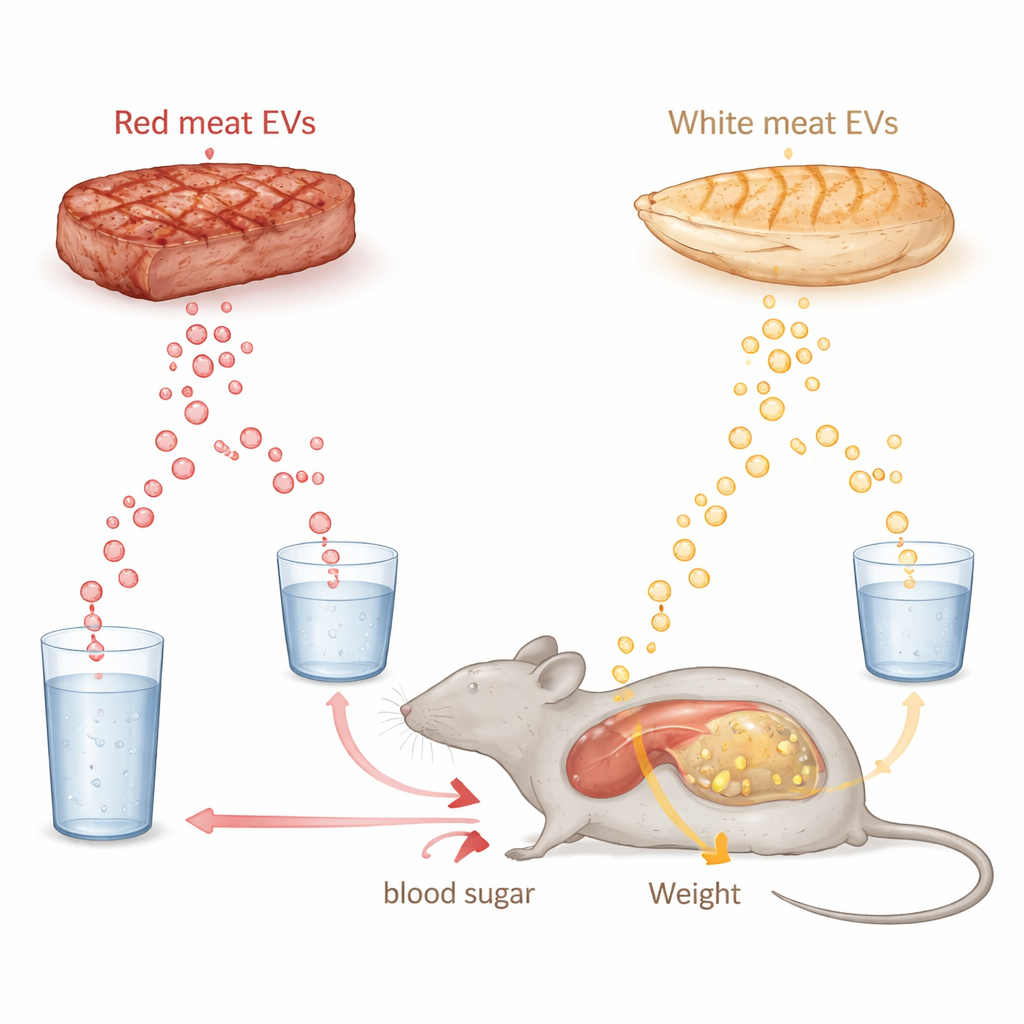
Tiny bubbles from our dinner
When animal cells break down or communicate, they shed nanosized sacs made of fat and protein membranes, known as extracellular vesicles. The team showed that such vesicles survive typical boiling of pork and chicken and can be isolated from the cooking liquid. These bubbles, only about one hundred billionths of a meter across, still carry molecular contents such as microRNAs—short pieces of genetic material that can dial genes up or down. Pork-derived vesicles were slightly larger on average than chicken-derived ones and were packed with a particular microRNA called ssc-miR-1, while chicken vesicles were richer in a related microRNA named gga-miR-133a-3p.
Feeding mice vesicles instead of meat
To understand how these vesicles might affect whole-body health, the scientists added them to the drinking water of mice for ten weeks, without changing the animals’ regular chow. Compared with control mice given only saline, mice that drank red-meat vesicles and those that drank white-meat vesicles both gained more weight and had higher body mass index. The red-meat group showed the biggest changes: they ran less on exercise wheels, handled a sugar load poorly, and responded sluggishly to insulin. When the researchers examined the livers, they found extra fat droplets, especially in mice exposed to red-meat vesicles, suggesting an early stage of fatty liver and disrupted metabolism.
Messages that disturb liver genes
Looking inside the liver, the team measured which genes were turned on or off after long-term exposure to the vesicles. Hundreds of genes changed their activity, including many involved in how cells burn fuel, handle fats, and respond to insulin. Red-meat vesicles in particular pushed gene patterns linked to atherosclerosis, nonalcoholic fatty liver disease, and other metabolic problems. High-throughput sequencing showed that the most abundant microRNA in red-meat vesicles, miR-1, is well positioned to influence these pathways. Computer predictions and lab tests indicated that miR-1 can latch onto the instructions for key proteins in growth control and sugar handling, including a growth factor (IGF1) and a signaling protein called PI3K.
Inside liver cells: how sugar handling is disrupted
To zoom in on the mechanism, the researchers moved to a mouse liver cell line grown in dishes. They showed that cells readily swallowed red-meat vesicles and that extra miR-1 slowed cell growth by reducing IGF1 levels. More importantly for metabolism, miR-1 directly blocked PI3K, a central switch in the insulin signaling pathway. When the team created an insulin-resistant cell model, adding miR-1 made matters worse: the cells took up less sugar, stored less glycogen, and showed weaker activity of PI3K, its partner AKT, and GLUT4, the gate that ferries glucose into cells. A chemical that re-activates PI3K could partially undo these effects, supporting the idea that miR-1 from red meat vesicles sabotages this pathway. 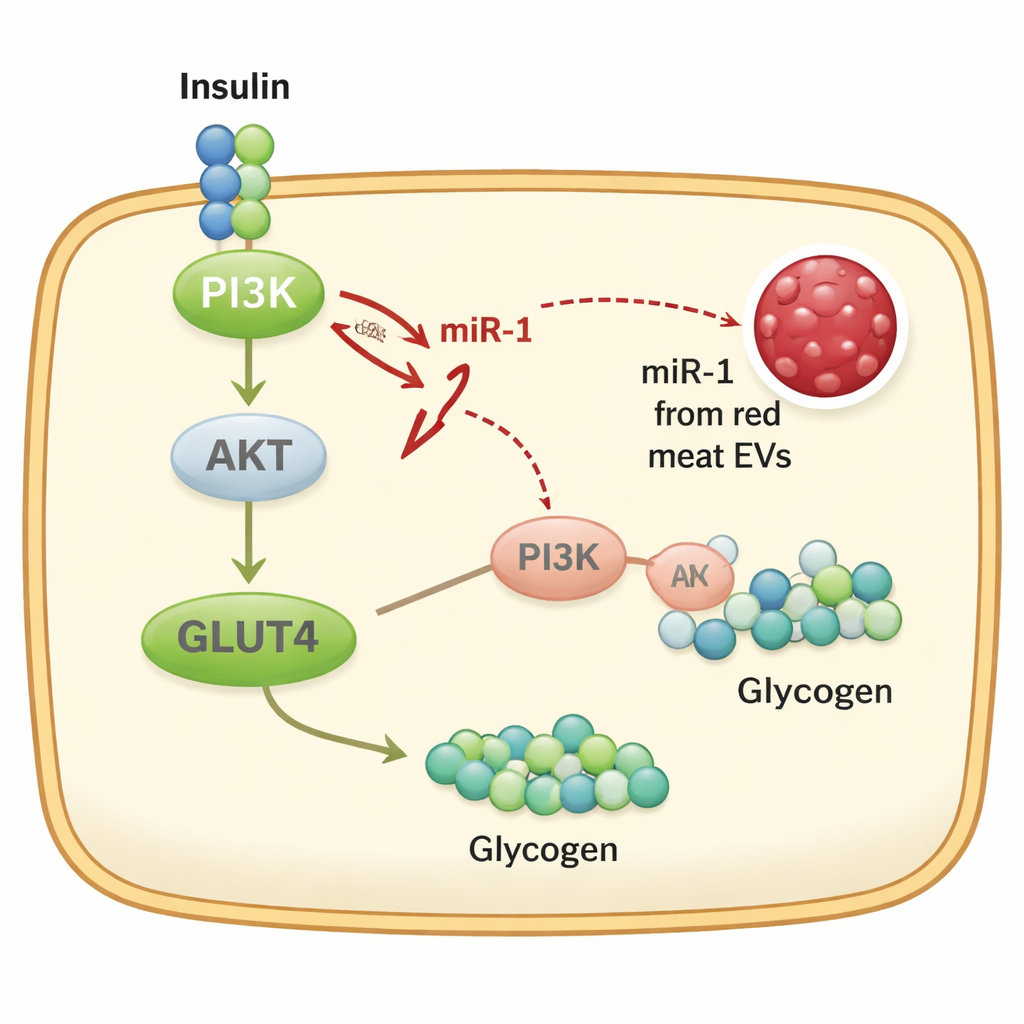
What this means for everyday eating
For non-specialists, the key message is that cooked meat may influence metabolism not only through fat, protein, and iron, but also through microscopic information packets that survive cooking and are absorbed by the body. In mice, vesicles from both pork and chicken promoted weight gain and signs of insulin resistance, with pork-derived vesicles having stronger effects. A single microRNA carried by red-meat vesicles was enough to worsen sugar handling in liver cells by dampening a major insulin signal. While more work is needed to confirm how strongly this applies to humans and normal diets, the study opens a new window on why high red meat intake often tracks with diabetes and fatty liver—and suggests that choosing less red meat may reduce exposure to this subtle molecular influence.
Citation: Shen, L., Ma, J., Liang, S. et al. Cooked meat-derived extracellular vesicles ssc-miR-1 induces metabolic disorders in the mice liver via PI3k/AKT pathway. npj Sci Food 10, 59 (2026). https://doi.org/10.1038/s41538-026-00709-7
Keywords: red meat, extracellular vesicles, microRNA, insulin resistance, fatty liver