Clear Sky Science · en
Expressive pragmatic language in mood and psychotic disorders: a systematic review and meta-analysis
When Everyday Conversation Becomes Hard Work
Most of us take it for granted that we can chat with friends, follow a joke, or politely end a phone call. But for many people living with serious mental illnesses such as schizophrenia, major depression, or bipolar disorder, these seemingly simple exchanges can be exhausting and confusing. This article explores how the “hidden rules” of conversation break down in these conditions, why that matters for relationships, work, and recovery, and what scientists are doing to measure and eventually improve these difficulties. 
The Hidden Rules Behind Natural Talk
Speaking is more than choosing the right words or using correct grammar. Conversation relies on an intricate set of unwritten rules: staying on topic, giving just enough detail, linking sentences together smoothly, and reading the social situation to know how direct, formal, or playful to be. Researchers call this collection of skills “pragmatic language” – the ability to use language appropriately in context. When these skills falter, people may sound vague, jumpy, overly literal, or oddly intense. Others can feel confused or uneasy without quite knowing why, and the speaker may end up isolated or misunderstood.
How Serious Mental Illness Affects Communication
The authors of this study gathered and analyzed 51 scientific papers that examined how adults with schizophrenia spectrum disorders, major depressive disorder, or bipolar disorder use language in real communication. Rather than focusing on how people understand language, they zoomed in on expressive skills – how people actually talk or write. They looked at 18 aspects of communication, from how well people keep their stories coherent, to whether they follow conversational rules like taking turns and staying relevant, to how they use figurative expressions such as metaphors, jokes, and irony.
What the Numbers Reveal About Speech Breakdowns
In 28 of the studies, the team could compare patients directly with healthy volunteers and combine the results statistically. The clearest problems emerged in three areas. First, “cooperativity” – roughly, how well someone follows basic conversational rules like being clear, relevant, and informative – showed the largest disruption. Second, people often struggled with “anaphora,” the small linking words like “he,” “she,” or “that one” that tie sentences together and help listeners follow who or what is being talked about. Third, “cohesion,” the glue that connects sentences into a smooth story, was also noticeably weaker. Overall coherence – how well the big picture of a story hangs together – was moderately affected. In contrast, the production of metaphors, once all data were pooled, was not consistently worse, suggesting that not every kind of figurative language is equally vulnerable. 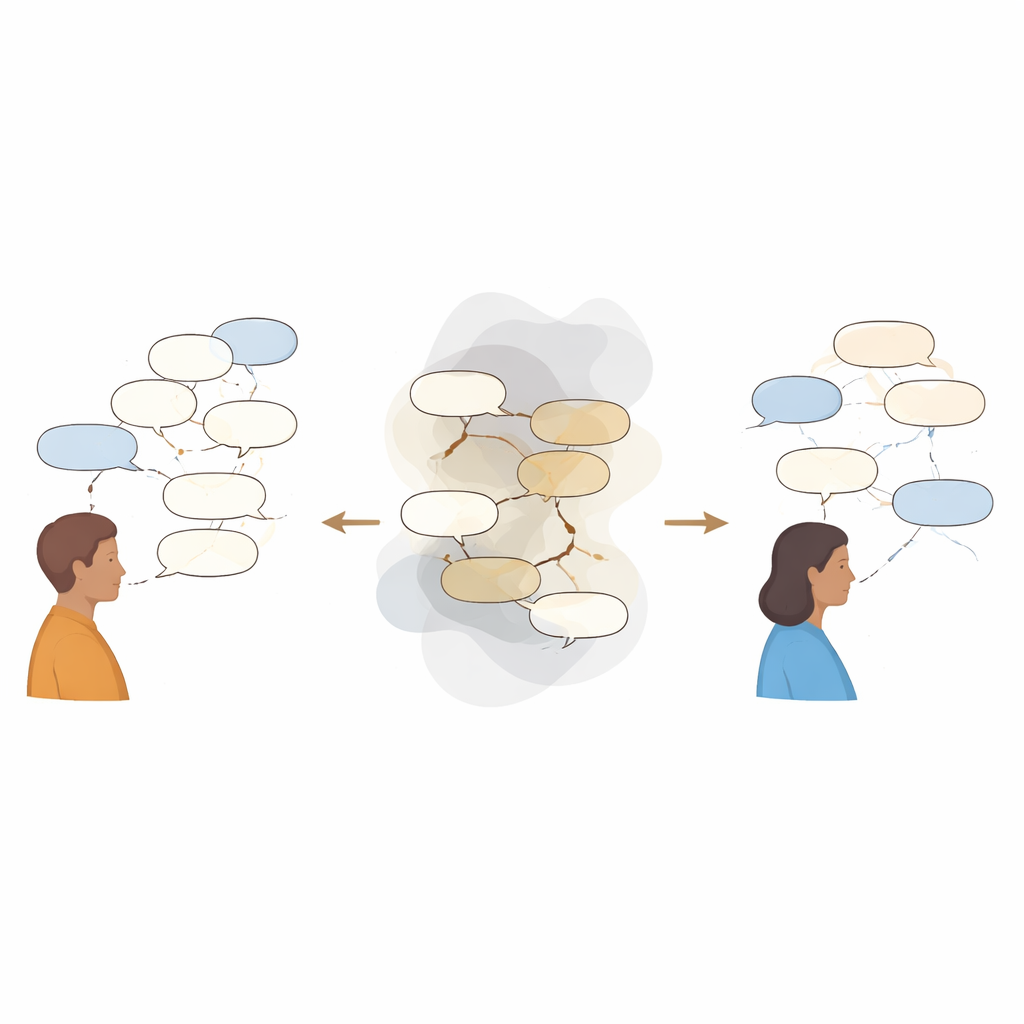
Different Conditions, Shared Challenges
Across the full set of studies, schizophrenia spectrum disorders were by far the most heavily researched and showed the broadest and most consistent pragmatic difficulties. People with these conditions were more likely to wander off topic, break social norms in conversation, mistime their turns, or produce speech that felt oddly fragmented. Evidence for similar problems in depression and bipolar disorder exists but is more patchy, with fewer studies and often smaller samples. For example, some work suggests that depressed individuals may speak in a slower, more monotonous way or struggle to organize their thoughts into a clear narrative, but the field lacks enough standardized data to draw firm conclusions.
Why These Findings Matter for Everyday Life
These subtle communication problems are not mere curiosities. They can shape whether someone is invited to social events, hired or kept on the job, or fully understood by their therapist. The authors argue that expressive pragmatic skills should be treated as a core part of mental health assessment, not an afterthought. Yet current research uses a patchwork of methods and tasks, making it hard to compare studies or track progress over time. The paper calls for more harmonized, preferably partly automated tools – potentially using modern language technologies – that can spot and quantify these conversational difficulties reliably in many languages and settings.
Looking Ahead: Toward Better Support and Treatment
In plain terms, the study concludes that many people with serious mental illness struggle with the “social side” of language, especially the fine-grained links and rules that keep conversation smooth and cooperative. These difficulties are strongest and best documented in schizophrenia but also appear, to a lesser extent, in depression and bipolar disorder. The authors see this as both a problem and an opportunity: a problem, because these issues can block social recovery; an opportunity, because they can be measured and directly targeted with training programs. By developing clearer tests and practical therapies that focus on how people actually speak with others, clinicians may be able to improve not just symptoms, but everyday connection and quality of life.
Citation: Meister, F., Sellier Silva, M., Melshin, G. et al. Expressive pragmatic language in mood and psychotic disorders: a systematic review and meta-analysis. Schizophr 12, 31 (2026). https://doi.org/10.1038/s41537-026-00733-2
Keywords: pragmatic language, schizophrenia, social communication, speech coherence, serious mental illness