Clear Sky Science · en
The link between GABA levels and P300 abnormalities in schizophrenia spectrum disorders: regional and symptom-based insights
Why this research matters
Schizophrenia spectrum disorders can make everyday tasks—following a conversation, staying focused at work, or remembering instructions—unusually hard. This study looks under the hood of the brain to see how changes in a calming brain chemical, called GABA, relate to changes in an electrical brain signal linked to attention and thinking. Understanding this link may help explain why some people with schizophrenia have milder symptoms and better thinking skills than others, and could point toward new treatment ideas.
Watching the brain respond to important sounds
When we hear a rare, important sound—like our name in a noisy room—the brain produces a brief electrical surge known as the P300, measured with EEG. A particular part, called the “P3b,” is strongest over the back of the head and reflects how well we focus and update our mental picture of what is going on. In people with schizophrenia spectrum disorders, this P3b response is often smaller than in healthy people and tends to shrink further when symptoms get worse. In this study, researchers compared 107 patients with schizophrenia spectrum disorders to 107 healthy volunteers using an auditory “oddball” task, where participants pressed a button to infrequent target tones hidden among many standard tones. 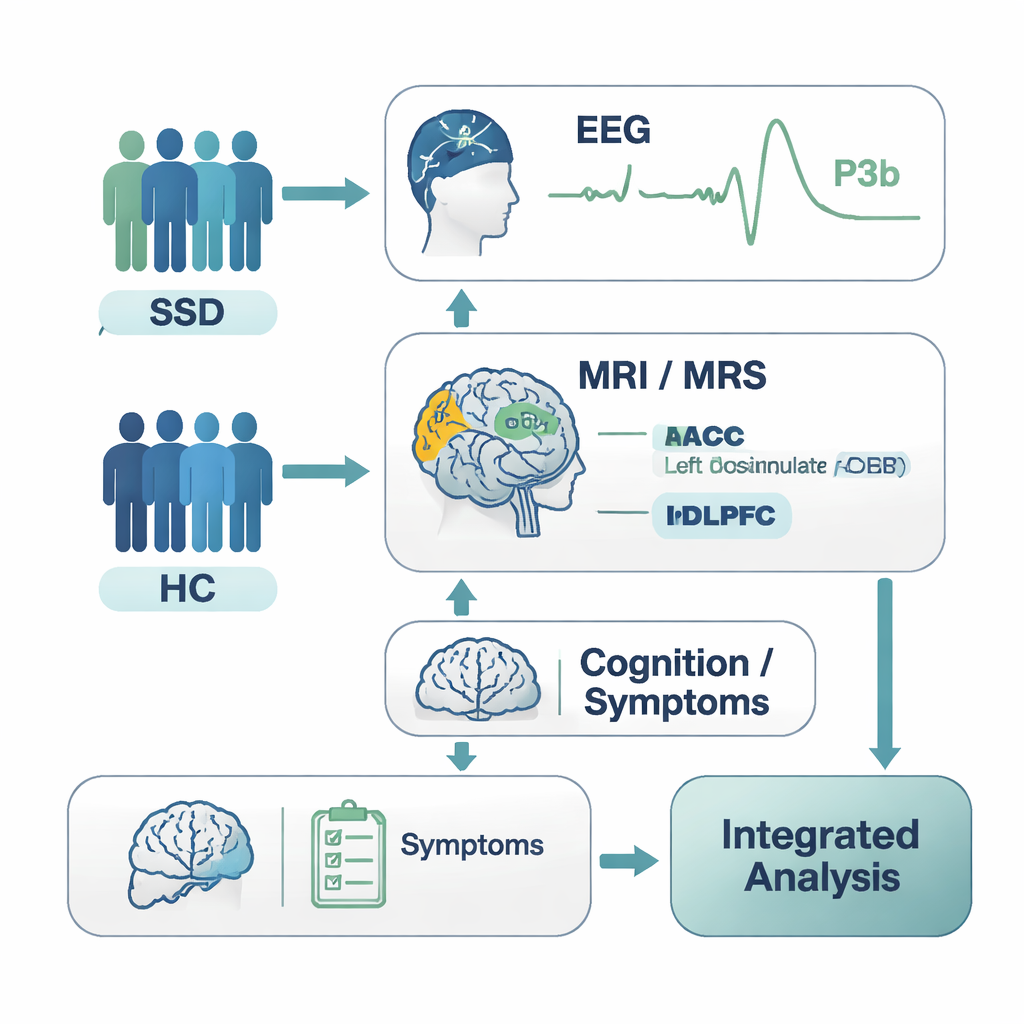
Two patient groups, different brain signal patterns
Not all patients were alike. Using a standard symptom scale, the team split the patient group into two clusters: a lower-symptom group and a higher-symptom group. Those with more severe symptoms showed broad reductions in the P3b signal, most clearly at parietal sites but also trending lower at central and frontal regions. In contrast, the lower-symptom group showed only a mild, parietal-specific reduction, with signals over frontal and central areas closer to healthy levels. Importantly, larger P3b amplitudes were linked to better task performance—more correct responses and faster reaction times—and to higher scores on a brief cognitive test. This supports the idea that the P3b is not just an abstract lab measure, but a practical marker of how effectively someone can pay attention and think.
Measuring brain chemicals in key control regions
The researchers also used magnetic resonance spectroscopy, a specialized MRI method, to measure levels of GABA and a combined glutamate-plus-glutamine signal (Glx) in two brain regions involved in control and attention: the anterior cingulate cortex (ACC) and the left dorsolateral prefrontal cortex (left DLPFC). These areas help manage working memory, decision-making, and conflict monitoring—functions that are often impaired in schizophrenia. Surprisingly, overall patients did not differ from healthy controls in ACC chemistry, and Glx levels were similar between groups in both regions. However, when the team focused on the clusters, they found that patients with fewer symptoms had higher GABA levels in the left DLPFC than healthy controls, while those with more severe symptoms did not show this increase.
How higher GABA may protect brain signals
Digging deeper, the team asked whether GABA or Glx levels were linked to the size of the P3b signal. They discovered that, in patients—but not in healthy volunteers—higher GABA levels in the left DLPFC were associated with larger P3b amplitudes over central and parietal scalp regions, particularly in the lower-symptom group. 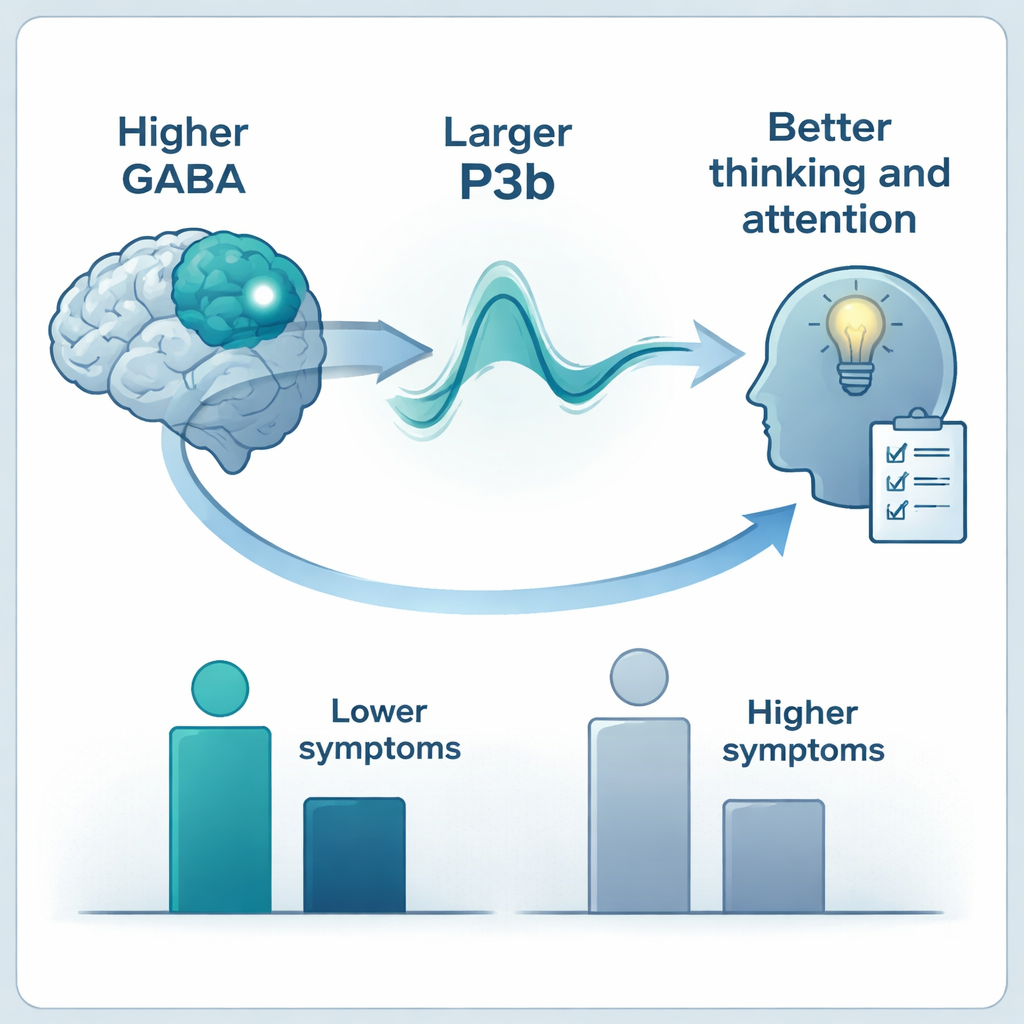
What this means for understanding schizophrenia
For a layperson, the takeaway is that some people with schizophrenia may have a kind of built-in balancing act happening in the prefrontal “control hub” of the brain. Higher levels of the calming chemical GABA in this region seem to support a stronger attention-related brain signal (P3b), which is linked to better thinking and task performance. In patients with milder symptoms, this GABA-related support appears to be working; in those with more severe illness, it may have broken down. While this study does not yet point to a ready-made treatment, it offers a clearer map of how brain chemistry, electrical signals, and symptoms fit together—and suggests that future therapies aimed at gently tuning GABA systems in specific brain areas could help preserve or improve cognitive function in schizophrenia spectrum disorders.
Citation: Karslı, B., Meisinger, V., Hasanaj, G. et al. The link between GABA levels and P300 abnormalities in schizophrenia spectrum disorders: regional and symptom-based insights. Schizophr 12, 11 (2026). https://doi.org/10.1038/s41537-026-00730-5
Keywords: schizophrenia, GABA, P300, cognitive function, brain imaging