Clear Sky Science · en
Pharmacological rescue of social deficits in rats featuring Disrupted-in-Schizophrenia-1 (DISC1) protein aggregation
Why this research matters to everyday life
Many people with schizophrenia struggle not only with hallucinations and delusions, but also with "negative" symptoms such as social withdrawal and difficulty adapting to new social situations. These problems often remain even when standard medicines control the more dramatic symptoms, making it hard to work, make friends, or live independently. This study explores a carefully designed rat model that mimics a biological change found in a subgroup of patients, and asks a simple but important question: can a specific drug restore flexible social behavior when the brain’s chemistry goes wrong?
A targeted look at social problems in schizophrenia
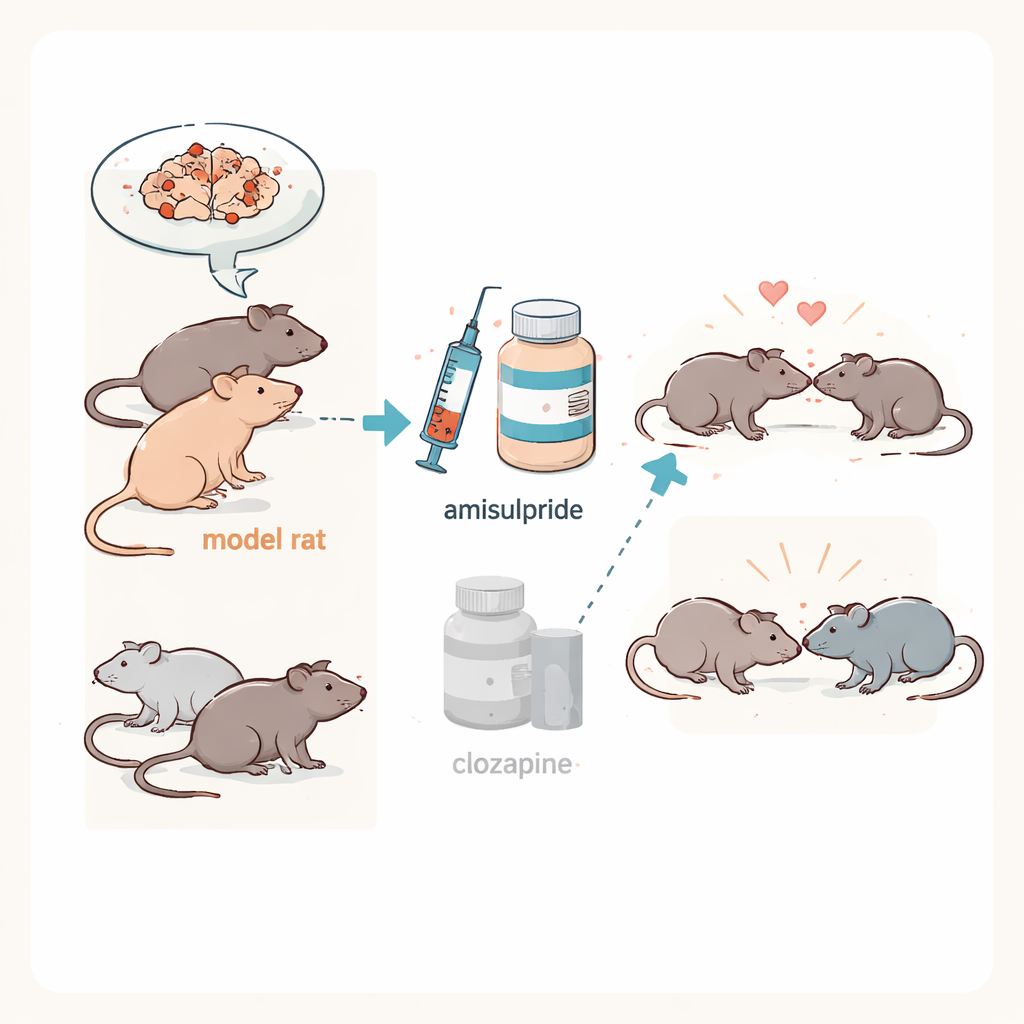
Rather than treating schizophrenia as a single, uniform condition, the researchers focused on patients who show abnormal build-up of a brain protein called DISC1. These protein clumps have been detected in post-mortem brain tissue and even in the spinal fluid of people with psychosis. To mirror this biology, they created "tgDISC1" rats that slightly overproduce the human DISC1 protein. This overproduction leads to DISC1 clumping inside brain cells and disturbs the signaling of dopamine, a chemical messenger involved in motivation, reward, and social behavior. The tgDISC1 rats show subtle but consistent problems in social flexibility, especially a reduced tendency to explore new social partners, while basic social interest and general thinking ability remain largely intact.
Testing two common medicines in a precise model
The team wanted to know if existing antipsychotic drugs could correct these social adaptability problems. They implanted tiny pumps under the skin of male tgDISC1 rats to deliver constant doses of either amisulpride or clozapine, two widely used medicines for schizophrenia, or an inactive solution. Amisulpride mainly blocks specific dopamine receptors (D2 and D3), while clozapine acts on a broader mix of dopamine and other receptors such as serotonin and noradrenaline. After a week of recovery, the rats went through a set of behavioral tests designed to separate social flexibility from more general issues like pleasure, memory, or basic activity levels.
How the rats handled new social encounters
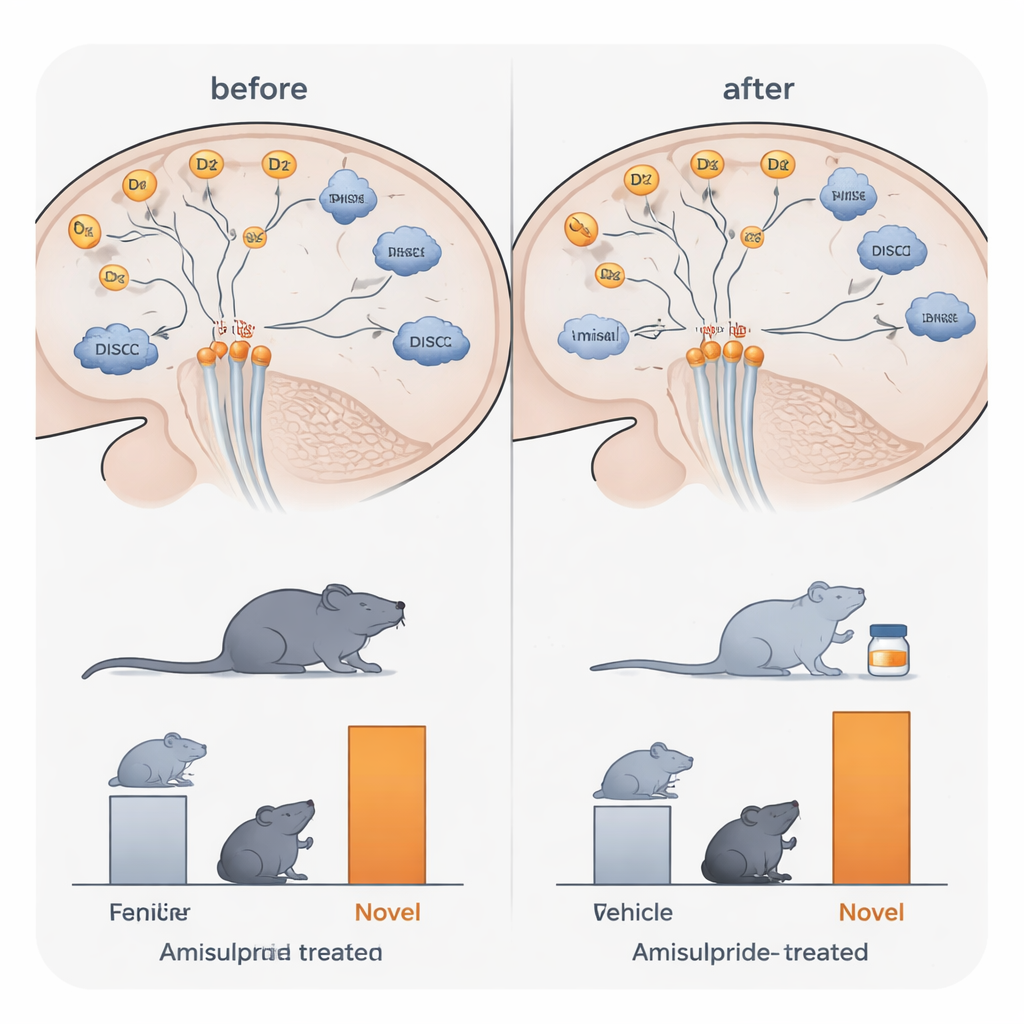
The central experiment was the "3-Chamber" task, which first measures how much a rat is drawn to another rat at all, and then tests whether it prefers a new social partner over one it already knows. As in earlier work, untreated tgDISC1 rats still sought social contact, but failed to show the normal preference for a novel companion, suggesting a specific problem with adapting to new social situations. Continuous treatment with amisulpride, at both low and high doses, restored this social novelty preference in tgDISC1 rats: they again spent more time exploring the unfamiliar rat than the familiar one. Importantly, amisulpride did not simply make them more active or more sociable overall; total social contact time and basic movement were not changed in a way that could explain the effect.
When a broad-acting drug was not enough
In contrast, clozapine did not significantly change social novelty behavior in tgDISC1 rats or in normal control rats, despite being a powerful and clinically important antipsychotic. It also did not produce clear changes in locomotion, memory, or pleasure-related tasks in this study. Blood measurements confirmed that both drugs reached the animals’ circulation in a dose-dependent manner, although clozapine levels were relatively low compared with human treatment ranges and may behave differently in rat brains. Other control tests, including a sucrose preference task for pleasure, a T-maze for short-term memory, and an open field test for exploratory drive, showed no major drug-related impairments or improvements, indicating that the key change was a targeted rescue of social adaptability by amisulpride.
What this means for future treatments
The findings suggest that in rats with DISC1-related brain changes, carefully tuning dopamine signaling with amisulpride can reverse a specific social deficit without broadly sedating or impairing the animals. Because this rat model was built to match a biologically defined subgroup of patients who show DISC1 protein aggregation, the work illustrates a full "precision psychiatry" loop: identify a biological subtype of schizophrenia, create a matching animal model, and test which treatments improve a clinically relevant behavior. For lay readers, the key takeaway is that not all patients with schizophrenia are the same, and not all antipsychotic drugs act on the same problems. By linking a concrete biological change to a focused social symptom and a tailored medicine, this research points toward more personalized strategies to help people regain the confidence and flexibility needed for everyday social life.
Citation: Dören, J., Van Gerresheim, E., Schäble, S. et al. Pharmacological rescue of social deficits in rats featuring Disrupted-in-Schizophrenia-1 (DISC1) protein aggregation. Schizophr 12, 16 (2026). https://doi.org/10.1038/s41537-026-00729-y
Keywords: schizophrenia, social behavior, dopamine, antipsychotics, animal models