Clear Sky Science · en
The relationship between schizophrenia polygenic scores, blood-based proteins and psychosis diagnosis in the UK Biobank
Why this matters for mental health
Psychotic illnesses like schizophrenia can be devastating, yet doctors still lack a simple blood test that helps diagnose them or track who is at greatest risk. In other conditions, such as Alzheimer’s disease or heart disease, blood-based “biomarkers” already guide diagnosis and treatment. This study asks a straightforward question with big implications: can we find clues in our genes and blood proteins that point to early warning signs, or even new treatment targets, for psychosis?
Genes, blood, and the search for clues
Psychosis is strongly influenced by genetics, but no single “schizophrenia gene” explains it. Instead, thousands of tiny genetic differences each nudge risk up or down. Researchers combine these into a single number called a polygenic score, which estimates a person’s inherited tendency toward schizophrenia. In this study, scientists used data from nearly 48,000 middle-aged adults in the UK Biobank, a huge health study, to see whether higher schizophrenia polygenic scores are linked to levels of more than 2,000 proteins circulating in blood plasma.

Scanning thousands of blood proteins
The team first focused on people without a psychosis diagnosis, to avoid the direct effects of illness or treatment. Using a high-throughput platform, they measured 2,077 different proteins in blood and then tested whether each protein’s level rose or fell with increasing schizophrenia polygenic score. After accounting for age, sex, lifestyle, kidney and liver function, and technical factors, 102 proteins showed some association, and four remained clearly linked even after strict statistical correction. These four proteins—named TMPRSS15, ADGRB3, CEACAM21, and KLK1—are involved in diverse processes, from digestion and immune signaling to brain connectivity and blood vessel function.
Zooming in on people with psychosis
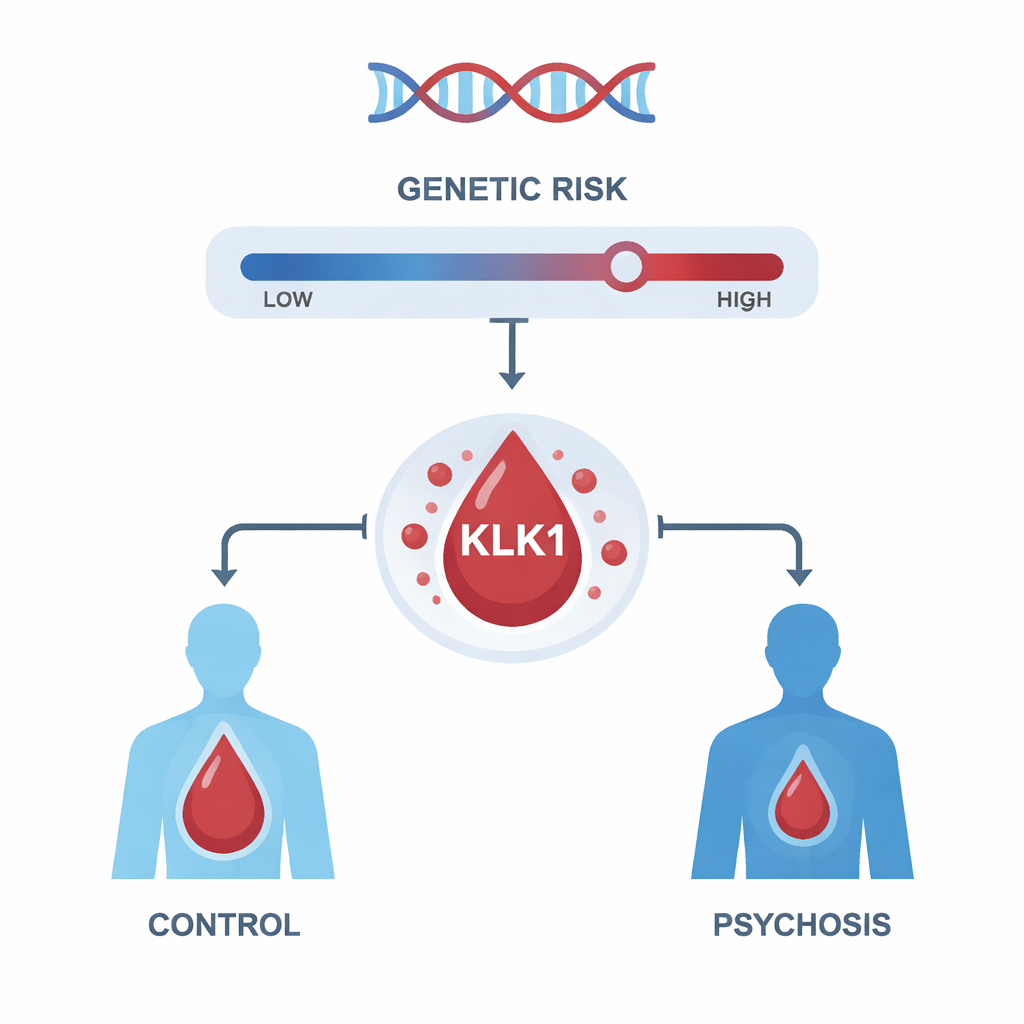
Next, the researchers asked whether these four “candidate” proteins actually differ in people with psychosis. They created a carefully matched case–control group of 283 individuals with schizophrenia-spectrum diagnoses and 849 similar individuals without psychosis, matched on age, sex, ethnicity, body weight, smoking, and medication count. In this direct comparison, only one protein—KLK1, short for kallikrein 1—showed a significant difference. Surprisingly, people with psychosis had lower levels of KLK1 in their blood, even though higher genetic risk for schizophrenia was associated with higher KLK1 levels in the larger, mostly healthy group.
A puzzling protein with a double signal
KLK1 is part of a family of enzymes that help regulate blood flow, inflammation, and protection against tissue damage, and it is found not only in blood vessels but also in the brain. Earlier research suggests that this family of proteins may protect brain cells under stress and influence mood and other neurological conditions. In this study, the mismatch between genetic risk (which pointed toward higher KLK1) and actual illness (which showed lower KLK1) suggests that KLK1 may be altered as the disease develops, or that the way genes influence this protein changes once someone becomes unwell. Importantly, the authors checked whether antipsychotic medications might explain the difference and found no clear link between these drugs and KLK1 levels.
What this means for future tests and treatments
The findings do not deliver an immediate diagnostic blood test for psychosis, but they mark an important step. By linking genetic risk scores to specific proteins and then showing that one of these, KLK1, also differs in people with psychosis, the study highlights a concrete biological pathway worth following. Larger and more diverse studies, especially those tracking people over time before and after illness onset, will be needed to confirm whether KLK1—or combinations of proteins—can reliably signal emerging psychosis or guide treatment choices. For now, KLK1 stands out as a promising lead in the long-term effort to turn genetic insights into practical blood tests for severe mental illness.
Citation: Kendall, K.M., Legge, S.E., Fenner, E. et al. The relationship between schizophrenia polygenic scores, blood-based proteins and psychosis diagnosis in the UK Biobank. Schizophr 12, 24 (2026). https://doi.org/10.1038/s41537-025-00725-8
Keywords: psychosis, schizophrenia, blood biomarkers, polygenic risk, proteomics