Clear Sky Science · en
Relationship between N100 amplitude and T1w/T2w-ratio in the auditory cortex in schizophrenia spectrum disorders
Listening to the Brain’s First Response
When we hear a sound, our brains react within a fraction of a second. This early electrical response can be measured on the scalp and may offer clues about conditions like schizophrenia, which often involve unusual experiences such as hearing voices. This study asked whether a simple brain signal to sound and the fine structure of the hearing center in the brain are altered together in people with schizophrenia spectrum disorders, and whether these changes differ between men and women.
How the Brain Answers a Sound
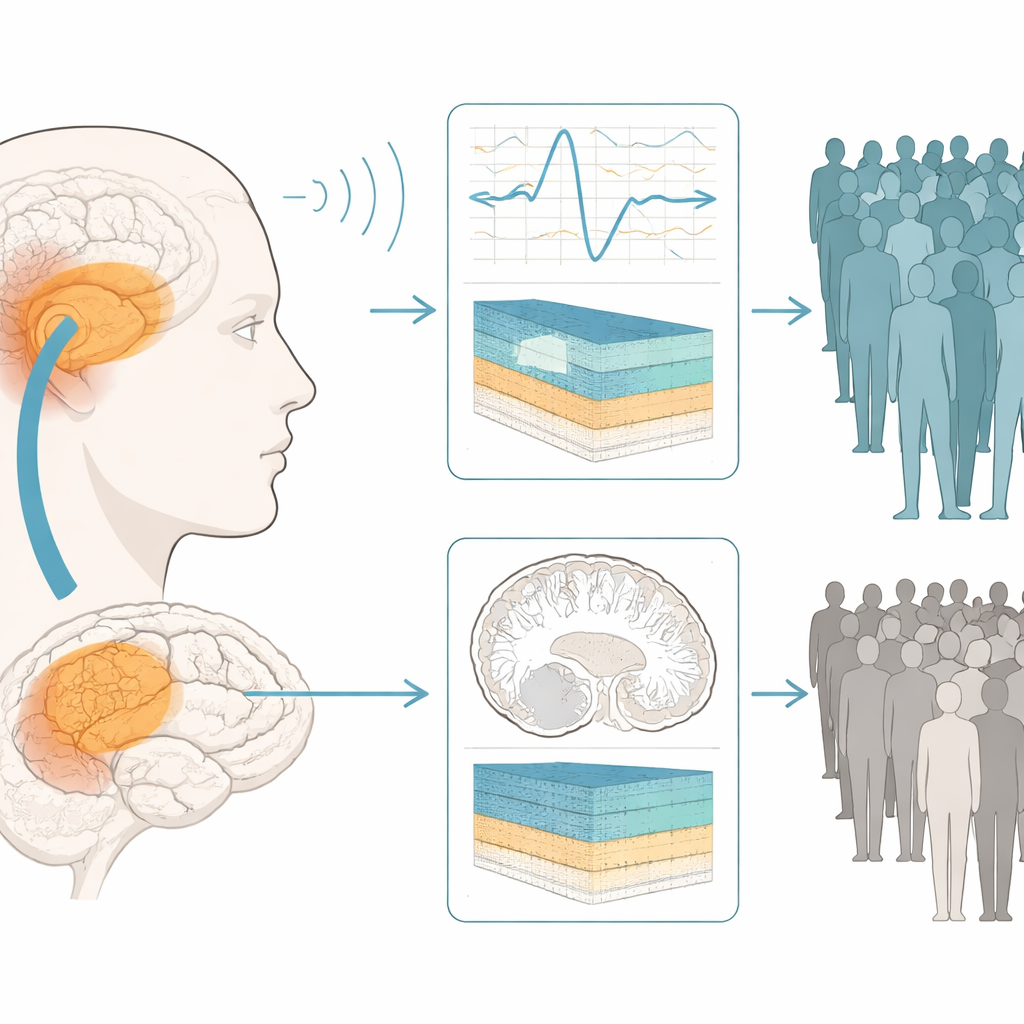
Scientists can record tiny voltage changes on the scalp when a brief noise is played through headphones. One key feature, called the N100 response, appears about a tenth of a second after the sound. In healthy listeners, a stronger N100 suggests a more robust reaction of brain cells in the auditory cortex, the region tucked in the temporal lobe that helps us detect and interpret sounds. Earlier research has repeatedly found that people with schizophrenia tend to show a weaker N100, hinting at disrupted communication among the brain cells that process sound.
A Closer Look at Brain Wiring
Communication between brain cells depends not only on how many cells there are, but also on how well their long, thin extensions are insulated. This insulation, called myelin, helps electrical signals travel quickly and in sync. Modern MRI scans can approximate how much myelin is present in different parts of the brain by comparing two types of images and taking their ratio. In this study, the researchers focused on the primary and secondary auditory cortex, two neighboring regions that receive and refine incoming sound information. They asked whether people with schizophrenia spectrum disorders show differences in this MRI-based measure of tissue microstructure, and whether those differences go hand in hand with a weaker N100 response.
Comparing Patients and Healthy Volunteers
The team combined brainwave recordings and MRI scans from 33 adults with schizophrenia spectrum disorders and 144 healthy volunteers of similar age. While listening to soft bursts of noise, participants produced clear N100 responses that were measured from a central scalp electrode. The researchers also calculated the myelin-related MRI ratio in the two auditory regions on both sides of the brain. Overall, they found that people with schizophrenia spectrum disorders tended to have a somewhat smaller N100 than healthy volunteers, echoing earlier work, but the groups did not differ in the MRI measure in either auditory region. In other words, a weaker sound response did not come with obvious changes in this particular marker of brain tissue structure.
Men and Women Show Different Patterns
Because schizophrenia often plays out differently in men and women, the researchers examined the data separately by sex. Here the contrast became clearer: men with schizophrenia spectrum disorders had a markedly smaller N100 response than healthy men, while women with the disorder did not differ noticeably from healthy women. Yet even with this split, the MRI measure in the auditory cortex looked similar across all four groups, and within each group there was no reliable link between an individual’s N100 strength and their MRI ratio. These findings suggest that sex is an important factor in how early sound responses are altered, but that this alteration is not easily explained by the myelin-related MRI signal in the hearing regions.
What This Means for Understanding Schizophrenia
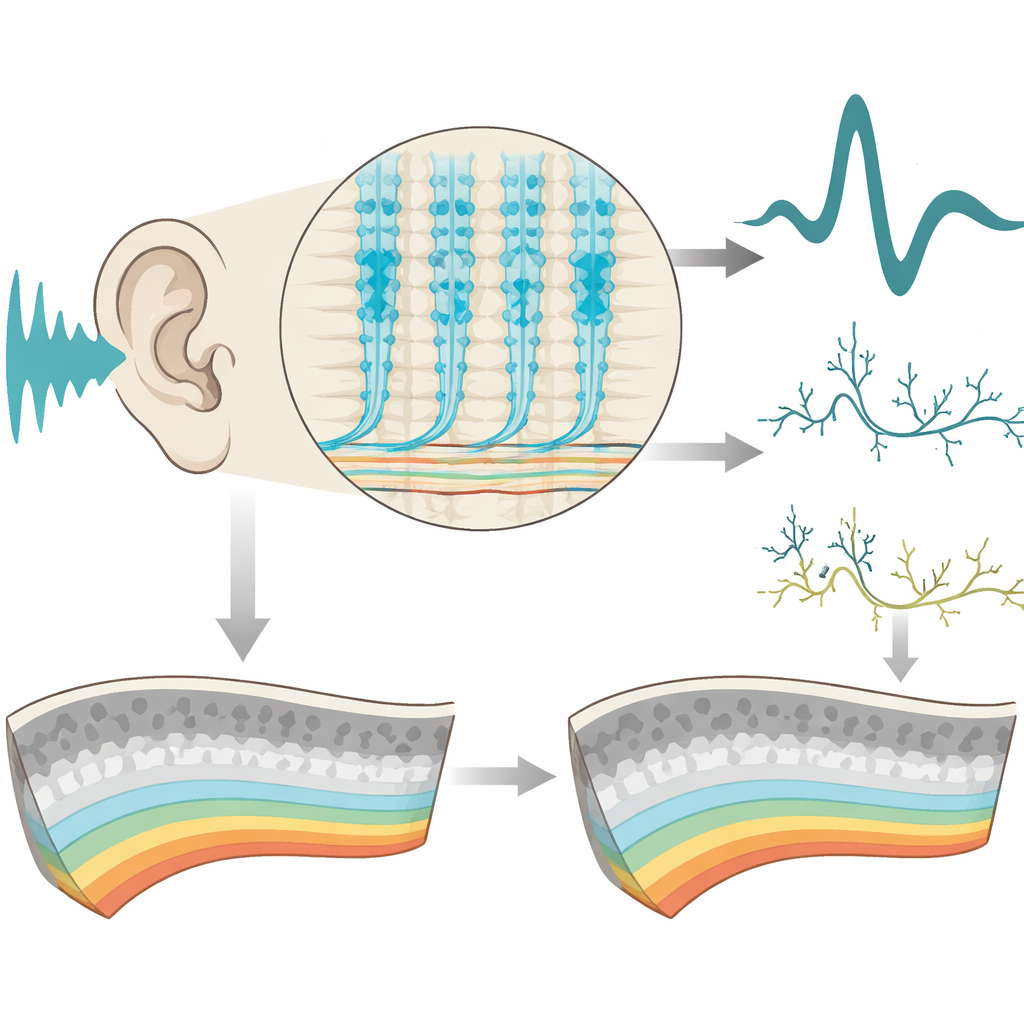
For non-specialists, the key message is that the brain’s first electrical response to sound is reduced in men with schizophrenia spectrum disorders, but this study did not find matching changes in a widely used MRI marker of tissue structure in the auditory cortex. This suggests that the early sound response and the fine wiring of the hearing center do not move in lockstep, at least not in a way that current MRI methods can easily detect. Other microscopic changes, such as subtle alterations in the branches of nerve cells or in deeper white matter pathways, may be more important. The work also highlights that men and women may show different patterns of brain changes in schizophrenia, an insight that could guide more tailored research and, eventually, more personalized treatments.
Citation: Slapø, N.B., Jørgensen, K.N., Nerland, S. et al. Relationship between N100 amplitude and T1w/T2w-ratio in the auditory cortex in schizophrenia spectrum disorders. Schizophr 12, 34 (2026). https://doi.org/10.1038/s41537-025-00715-w
Keywords: schizophrenia, auditory cortex, brain waves, myelination, sex differences