Clear Sky Science · en
Altered auditory seed-based functional connectivity in other specified schizophrenia spectrum and other psychotic disorder compared to schizophrenia spectrum disorders
Why this research matters
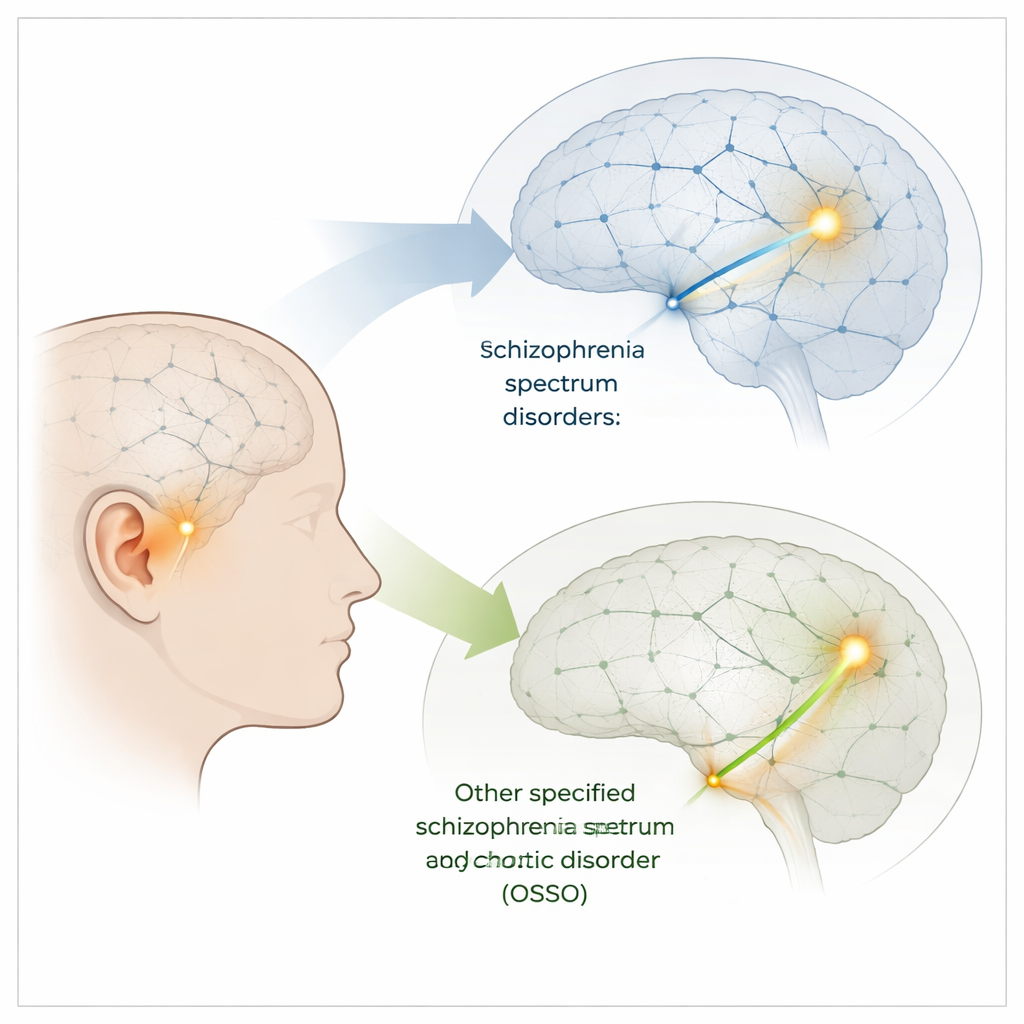
People with psychotic illnesses can hear voices or hold strong beliefs that others find puzzling, but not all psychotic disorders are the same. Doctors often struggle to tell whether someone with early or unusual symptoms will go on to develop full schizophrenia or will follow a different, often milder, course. This study uses brain-scanning techniques to see whether the "wiring" of the hearing system in the brain differs between classic schizophrenia and a lesser-known diagnosis called "other specified schizophrenia spectrum and other psychotic disorder" (OSSO). Understanding these differences may help clinicians offer more accurate diagnoses and more tailored treatments.
Two related but distinct conditions
OSSO is a diagnosis introduced in the current psychiatric manual to capture people who have clear psychotic symptoms, such as delusions (fixed false beliefs) or milder forms of hearing voices, but do not meet full criteria for schizophrenia. Historically, this group was labeled "psychotic disorder not otherwise specified" and often treated as a temporary or catch‑all diagnosis. Yet follow-up studies suggest that many people with these symptoms do not progress to schizophrenia and generally have better outcomes. The authors focused on two relatively stable OSSO subtypes: people with pure delusions and people with delusions plus only attenuated, or less intense, auditory hallucinations. They compared them with patients who clearly met criteria for schizophrenia spectrum disorders and experienced prominent hearing of voices.
Listening to the resting brain
To probe brain function, the researchers used resting-state functional MRI, which tracks slow, spontaneous activity across the brain while a person lies quietly in the scanner. Rather than asking participants to perform tasks, this method measures how strongly different regions "talk" to one another over time, a concept known as functional connectivity. The team concentrated on five key hubs in the brain's hearing system: regions along the side of the temporal lobe that help detect sounds, process speech and meaning, and link sounds to emotion and memory. They examined how activity in these auditory hubs was synchronized with every other part of the brain, and how this differed in 88 patients with OSSO, 81 with schizophrenia spectrum disorders, and 85 healthy volunteers of similar age, sex, and education.
Shared listening problems, different brain partners
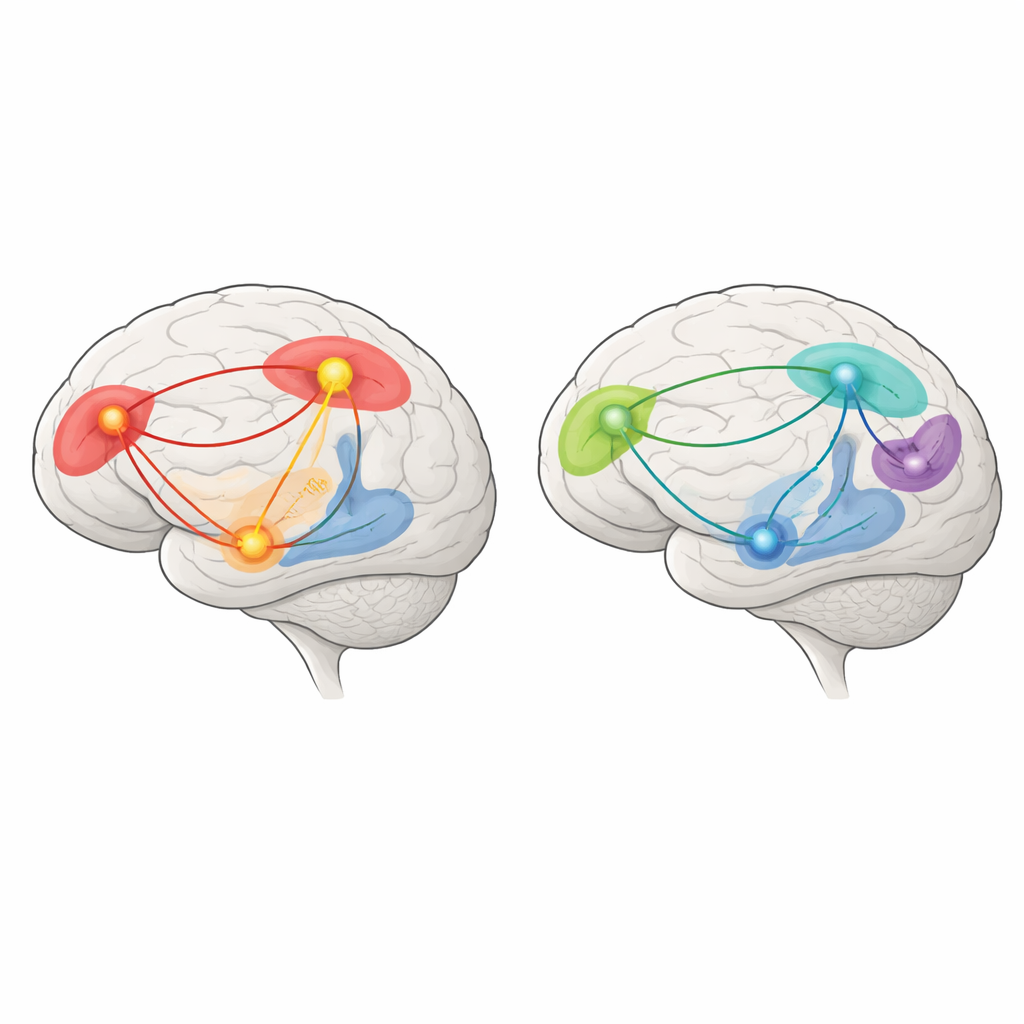
Both patient groups showed a broad reduction in connectivity between auditory hubs and many other regions compared with healthy volunteers, suggesting a common disturbance in how sound-related information is integrated across the brain. At the same time, one auditory region, the middle temporal gyrus, showed stronger than normal links to certain deep and back-of-the-brain structures, hinting at compensatory or maladaptive changes. The clearest difference between OSSO and schizophrenia emerged in connections involving the superior temporal gyrus and the temporal pole—areas heavily involved in hearing, language, and social meaning—and a midline region called the precuneus, which is part of the brain's "default mode" network that supports self-awareness and internal thoughts. In people with schizophrenia, these hearing and temporal regions were more strongly coupled to the precuneus than in OSSO, pointing to a tighter link between what is heard and internally focused, self-related processing.
Symptoms and brain wiring go hand in hand
The study also linked specific connectivity patterns to patients' symptoms. In OSSO, more severe hallucinations were associated with stronger communication between a deep emotional region (the insula) and a movement-related structure (the putamen), while stronger links between temporal and insula regions tended to accompany fewer delusions and less severe negative symptoms such as emotional flatness. In schizophrenia, hallucination severity tracked with stronger ties between core hearing areas and between temporal and insula regions, whereas weaker links between hearing areas and the insula were tied to more pronounced negative symptoms. Within the broader hearing network, people with schizophrenia showed especially weak internal connections, reinforcing the idea that voices may arise when internally generated signals are misprocessed as coming from the outside world.
What this means for patients
Taken together, these findings suggest that OSSO is not simply a milder, early form of schizophrenia but has its own signature pattern of brain connectivity. Both groups share a general weakening of the hearing network, yet schizophrenia shows an added over-connection between auditory regions and self-focused brain hubs, while OSSO shows a different pattern involving regions that support meaning and emotion. Recognizing these distinct wiring patterns supports viewing OSSO as a separate clinical syndrome rather than just a vague placeholder diagnosis. In the future, brain-based measures of connectivity might help identify who is at higher risk of progressing to schizophrenia and guide targeted treatments—such as brain stimulation or specialized auditory training—that aim to normalize these disrupted circuits and, ultimately, reduce distressing experiences like voices and fixed false beliefs.
Citation: Kim, WS., Odkhuu, S., Jeon, EJ. et al. Altered auditory seed-based functional connectivity in other specified schizophrenia spectrum and other psychotic disorder compared to schizophrenia spectrum disorders. Schizophr 12, 33 (2026). https://doi.org/10.1038/s41537-025-00708-9
Keywords: schizophrenia, psychosis, auditory hallucinations, functional connectivity, resting-state fMRI