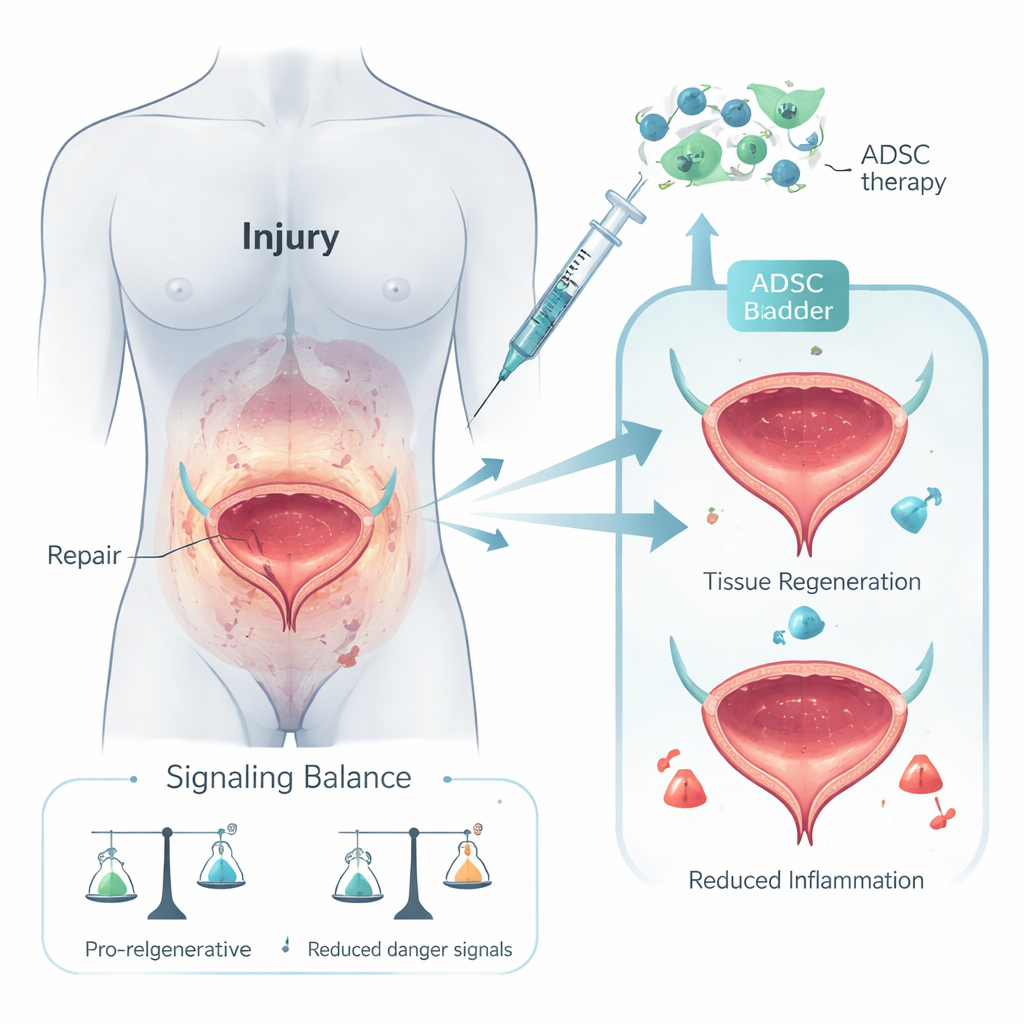
For many people with spinal cord injury, multiple sclerosis, diabetes, or nerve damage after surgery, the bladder stops working properly. This condition, called neurogenic bladder, can cause constant leaking, dangerous urine retention, infections, and a heavy hit to quality of life. Current drugs and devices help some symptoms but do not actually repair the damaged bladder tissue. This study explores whether a patient’s own fat-derived stem cells, specially tuned through a molecule called CD73, could both rebuild the bladder wall and calm damaging inflammation in an animal model.
Stem cells as tiny repair crews
The researchers focused on adipose-derived stem cells (ADSCs), which are abundant in body fat and already being explored for tissue repair. These cells can release growth factors that support blood vessels, nerves, and muscle. The team separated ADSCs into those naturally carrying high levels of CD73 and those with little or none. CD73 is a surface protein that turns chemical signals into adenosine, a molecule known to protect tissues and regulate immune responses. The scientists then engineered a group of ADSCs to overproduce CD73 and compared them with regular cells in lab dishes and in rats with nerve injury–induced neurogenic bladder.
How boosted CD73 changes cell behavior Figure 1.
In cell culture tests, ADSCs with extra CD73 multiplied and migrated more vigorously than cells with low CD73. They also released more of two important signaling proteins, VEGF and SDF-1. VEGF is a growth factor that supports blood vessels and tissue repair, while SDF-1 helps attract stem cells to sites of injury. When CD73 was chemically blocked, these helpful signals dropped and cell growth slowed, showing that CD73 is a key upstream switch. The team found that CD73 turned on an internal growth pathway inside cells called PI3K/AKT/mTOR, which is known to support cell survival, energy balance, and rebuilding of damaged tissue.
Helping the injured bladder rebuild and refill
The scientists then tested their approach in rats whose pelvic nerves had been crushed to mimic human neurogenic bladder. Two weeks after injury, some rats received injections of low-CD73 ADSCs, some got regular ADSCs, and others received the engineered high-CD73 cells directly into the bladder wall. After four weeks, the animals treated with CD73-boosted cells showed much better bladder function: they could hold urine longer, had stronger yet more controlled contractions, and emptied more effectively. Tissue staining revealed thicker smooth muscle and less scarring in their bladder walls. The treated bladders also showed higher levels of CD73 and VEGF, matching the lab findings that these signals go hand in hand with repair.
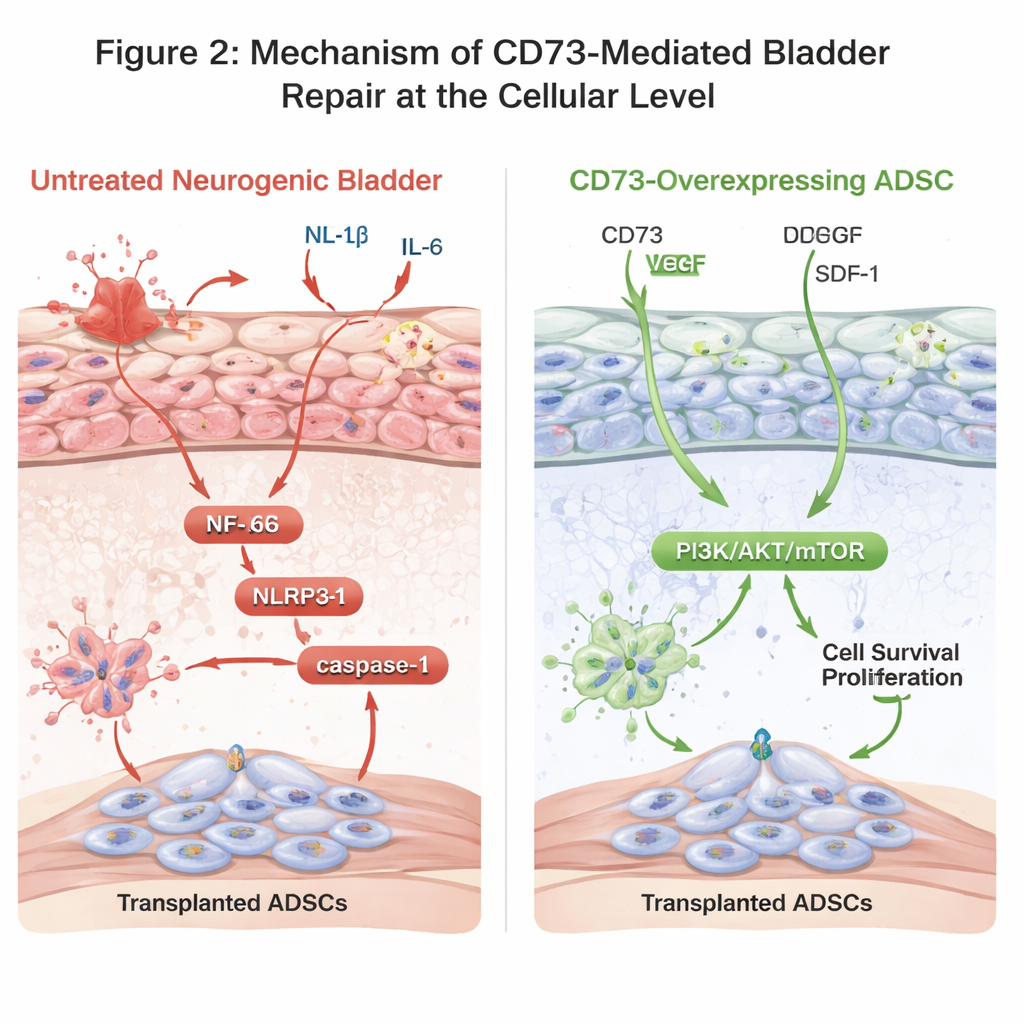
Turning down a fiery form of cell death Figure 2.
Neurogenic bladder is not just a mechanical problem; injured cells release inflammatory molecules such as IL-1β and IL-6 that can drive a fiery type of cell death called pyroptosis, further weakening the bladder wall. The study found that nerve-injured rat bladders had high activity of a danger-sensing chain known as the NFκB/NLRP3/caspase-1 axis, which promotes pyroptosis and inflammation. CD73-overexpressing ADSCs largely reversed this pattern. Bladders from treated rats had fewer dying cells, lower levels of NLRP3 and caspase-1, and reduced IL-1β and IL-6. At the same time, CD73 increased SDF-1 and its receptor CXCR4, helping more stem cells home in to and remain within the damaged bladder, where they could continue to support repair.
What this could mean for future treatments
Taken together, the findings suggest that enhancing CD73 in fat-derived stem cells gives them a powerful one-two punch: they boost growth and rebuilding pathways while dialing down destructive inflammation and pyroptosis. In the rat model, this dual action translated into stronger bladder muscles and better urine storage and emptying. Although much work remains—especially to confirm long-term safety, refine cell delivery methods, and bridge differences between rats and humans—the study points toward a future therapy in which a patient’s own modified stem cells could help restore bladder function rather than just manage its symptoms.
Citation: Zhu, G., Zhang, R., Huang, J. et al. CD73 overexpression in ADSCs accelerates bladder repair by regulating the NFκB/NLRP3/caspase-1 signaling axis in neurogenic bladder rats.
npj Regen Med11, 10 (2026). https://doi.org/10.1038/s41536-026-00454-1