Clear Sky Science · en
Unraveling quantum dephasing of nitrogen-vacancy center ensembles in diamond
Diamonds as ultra-sensitive field detectors
Imagine a sensor so small it can sit on the tip of a needle and still detect magnetic fields a billion times weaker than a fridge magnet. This is the promise of tiny atomic-scale defects in diamond, called nitrogen-vacancy (NV) centers. They behave like quantum compasses and are already being used to study brain activity, exotic new materials, and even single protein molecules. But to turn them into practical devices for medicine, geology, or fundamental physics, scientists must overcome one stubborn barrier: the fragile quantum states of these defects lose their memory too quickly. This paper tackles that problem head-on, dissecting exactly what scrambles the quantum behavior of NV centers in bulk diamond and how to tame it.
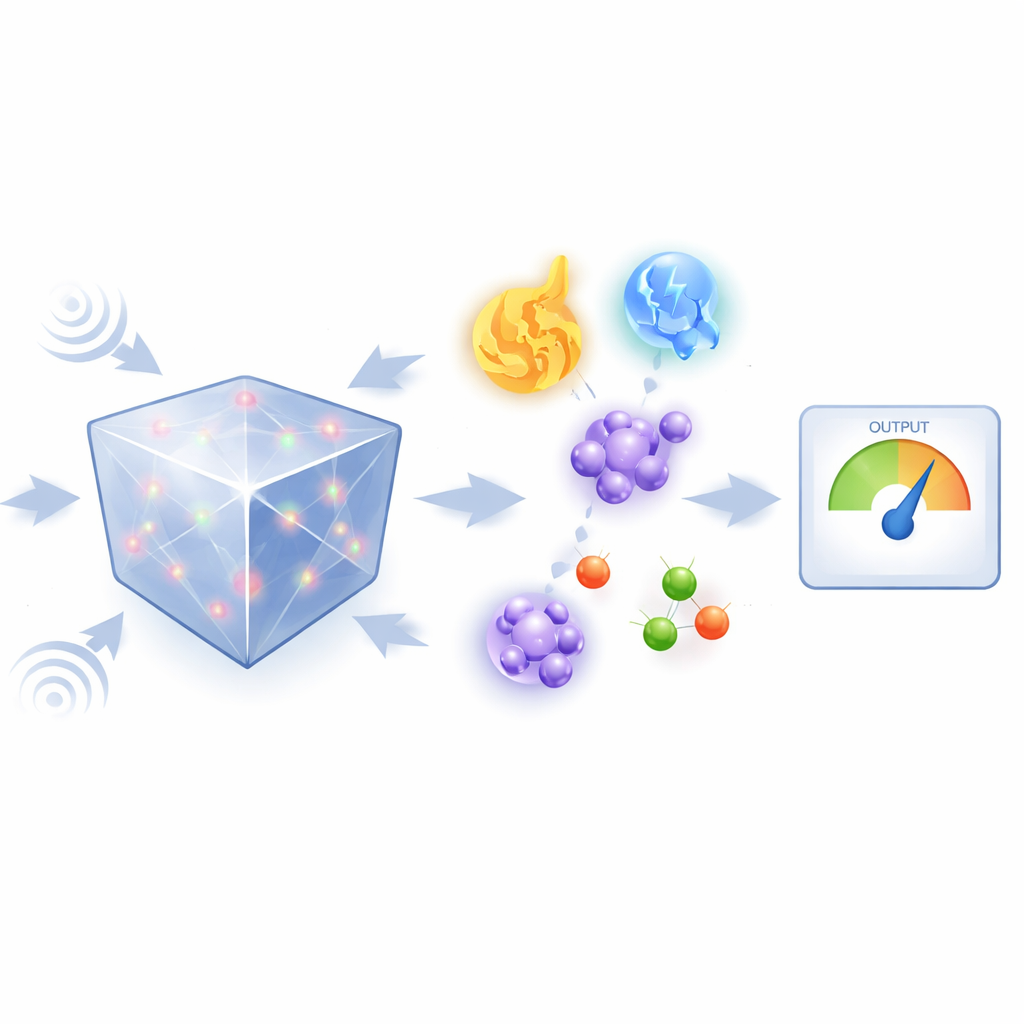
How tiny defects turn diamond into a quantum sensor
NV centers form when a carbon atom in the diamond lattice is replaced by a nitrogen atom and an empty site appears next to it. The unpaired electrons at this defect act like a tiny spinning top whose direction can be controlled and read out with laser light and microwaves. When many such NV centers are packed into a small diamond volume, their combined signal can reveal minuscule magnetic fields with high spatial resolution. The catch is that these spins gradually lose their well-defined orientation – a process called dephasing – which limits how long the sensor can integrate a signal and therefore how sensitive it can be. To get the best performance, one must pack many NV centers close together without causing them to disturb each other too much.
Tracking down every source of quantum “blur”
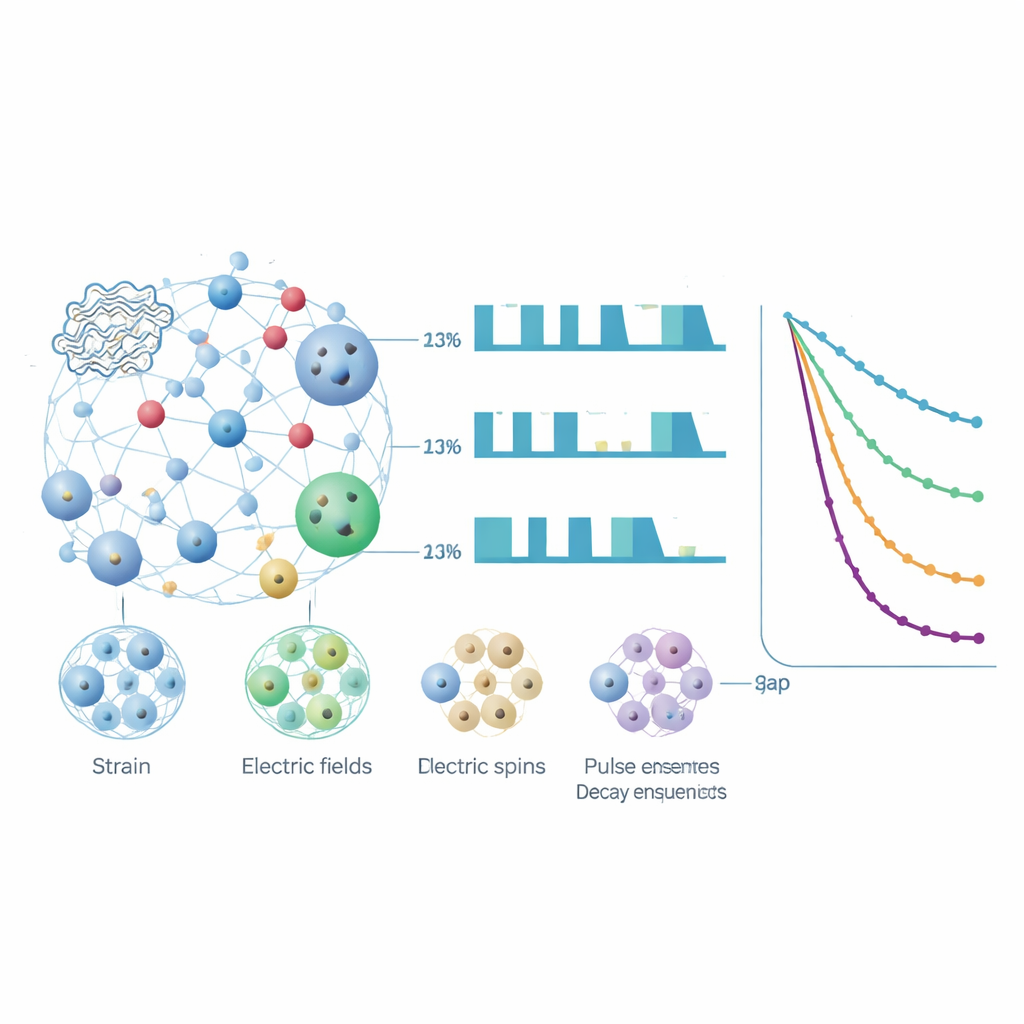
The authors develop a systematic way to separate and quantify all the main culprits that shorten the NV centers’ dephasing time. They identify four dominant categories: distortions in the diamond lattice (strain) and fluctuating electric fields, the random magnetic fields from nearby nuclear spins of carbon-13 atoms, unpaired electron spins from nitrogen impurities known as P1 centers, and mutual interactions between NV centers themselves. Using a toolkit of sophisticated pulse sequences – variations of Ramsey, echo, and dynamical decoupling measurements – they design experiments that selectively pick out each contribution. For example, special “double-quantum” and strain-sensitive sequences distinguish effects that depend on electric fields and strain from those that depend on magnetic fields, while double electron–electron resonance sequences isolate the influence of P1 spins.
What the diamonds reveal across many samples
To test their approach, the team examines eleven high-quality diamond samples grown by two different methods and processed under various irradiation and annealing conditions. By carefully fitting the observed decay curves, they extract how much each type of noise contributes to the overall dephasing rate. They find that in natural diamonds, nuclear spins from carbon-13 dominate and can limit coherence times to below a microsecond. In isotopically purified diamonds, the main troublemakers shift to electron spins from P1 defects and the NV centers themselves. Strain in the crystal turns out to be highly sample-dependent but does not track NV concentration, whereas electric-field noise does correlate strongly with how many NV centers and donors are present. From the measured NV–NV interaction strengths, they also obtain accurate NV concentrations, which are crucial for estimating the ultimate sensitivity of each sample.
Design rules for better quantum magnetometers
By comparing all samples, the authors map out how the dephasing rate scales with NV density and initial nitrogen content. They show that for the best current crystals, the product of NV density and coherence time already reaches a level where sensitivities of a few picotesla per square root hertz should be possible for a tiny diamond chip. They then use their breakdown of noise sources to chart a path forward: grow diamonds with even lower strain, further reduce residual P1 centers without creating new defects, and apply advanced control techniques that simultaneously suppress strain noise, spin-bath noise, and NV–NV interactions. Combining double-quantum sensing, active driving of the surrounding spins, and special pulse sequences designed to cancel dipolar couplings could extend coherence by at least a factor of four over today’s best ensemble samples.
Why this matters for future sensing technologies
For non-specialists, the key outcome is that the authors provide a detailed “budget” of what spoils quantum memory in real diamonds and demonstrate practical ways to measure and control each part. Their results indicate that with realistic improvements in crystal growth and pulse control, diamond magnetometers could push into the sub-picotesla regime while still offering millimeter or even micrometer spatial resolution – rivaling the best atomic magnetometers but in a compact, solid-state platform. That would open doors to new forms of brain and heart imaging, searches for exotic physics, and precision studies of magnetic behavior in advanced materials, all powered by tiny quantum defects embedded in an everyday gemstone.
Citation: Zhang, J., Cheung, C.K., Kübler, M. et al. Unraveling quantum dephasing of nitrogen-vacancy center ensembles in diamond. npj Quantum Mater. 11, 27 (2026). https://doi.org/10.1038/s41535-026-00869-5
Keywords: nitrogen-vacancy centers, diamond magnetometry, quantum sensing, spin dephasing, solid-state qubits