Clear Sky Science · en
Superconductivity induced by spin-orbit coupling in a two-valley ferromagnet
Why this strange state of graphene matters
Graphene, a one-atom-thick sheet of carbon, keeps revealing new electronic tricks, from unusual magnetism to superconductivity—electric currents that flow without resistance. This paper explores a particularly surprising combination: a form of superconductivity that appears inside a strongly magnetic state of multilayer graphene placed on a material that twists the electrons’ spins. Understanding how these effects cooperate, rather than compete, could guide the design of new devices that switch superconductivity on and off using electric and magnetic controls.
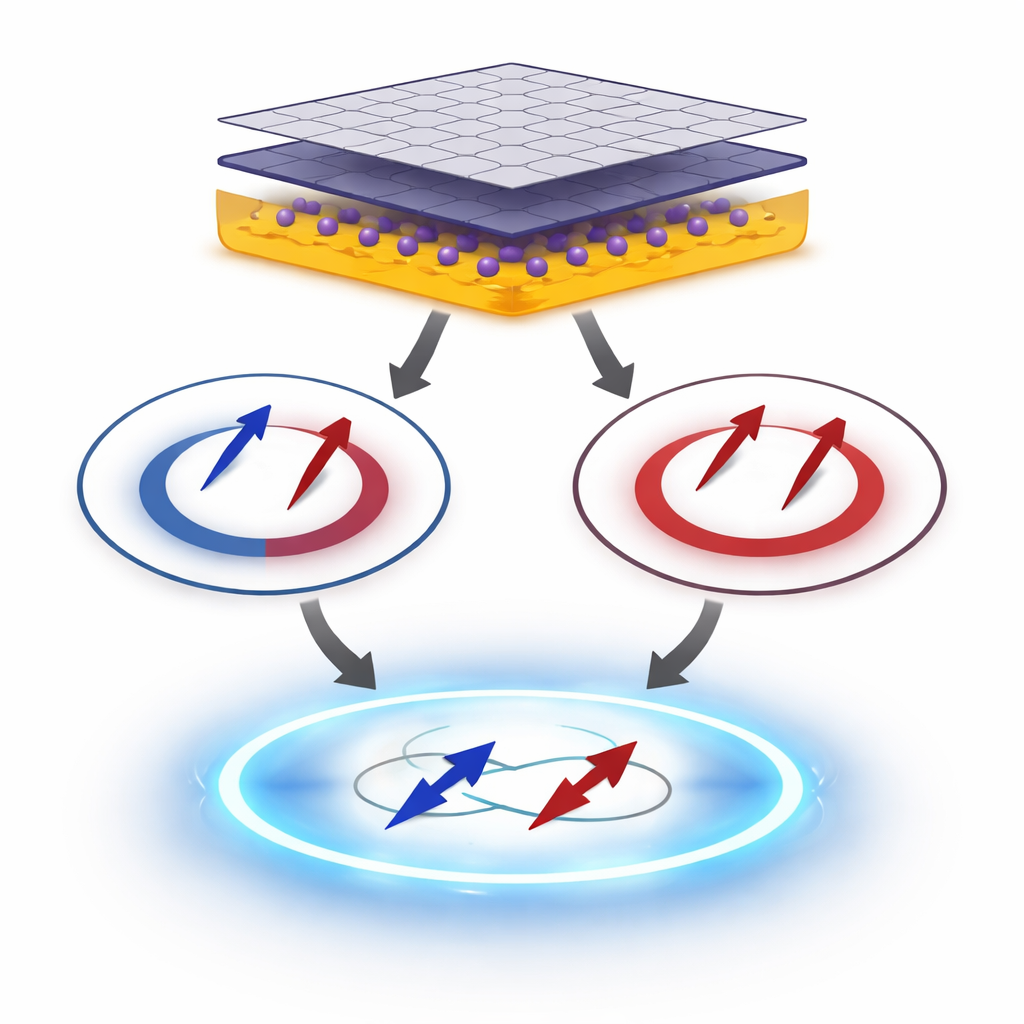
Stacking graphene on a spin-twisting base
The authors focus on Bernal and rhombohedral multilayer graphene sheets encapsulated and placed on top of a tungsten diselenide (WSe2) substrate. Experiments have shown that in such devices, an electric field and charge doping can tune the system into regimes where superconductivity and magnetism coexist, with the superconducting transition temperature markedly higher than in similar samples without WSe2. The key role of WSe2 is to induce an "Ising" type of spin–orbit coupling: electrons near the two valleys (distinct momentum regions labelled K and K′ in the graphene band structure) feel opposite effective magnetic fields that pin their spins in opposite out-of-plane directions. This valley-dependent spin twisting sets the stage for an unusual magnetic order and for a special kind of electron pairing.
From canted magnet to half-metal
In the theoretical model, electrons live in two valleys with initially four equivalent bands—one for each spin and valley. Repulsive interactions between electrons, together with the valley-opposite spin–orbit effect, drive the system into a “canted ferromagnet.” In this state, the spins develop a common in-plane component (a ferromagnetic order) while also retaining an out-of-plane polarization of opposite sign in the two valleys. The result is a half-metal: only one spin projection at low energy forms a Fermi surface, while the opposite spin states are pushed to higher energies and become effectively absent at the Fermi level. Despite this spin polarization, the continuous spin symmetry in the plane is still broken, giving rise to low-energy spin waves, or magnons, which are collective ripples of the ordered spins.
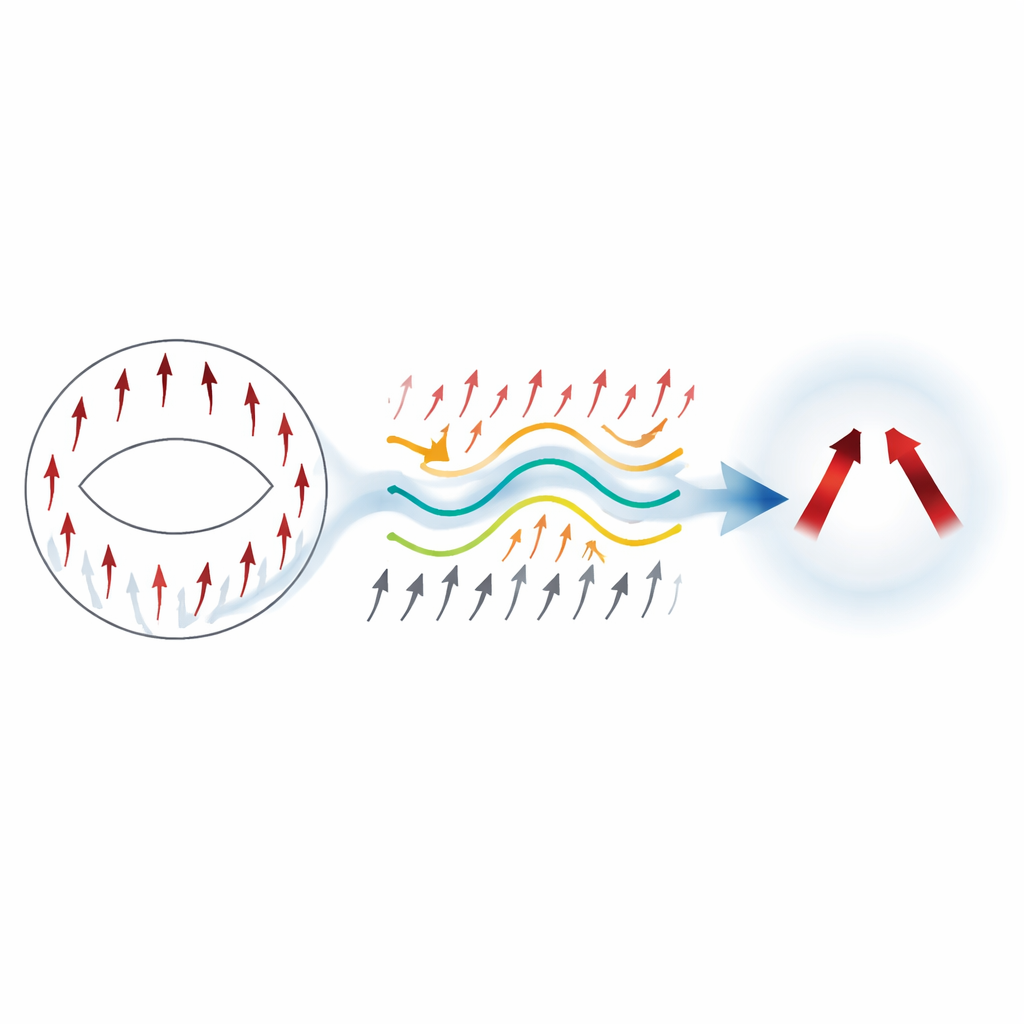
How spin waves glue electrons together
The central question is whether these magnons can mediate an effective attraction between the remaining majority-spin electrons and thereby cause superconductivity. In many antiferromagnets, where both spin species remain near the Fermi surface, previous work has shown that spin waves can contribute to pairing, but subtle conservation rules (Adler’s principle) strongly constrain the interaction. Here, the situation is different: in a true half-metal, a single magnon always flips spin and therefore cannot keep both initial and final electrons on the Fermi surface. The authors show that to obtain a meaningful pairing force, one must treat on equal footing two types of processes: single-magnon spin-flip scatterings taken to second order, and processes in which two magnons are exchanged while the electron spins are preserved overall. When all such contributions are combined carefully, the resulting effective interaction between low-energy majority-spin electrons respects Adler’s principle yet includes a universal attractive part that exists only because of spin–orbit coupling.
A narrow window where attraction wins
The analysis reveals that this attractive magnon-mediated interaction is strongest when the system is tuned very close to the onset of the canted ferromagnetic state. In that narrow region, the magnon spectrum becomes effectively linear in momentum at low energies—a consequence of the reduced spin symmetry induced by spin–orbit coupling—and the two-magnon processes generate an attractive pairing strength that can overwhelm the direct repulsive interaction between electrons in different valleys. The resulting superconducting state has equal-spin (spin-triplet) pairs, is antisymmetric between the two valleys, and remains spatially even, a combination dictated by the symmetry of the problem. Importantly, the attraction is confined to energies much smaller than the Fermi energy, while the repulsion acts over a broader range; renormalization effects further reduce the harmful impact of the repulsion at low energy, tipping the balance toward pairing.
What the theory says about experiments
Putting these pieces together, the paper concludes that in two-valley multilayer graphene on WSe2, superconductivity can naturally emerge inside the canted ferromagnetic phase, but only very close to its boundary. There, spin–orbit coupling reshapes the spin waves so that exchanging pairs of them effectively glues majority-spin electrons from opposite valleys into robust spin-triplet pairs. This framework provides a microscopic explanation for recent observations of relatively high-temperature superconductivity appearing just inside a magnetically ordered, nearly half-metallic regime in bilayer and trilayer graphene devices, and suggests that carefully tuning spin–orbit strength and magnetic proximity may be a powerful route to engineered superconducting states.
Citation: Raines, Z.M., Chubukov, A.V. Superconductivity induced by spin-orbit coupling in a two-valley ferromagnet. npj Quantum Mater. 11, 31 (2026). https://doi.org/10.1038/s41535-026-00864-w
Keywords: multilayer graphene, spin-orbit coupling, canted ferromagnetism, magnon-mediated pairing, spin-triplet superconductivity