Clear Sky Science · en
The influence of phonon symmetry and electronic structure on the electron-phonon coupling momentum dependence in cuprates
Listening to the Atoms in Superconductors
Why do some copper-based materials conduct electricity with zero resistance at unusually high temperatures? One long-standing mystery is how strongly the electrons in these “cuprate” superconductors talk to the vibrations of the crystal lattice, known as phonons. This paper shows how a powerful X-ray technique can map that conversation in detail, revealing that the pattern of atomic motion and the fine structure of the electrons both shape how strongly they interact.
How Light Reveals Atomic Vibrations
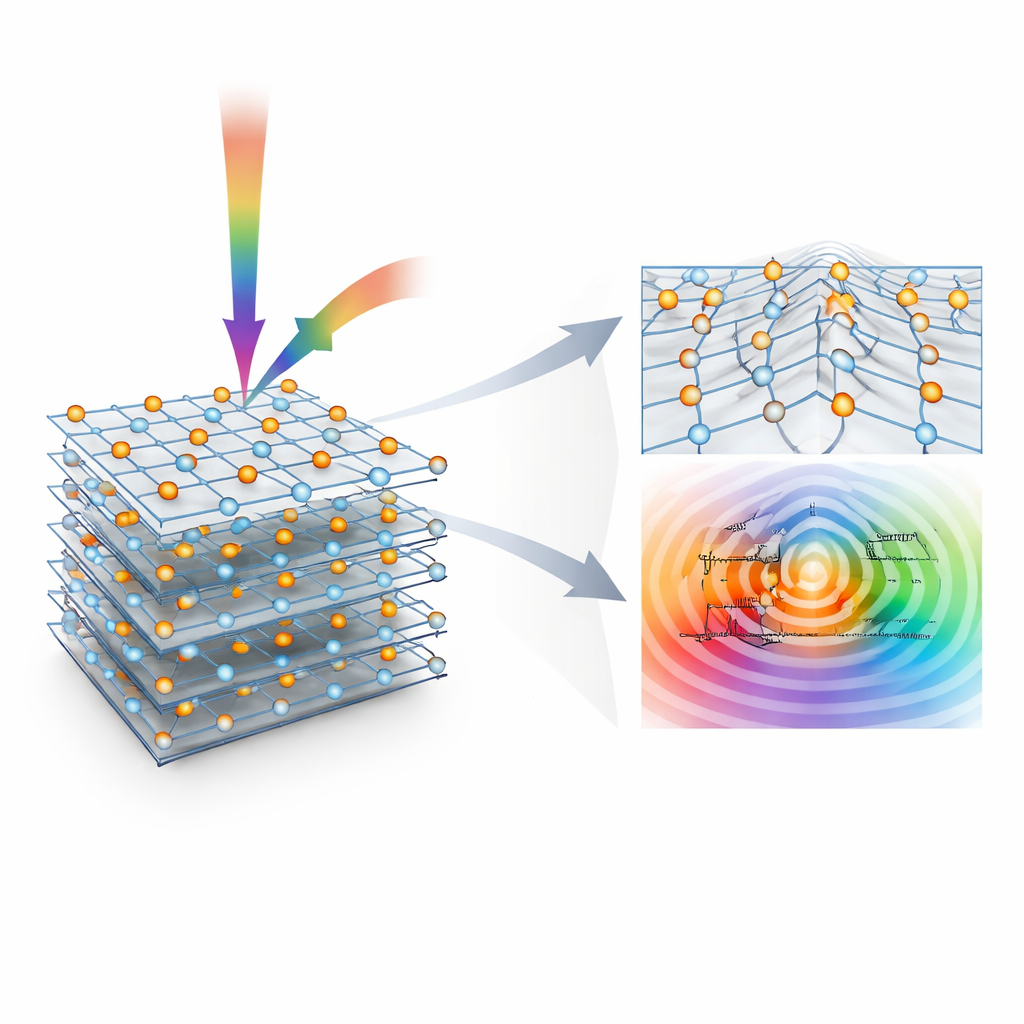
To probe the link between electrons and vibrations, the authors use resonant inelastic X-ray scattering, or RIXS. In this process, an incoming X-ray briefly promotes an electron from a deep core level on a copper atom to an empty state, creating a highly excited intermediate state. As the system relaxes, an X-ray is emitted with slightly less energy than it had before. The missing energy shows up as excitations left behind in the material: ripples of spin, charge, or lattice motion. By measuring precisely how much energy and momentum the X-ray loses, the researchers can pick out a specific high-frequency vibration in which the copper–oxygen bonds alternately stretch and compress along the copper–oxygen planes.
Focusing on a Key Lattice Vibration
Not all vibrations are created equal for superconductivity. The study concentrates on so‑called bond-stretching modes, where the distances between copper and neighboring oxygen atoms change in a breathing-like motion. These modes come in two main flavors: along the copper–oxygen bond direction, only two bonds expand and contract (a “half-breathing” motion), whereas at 45 degrees, all four bonds around a copper site participate (a “full-breathing” motion). Because these modes change the length of bonds that directly host the charge carriers, they are believed to couple particularly strongly to electrons and may influence phenomena such as charge ordering and the formation of superconducting pairs.
Measuring How Strongly Electrons and Vibrations Interact
The central challenge is to turn the intensity of the phonon peak in a RIXS spectrum into a quantitative measure of electron–phonon coupling strength. Building on a widely used theoretical framework, the team varies the energy of the incoming X-rays away from the copper resonance and tracks how the phonon signal weakens. The rate of this decay encodes how likely it is that an electron in the short-lived intermediate state has time to exchange energy with a lattice vibration. Applying this “detuning” method to three different undoped cuprates, they find very similar coupling strengths for the bond-stretching mode—about 0.15 to 0.17 electronvolts—suggesting a robust, material-independent baseline interaction within the copper–oxygen planes.
Mapping Directional Dependence Across the Crystal
Electron–phonon coupling is not the same in every direction of momentum space. By rotating and tilting the samples relative to the X-ray beam, the authors scan the phonon intensity along two high-symmetry directions within the copper–oxygen planes and around a circle of constant in-plane momentum. They observe that the coupling grows as one moves toward the edges of the Brillouin zone, but is systematically stronger along the copper–oxygen bond direction than along the diagonal. This anisotropy runs counter to the simplest tight-binding models, which average over the electronic states and predict a stronger interaction along the diagonal. When the researchers replace these simplified band structures with more detailed electronic states calculated by density functional theory, the predicted directional trends align much better with the data.
When Symmetry Matters More Than Details
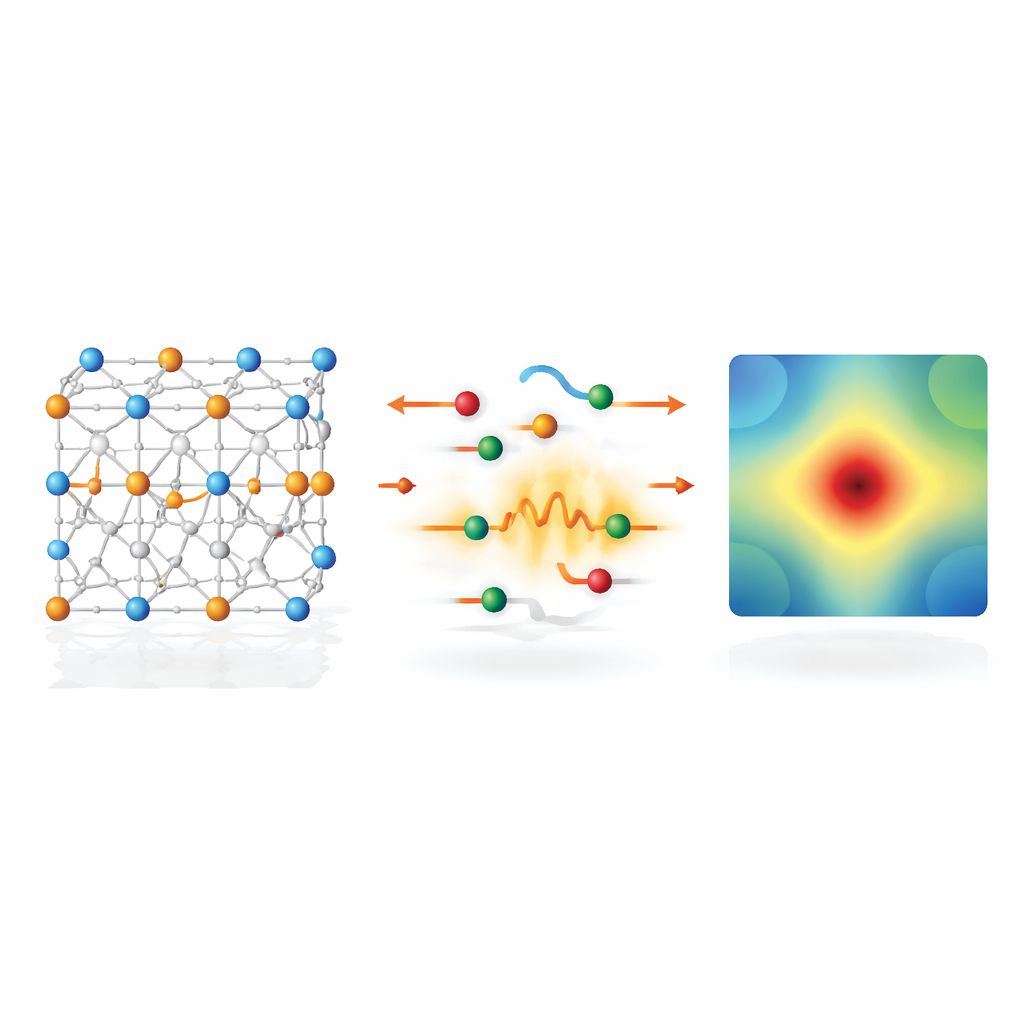
To disentangle the roles of phonon pattern and electronic structure, the team also constructs a deliberately stripped-down model that ignores the electrons almost entirely and focuses on how the local X-ray response of copper changes when the surrounding oxygens move. Remarkably, this “resonant form factor modulation” picture reproduces many features of the momentum dependence captured by more elaborate theories. It shows that the overall shape of the phonon intensity across momentum space is largely dictated by the symmetry of the breathing motion—specifically, by how strongly the oxygen displacements project onto the lobes of the copper orbitals that host the mobile electrons—while finer differences, such as the weaker coupling along the diagonal, require an accurate description of the electronic bands near the Fermi level.
What This Means for High-Temperature Superconductors
For non-specialists, the key message is that this work turns RIXS into a reliable “stethoscope” for listening to how electrons and atomic vibrations interact in cuprate superconductors across different momenta. The authors show that the bond-stretching vibrations couple to electrons with comparable strength in several families of cuprates, and that the way this coupling varies with direction is controlled both by the geometry of the vibration and by the detailed shape of the electronic states. Their extensive measurements and comparisons with theory set a stringent benchmark for future models that aim to explain high-temperature superconductivity, and clarify that any successful theory must treat electron–phonon interactions and electronic structure on equal, momentum-resolved footing.
Citation: Zinouyeva, M., Heid, R., Merzoni, G. et al. The influence of phonon symmetry and electronic structure on the electron-phonon coupling momentum dependence in cuprates. npj Quantum Mater. 11, 30 (2026). https://doi.org/10.1038/s41535-026-00863-x
Keywords: electron-phonon coupling, cuprate superconductors, resonant inelastic X-ray scattering, lattice vibrations, quantum materials