Clear Sky Science · en
Self-dressing Rydberg atomic receiver based on laser-induced DC field
Listening to Faint Signals with Clouds of Atoms
Our world quietly hums with very low-frequency radio waves, used for long-distance navigation, underground sensing, and underwater communication. Traditional antennas that pick up these slow waves must be physically large, which limits how small and portable receivers can be. This paper shows how a tiny glass-like cell filled with special "excited" atoms can act as an ultra-sensitive, matchbox-sized antenna for such weak, low-frequency signals, potentially reshaping how we detect and communicate with them.
Turning Atoms into Tiny Radio Antennas
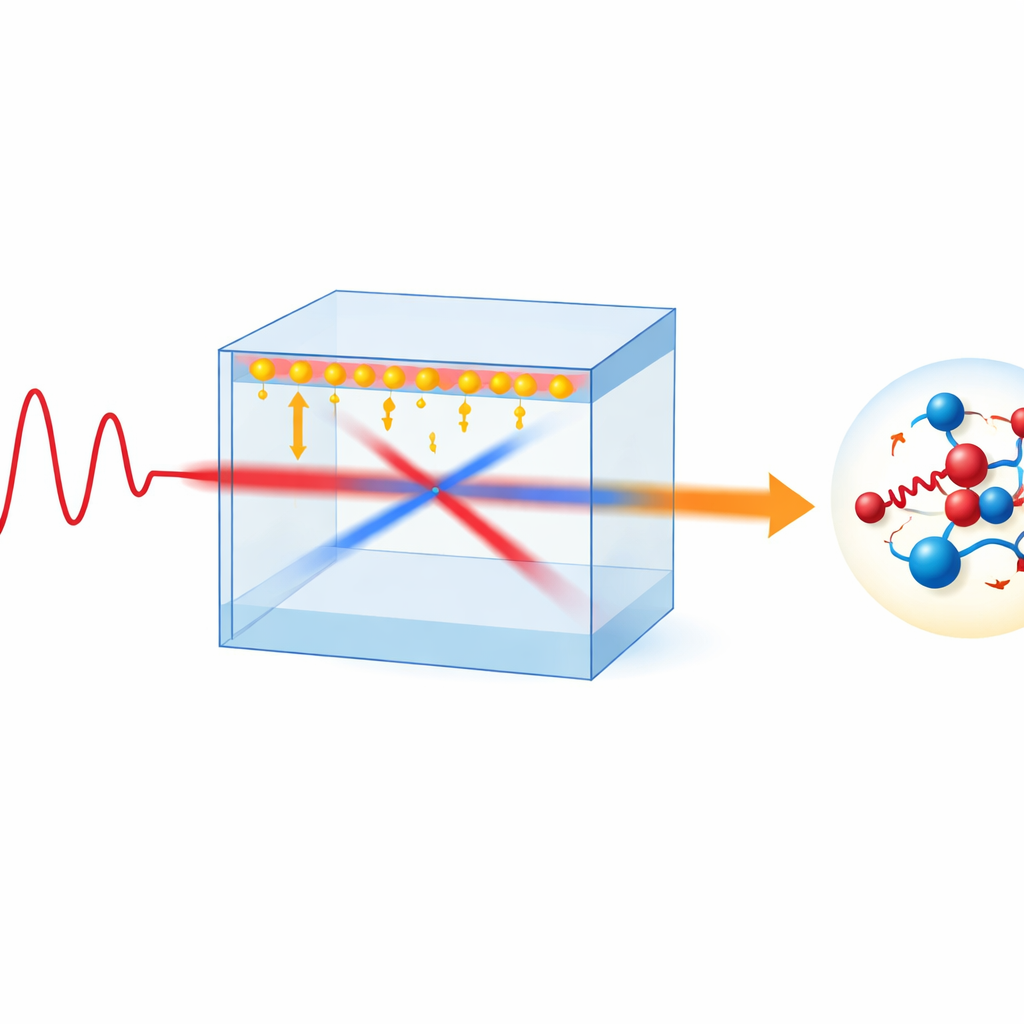
The researchers build their receiver from Rydberg atoms—atoms whose outer electron has been lifted far from the nucleus by laser light, making them extremely sensitive to electric fields. Two laser beams pass through a small cell of cesium vapor, preparing the atoms in a state where changes in electric field cause measurable changes in the light that emerges. In principle, this allows the atoms to sense radio waves from kilohertz (thousands of cycles per second) all the way up to terahertz. In practice, however, the lowest frequencies are the hardest: the inner walls of the usual glass cells develop a thin, conductive layer of alkali atoms that blocks slow-changing electric fields, so that by the time the wave reaches the atoms, only a tiny fraction remains.
Using Unwanted Fields as a Helpful Tool
Instead of trying to eliminate every stray electric field, the team finds a way to turn one of them into a powerful ally. When a green laser used to excite the atoms hits the inside wall of the cell, it can knock electrons loose and leave behind positive charges. In ordinary glass, these effects mostly worsen shielding. Here, the researchers switch to sapphire, a crystal whose surface chemistry suppresses the build-up of negative charges that would cancel the field. As a result, the laser creates a strong, stable internal electric field across the atoms. This so-called DC field "dresses" the atoms, shifting and splitting their energy levels. Under these conditions, a tiny oscillating field at kilohertz frequencies no longer produces only a feeble, second-order effect; instead, it produces a much larger, nearly linear response in the atoms that can be read out as a clear electrical signal from a photodetector.
Beating the Low-Frequency Wall
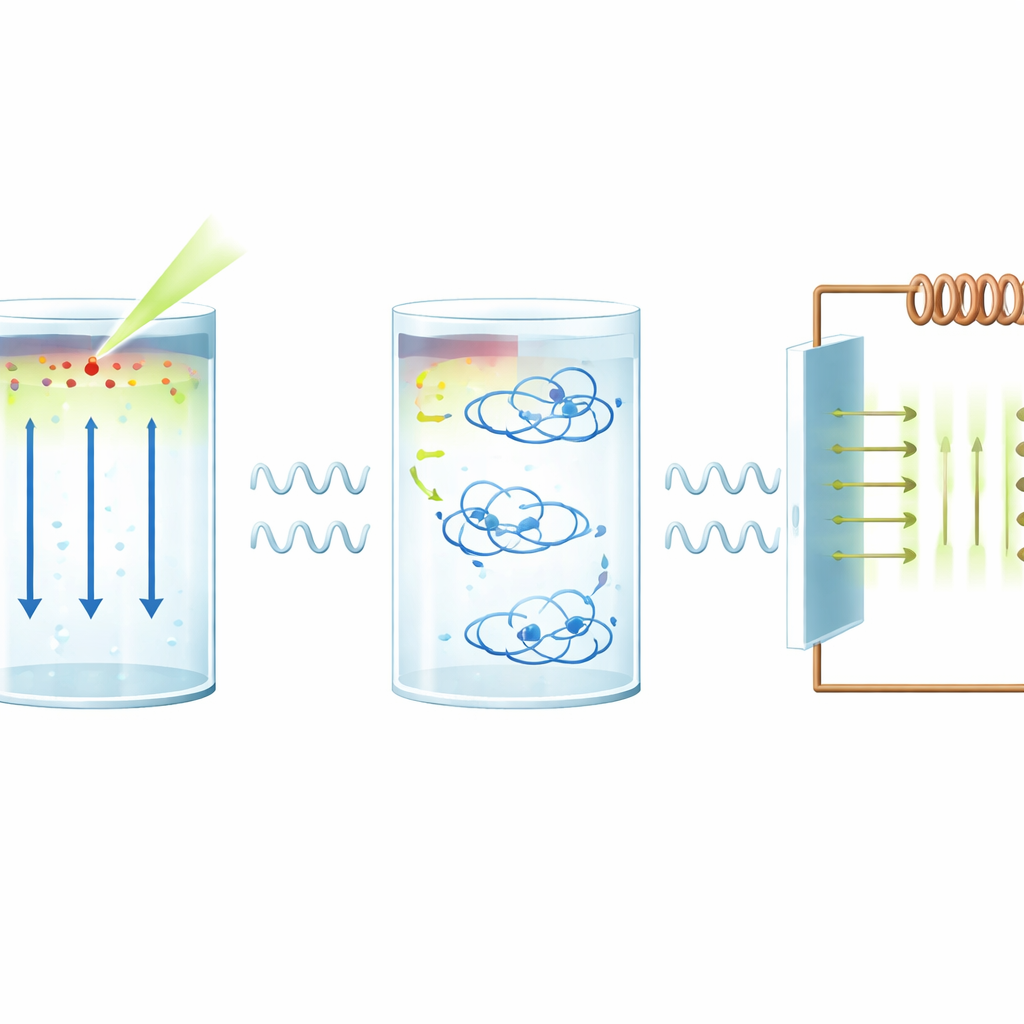
The authors carefully analyze how much of an external low-frequency field actually reaches the atoms by treating the cell walls as a thin, resistive shell. They show that glass cells strongly suppress kilohertz fields, while sapphire cells with reduced surface adsorption allow far more of the field to penetrate. By measuring how the atomic response changes with frequency, they extract a "shielding factor" that describes how fast charges on the walls rearrange to cancel external fields. Experiments confirm that in the sapphire cell, the self-generated DC field from the laser greatly improves the atoms’ ability to follow slow signals, and avoids the extra shielding that arises when bright light-emitting diodes are used to create internal fields.
Boosting Weak Waves with a Compact Resonator
To push sensitivity even further, the team surrounds the vapor cell with a specially designed resonant structure tuned to kilohertz frequencies. A coil and a set of metal plates form an electrical circuit that naturally amplifies fields at a chosen frequency, concentrating them between the plates where the atoms sit. Because kilohertz wavelengths are so long, conventional half-wave antennas would be enormous; instead, this compact coil-and-plate design plays the same role in a tiny footprint. Tests inside a shielded box show that, with this structure, the atomic receiver can detect fields as small as a few tens of nanovolts per centimeter—far below the typical background noise in open space—at both 20 kHz and 100 kHz.
What This Means for Future Sensors
In everyday terms, the researchers have taught a small cloud of atoms to act like a self-amplifying, miniaturized radio receiver for very low-frequency signals. By changing the wall material to sapphire and cleverly using a laser-induced field that was once seen as a nuisance, they overcome a fundamental shielding problem and then add a compact resonant structure to boost the tiniest waves. The result is an ultra-sensitive, centimeter-scale sensor that could eventually aid long-range navigation, underwater communication, and subsurface exploration, all while pointing the way toward even smaller, more capable quantum-based receivers.
Citation: Zhang, J., Sun, Z., Yao, J. et al. Self-dressing Rydberg atomic receiver based on laser-induced DC field. npj Quantum Mater. 11, 28 (2026). https://doi.org/10.1038/s41535-026-00862-y
Keywords: Rydberg atom sensors, low-frequency radio detection, quantum receivers, sapphire vapor cells, ultra-sensitive electrometry