Clear Sky Science · en
Robust magnetic polaron percolation in the antiferromagnetic CMR system EuCd2P2
Why tiny magnets matter for future tech
Electronic gadgets increasingly rely on not just the charge of electrons, but also their magnetic “spin.” Materials whose electrical resistance can be dramatically changed by a magnetic field are prime candidates for new memory chips and sensitive sensors. This paper explores such behavior in a crystalline compound called EuCd2P2 and shows that its spectacular response to magnetic fields comes from miniature magnetic islands that form and link up inside the material.
A crystal with an unusual magnetic trick
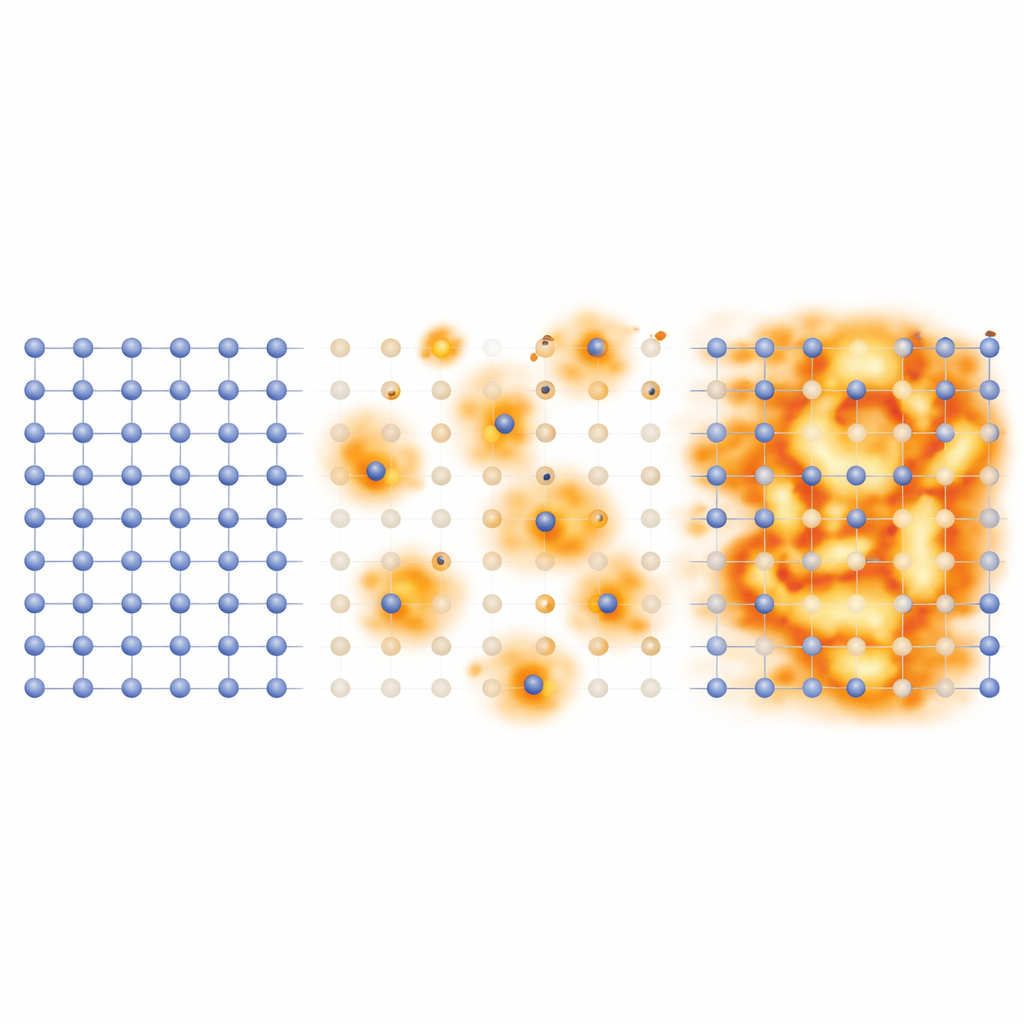
EuCd2P2 belongs to a family of quantum materials where electrons move sluggishly and their magnetic moments strongly interact. At very low temperatures it orders in an antiferromagnetic pattern: neighboring spins alternate up and down so that, overall, the magnetism cancels out. Surprisingly, despite this antiferromagnetic ground state, EuCd2P2 shows colossal magnetoresistance—its electrical resistance can drop by more than a factor of a thousand when a magnetic field is applied. The central question the authors tackle is: what microscopic process turns a fairly insulating crystal into a good conductor under a magnetic field, even before full magnetic order sets in?
Islands of magnetism inside an uneven sea
By carefully growing and comparing two single crystals with different levels of mobile charge carriers, the researchers found a common pattern. As the temperature falls from room temperature, the resistance rises like that of a semiconductor and then peaks just above the antiferromagnetic ordering temperature. At the same time, magnetic measurements and Hall effect data reveal that the electronic system becomes uneven: instead of a uniform medium, it breaks into regions with different magnetic behavior. In these regions, called magnetic polarons, an itinerant charge carrier locally aligns many surrounding spins, creating a tiny ferromagnetic island embedded in an antiferromagnetic sea.
Listening to fluctuations and following current paths
To see how these islands affect transport, the team used noise spectroscopy and weakly nonlinear electrical measurements, which are very sensitive to inhomogeneity. Near the temperature where resistance peaks, the low-frequency resistance noise swells by more than two orders of magnitude, and a strong third-harmonic signal appears in the voltage response. Both are classic signatures of percolation: current is forced through a patchy network where only some regions conduct well. In EuCd2P2, applying a magnetic field suppresses both the noise and the nonlinearity at the same time it makes the material more conductive, indicating that the same process—growth and connection of ferromagnetic clusters—controls the colossal magnetoresistance.
Probing hidden magnetism with implanted muons
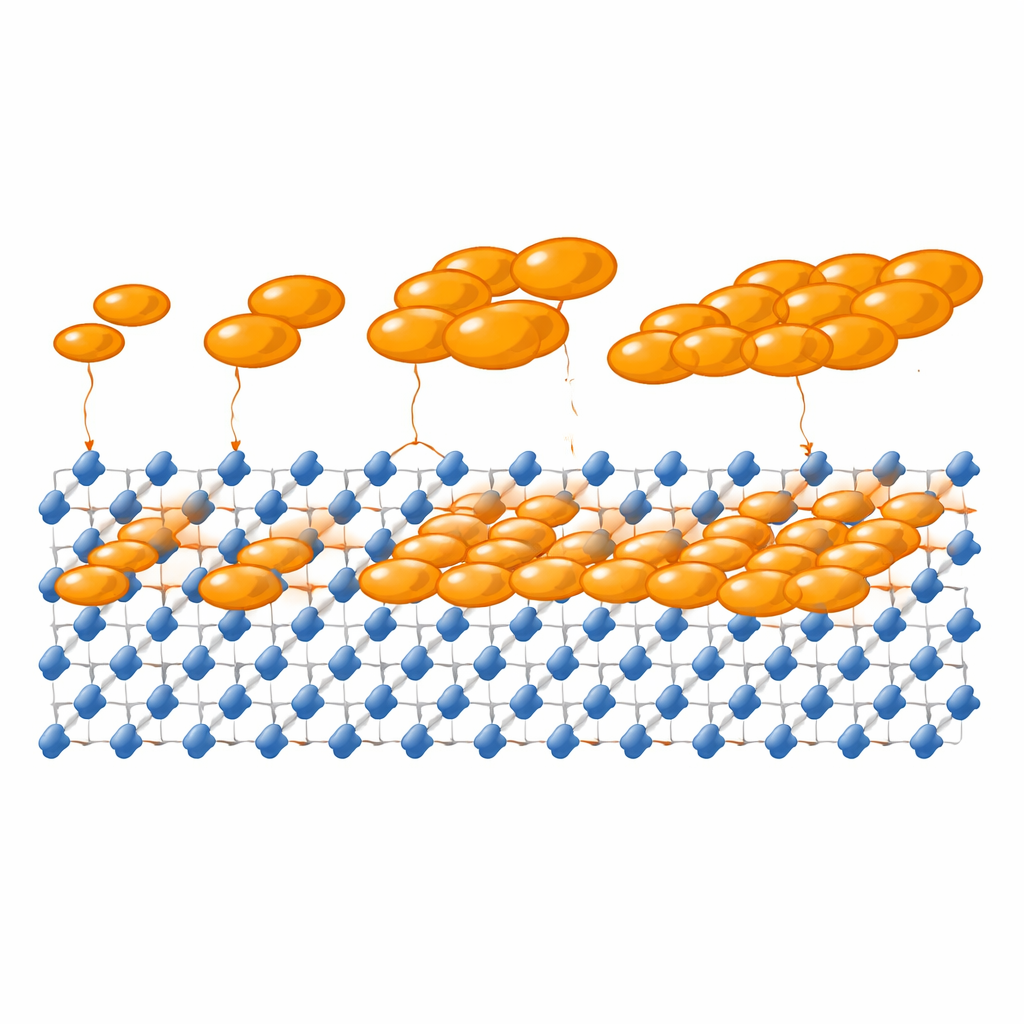
Muon-spin relaxation experiments, which detect tiny local magnetic fields using implanted elementary particles as probes, add a microscopic view of the magnetism. Below the ordering temperature, most of the sample shows long-range antiferromagnetic order, but a substantial minority volume displays much faster magnetic fluctuations, consistent with regions near ferromagnetic clusters or domain walls. Above the ordering temperature yet below roughly twice that temperature, the muons sense rapidly fluctuating local fields that weaken sharply at a characteristic crossover temperature. This crossover coincides with the onset of strong magnetoresistance and with changes in electronic noise, tying the magnetic dynamics directly to the formation and percolation of magnetic polarons.
A network of nanoscale magnets as the main actor
Putting all the evidence together, the authors propose that, on cooling, magnetic polarons in EuCd2P2 start to form at relatively high temperatures, grow in size, and eventually overlap to create continuous ferromagnetic pathways through the crystal. Around the temperature where the resistance peaks, these pathways first percolate, so that a small increase in magnetic field dramatically improves connectivity and slashes the resistance. From the strength of the nonlinear signals and known theoretical models, the characteristic size of these polarons near the percolation threshold is estimated to be on the order of 6–10 nanometers. Even when the background spins settle into an antiferromagnetic pattern at lower temperatures, the frozen ferromagnetic clusters remain and continue to influence transport. The work thus establishes dynamic magnetic polaron percolation within an antiferromagnetic matrix as the microscopic origin of colossal magnetoresistance in EuCd2P2, offering a unified picture for similar Eu-based semiconductors that could inform future spintronic devices.
Citation: Kopp, M., Garg, C., Krebber, S. et al. Robust magnetic polaron percolation in the antiferromagnetic CMR system EuCd2P2. npj Quantum Mater. 11, 22 (2026). https://doi.org/10.1038/s41535-026-00859-7
Keywords: colossal magnetoresistance, magnetic polarons, antiferromagnetic semiconductors, spintronics, quantum materials