Clear Sky Science · en
Band-selective plasmonic polaron in thermoelectric semimetal Ta2PdSe6 with ultra-high power factor
Why a curious reader should care
Turning waste heat into useful electricity is a long-standing dream for cleaner energy. Devices called thermoelectrics can already do this, but most known materials only work well at high temperatures or are costly and inefficient. This study examines an unusual crystal, Ta2PdSe6, that breaks the rules by behaving like a metal and yet delivering an extraordinarily strong thermoelectric response at low temperatures. Understanding how it does this could open up a new class of efficient, compact power sources and coolers for electronics and sensors.
A material that looks like the wrong candidate
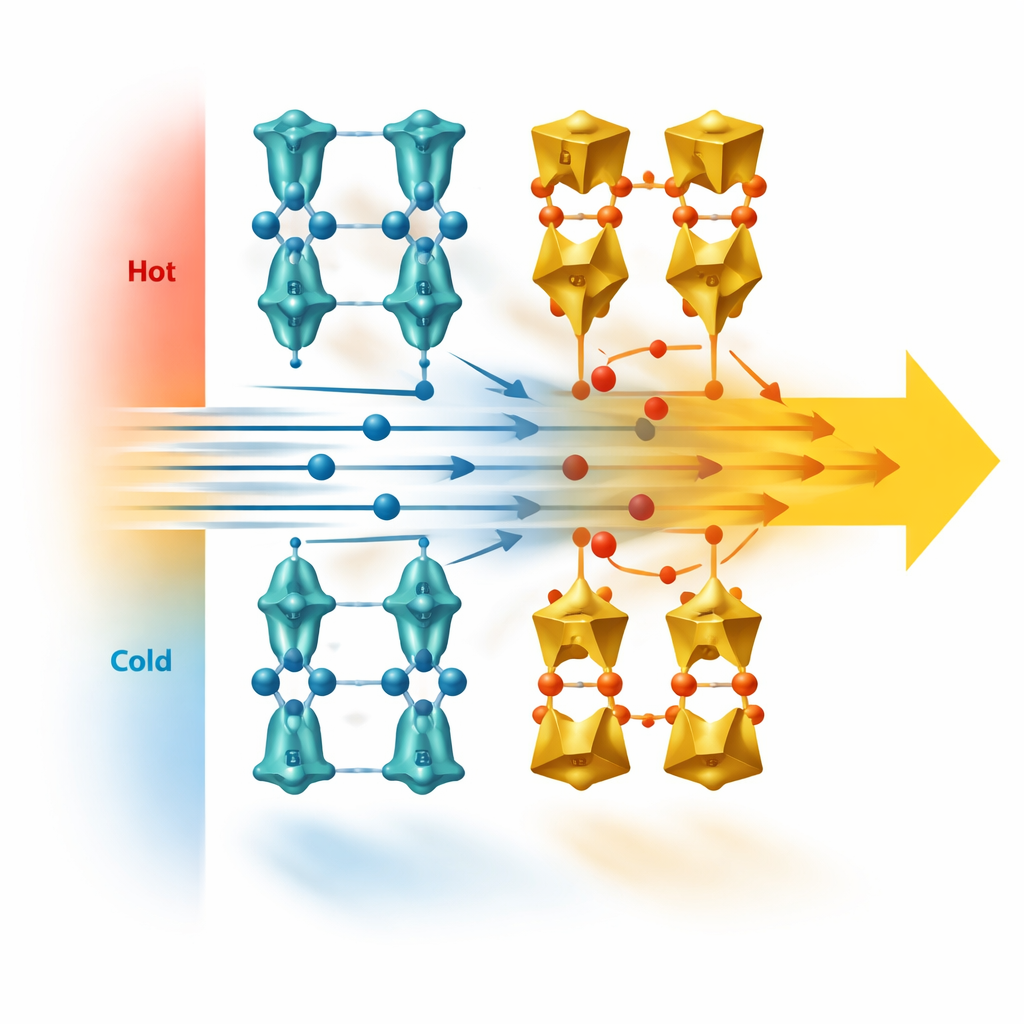
Ta2PdSe6 belongs to a family of compounds where metal and chalcogen (selenium) atoms form chain-like structures running through the crystal. Electrically, it is a semimetal: its electron and hole bands overlap slightly, so both types of charge carriers are present. In most semimetals this is bad news for thermoelectricity, because the positive (holes) and negative (electrons) contributions to voltage largely cancel. Surprisingly, earlier transport measurements showed that Ta2PdSe6 combines very high electrical conductivity with a large Seebeck coefficient, leading to an ultra-high power factor and “giant” Peltier conductivity. That means a small piece of this material can generate an unusually large electrical current from a tiny temperature difference, something normally associated with carefully tuned semiconductors rather than semimetals.
Peering into the electronic landscape
To uncover why Ta2PdSe6 performs so well, the authors used angle-resolved photoemission spectroscopy (ARPES), a technique that maps how electrons move inside a material by measuring their energies and directions after being knocked out by light. They found that the Fermi surface—the set of states that control electrical behavior—splits into two very different parts. One is a sharp, well-defined hole band with a light effective mass, meaning these carriers can move easily and have long mean free paths. The other is a broader, heavier electron band near the edge of the Brillouin zone, indicating stronger scattering and shorter paths. These two bands originate from different types of atomic chains in the crystal: one chain primarily hosts holes, the other primarily hosts electrons. This built-in structural separation already creates an imbalance between how the two types of carriers behave.
Hidden kinks and ghost copies
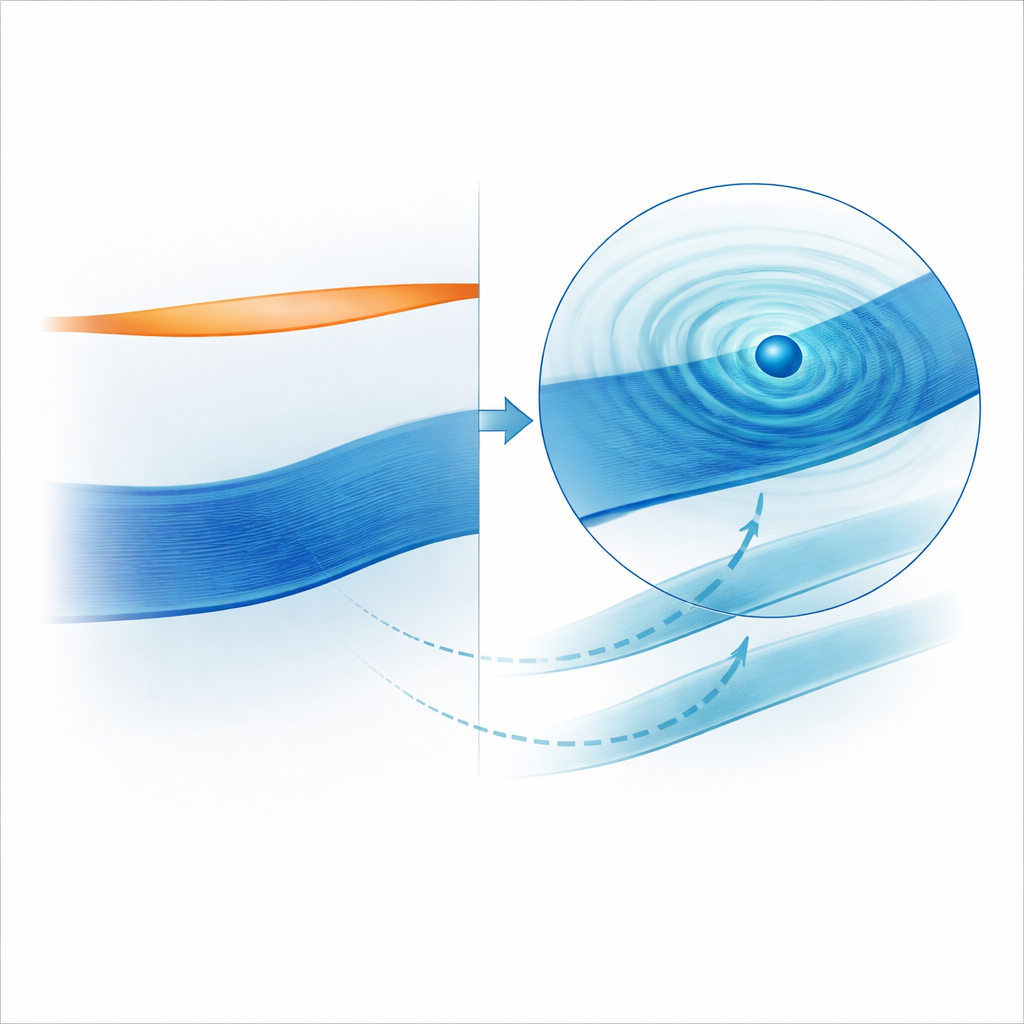
A closer look reveals further asymmetry. In the hole band, the researchers detected a subtle “kink” in the energy–momentum relation at very low energies, consistent with holes interacting modestly with lattice vibrations (phonons). In contrast, the electron band shows a much more dramatic signature: below the main band, ARPES reveals replica bands—faint echo-like copies offset by a fixed energy and following the same dispersion. Additional, even weaker replicas appear at still lower energies. The spacing between these replicas is far too large to be explained by ordinary phonons in this material, and the strength of the replicas changes in a way characteristic of polarons, quasiparticles where an electron drags along a cloud of collective excitations.
Electrons dressed by charge waves
To explain the large energy separation, the team turns to the idea of plasmonic polarons. Here, electrons couple not mainly to vibrations of the atoms, but to plasma oscillations—collective ripples of the electron sea itself. Using known carrier densities and effective masses from previous measurements, and a reasonable estimate for the material’s dielectric constant, the authors show that the observed replica spacing matches the expected energy of such plasmonic excitations. They further test this picture by gently adding extra electrons through potassium deposition on the surface. As the electron density rises, the main electron band and its replicas shift in energy, and the spacing between them increases, just as predicted for plasmonic polarons, but opposite to what would be expected for ordinary electron–phonon polarons. This strongly supports the view that only the electron band is heavily dressed by plasmonic excitations, while the hole band remains comparatively clean.
How asymmetry boosts thermoelectric power
For a layperson, the key takeaway is that Ta2PdSe6 succeeds by making electrons and holes behave very differently. The holes, living on one set of chains, are light and long-lived, providing a good pathway for current. The electrons, on another set of chains, are slowed and strongly scattered because they form plasmonic polarons with the collective charge waves of the system. This imbalance in scattering and band shape prevents the usual mutual cancellation between electron and hole contributions to the Seebeck effect. As a result, even though the material is a semimetal, it can sustain a large thermoelectric voltage while still conducting electricity very well. The work not only explains a long-standing puzzle about Ta2PdSe6, but also suggests a broader design strategy: by engineering materials where different atomic networks host carriers with sharply contrasting interactions—especially plasmonic polarons—researchers may be able to turn supposedly unsuitable semimetals into powerful new thermoelectric materials.
Citation: Ootsuki, D., Nakano, A., Maruoka, U. et al. Band-selective plasmonic polaron in thermoelectric semimetal Ta2PdSe6 with ultra-high power factor. npj Quantum Mater. 11, 23 (2026). https://doi.org/10.1038/s41535-026-00858-8
Keywords: thermoelectric semimetal, plasmonic polaron, Ta2PdSe6, angle-resolved photoemission, Seebeck effect