Clear Sky Science · en
Optical phonons as a testing ground for spin group symmetries
Listening to the Quiet Motions Inside Crystals
Inside every crystal, atoms are constantly jiggling in tiny, organized ways. These collective vibrations, called phonons, are usually the concern of specialists. But they also offer a powerful, non-destructive way to “listen in” on what the electrons and magnetic moments inside a material are doing. This study shows how carefully measuring these vibrations with light can reveal whether a new class of magnets, called altermagnets, really behave in a purely non-relativistic way or whether subtle relativistic effects still rule the game.
A New Kind of Magnet in the Spotlight
Traditional magnets are divided into two broad families: ferromagnets, where tiny atomic magnets line up, and antiferromagnets, where they alternate up and down and largely cancel out. Recently, theorists proposed a third category, altermagnets, in which up and down spins alternate in a pattern that breaks some symmetries in momentum space without relying on strong spin–orbit coupling. Several well-known antiferromagnets are now being re-examined as possible members of this new class. The compound studied here, Co2Mo3O8, is one of them: it is a polar crystal whose cobalt ions carry magnetic moments that order in a simple up–down pattern at low temperature, while the overall atomic arrangement of the crystal remains unchanged.
Two Ways to Describe Symmetry
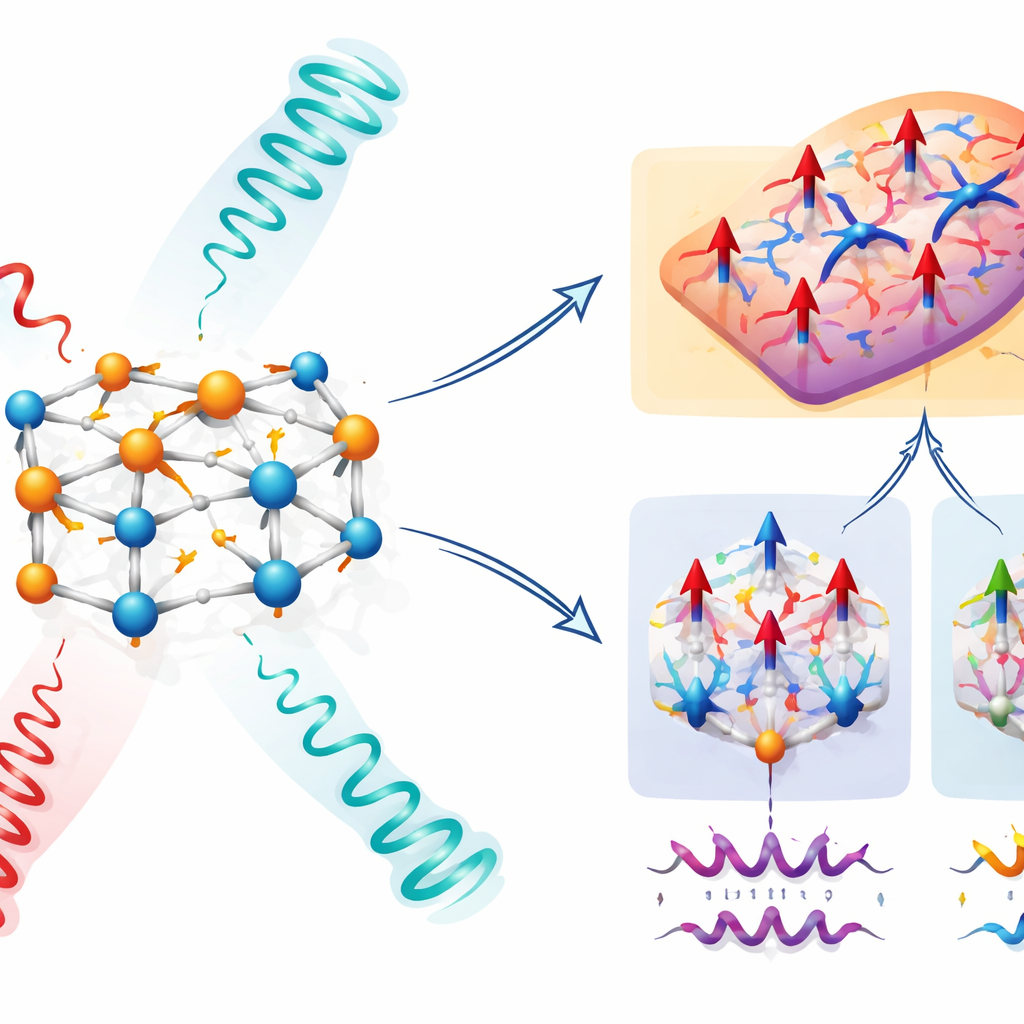
To understand how light interacts with a magnet, physicists use symmetry rules. In the usual, relativistic description, space and spin are tied together: a symmetry operation rotates both the crystal and the magnetic moments in a linked way, reflecting the presence of spin–orbit coupling. This is encoded in so-called magnetic point groups, which tell you which vibrational modes can absorb infrared light or scatter laser light in a Raman experiment. Altermagnets, by contrast, are often described by spin groups, a non-relativistic framework in which spatial symmetries and spin symmetries are treated separately and spin–orbit coupling is assumed to be negligible. These two approaches predict different patterns of allowed and forbidden phonon signals once the material orders magnetically.
Probing Vibrations with Light
The authors used two complementary optical tools to catalogue the phonons in Co2Mo3O8 above and below its magnetic ordering temperature. Infrared reflectivity reveals vibrational modes that carry an electric dipole, while Raman scattering detects how laser light loses or gains energy by creating or absorbing phonons. Guided by detailed quantum-chemical calculations, the team identified every expected optical phonon of the high-temperature, non-magnetic crystal and determined which light polarizations should excite each mode. As the material was cooled into its antiferromagnetic phase, they looked for new lines appearing, old lines disappearing, or shifts in which polarization channels modes showed up in—changes that would signal altered symmetry rules.
What the Phonons Revealed
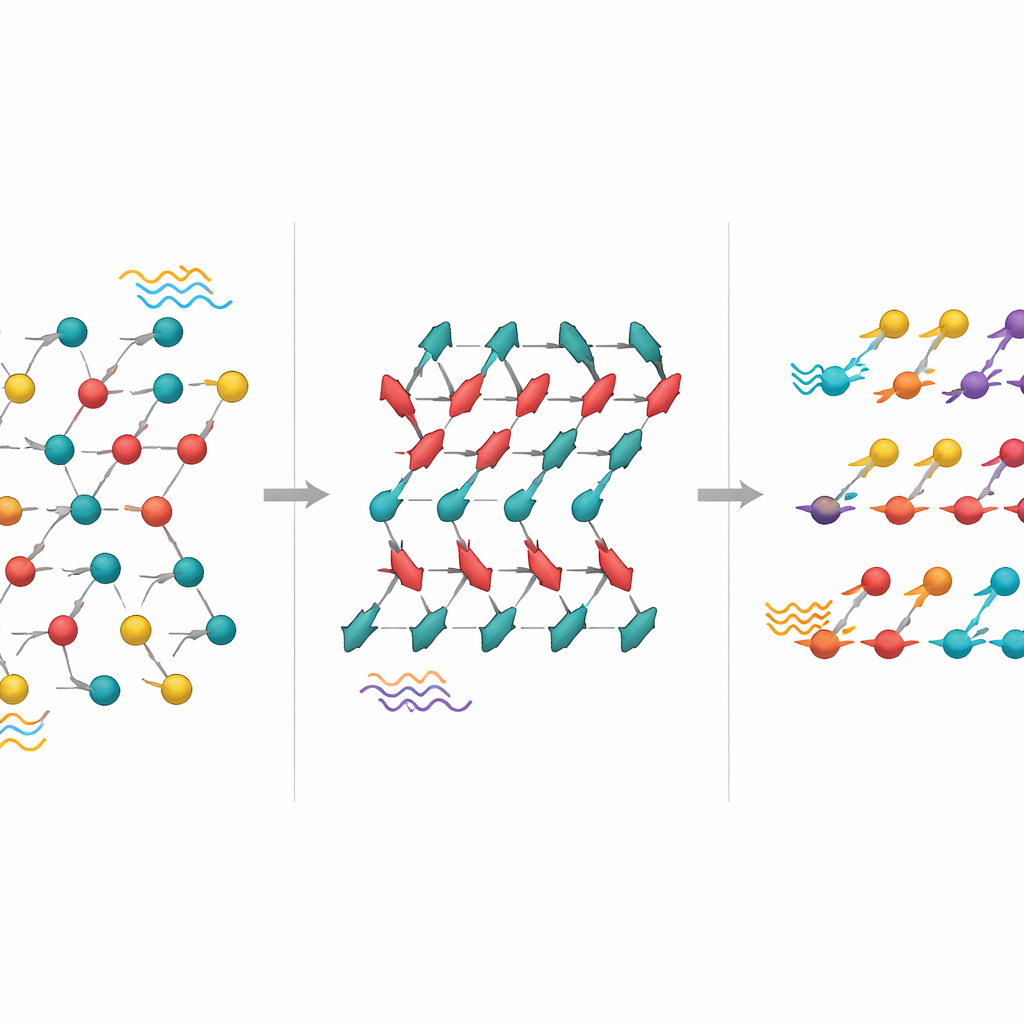
The key experimental finding is that the pattern of phonon activity does change across the magnetic transition, and it changes exactly as predicted by the relativistic magnetic point-group description. Several vibrational modes that were silent in certain geometries at high temperature become visible only in the magnetically ordered state, in just the combinations expected when spin and space are tied together by spin–orbit coupling. By contrast, the non-relativistic spin-group framework would predict no such qualitative change in the optical phonon selection rules, because it treats magnetic ordering as leaving the relevant light–lattice couplings unchanged. The fact that the phonons “feel” the onset of order in a way consistent with relativistic symmetry shows that spin–orbit effects cannot be ignored, even in a proposed altermagnet. The team also observes additional features they attribute to electronic excitations and to resonant Raman processes, but these do not alter the main symmetry-based conclusion.
Why This Matters Beyond One Crystal
For a general reader, the message is that tiny lattice vibrations can act as sensitive detectors of deep symmetry principles inside quantum materials. In Co2Mo3O8, they decisively side with a relativistic picture in which spin–orbit coupling shapes how magnetism and light interact, challenging the idea that the material’s low-energy behavior can be fully captured by a spin-only, non-relativistic altermagnet model. The approach—using optical phonons as a testing ground for subtle symmetry distinctions—can now be applied to many other candidate altermagnets and complex magnets, offering a practical way to check whether their excitations really follow non-relativistic rules or whether relativity quietly leaves its fingerprint in their spectra.
Citation: Schilberth, F., Kondákor, M., Ukolov, D. et al. Optical phonons as a testing ground for spin group symmetries. npj Quantum Mater. 11, 26 (2026). https://doi.org/10.1038/s41535-026-00857-9
Keywords: altermagnetism, optical phonons, Raman spectroscopy, spin–orbit coupling, Co2Mo3O8