Clear Sky Science · en
Vanishing ordered moment in the frustrated triangular lattice antiferromagnet CuNdO2
Magnetism That Nearly Disappears
Most magnets owe their behavior to tiny atomic magnets that line up and produce a noticeable effect. In this study, scientists discovered a material where those microscopic magnets do organize themselves over long distances, yet the usual telltale magnetic signature is almost invisible. This curious case, found in a compound called CuNdO2, reveals how the geometry of a crystal and the preferred directions of atomic magnets can conspire to hide order in plain sight.
A Triangular Playground for Atomic Magnets
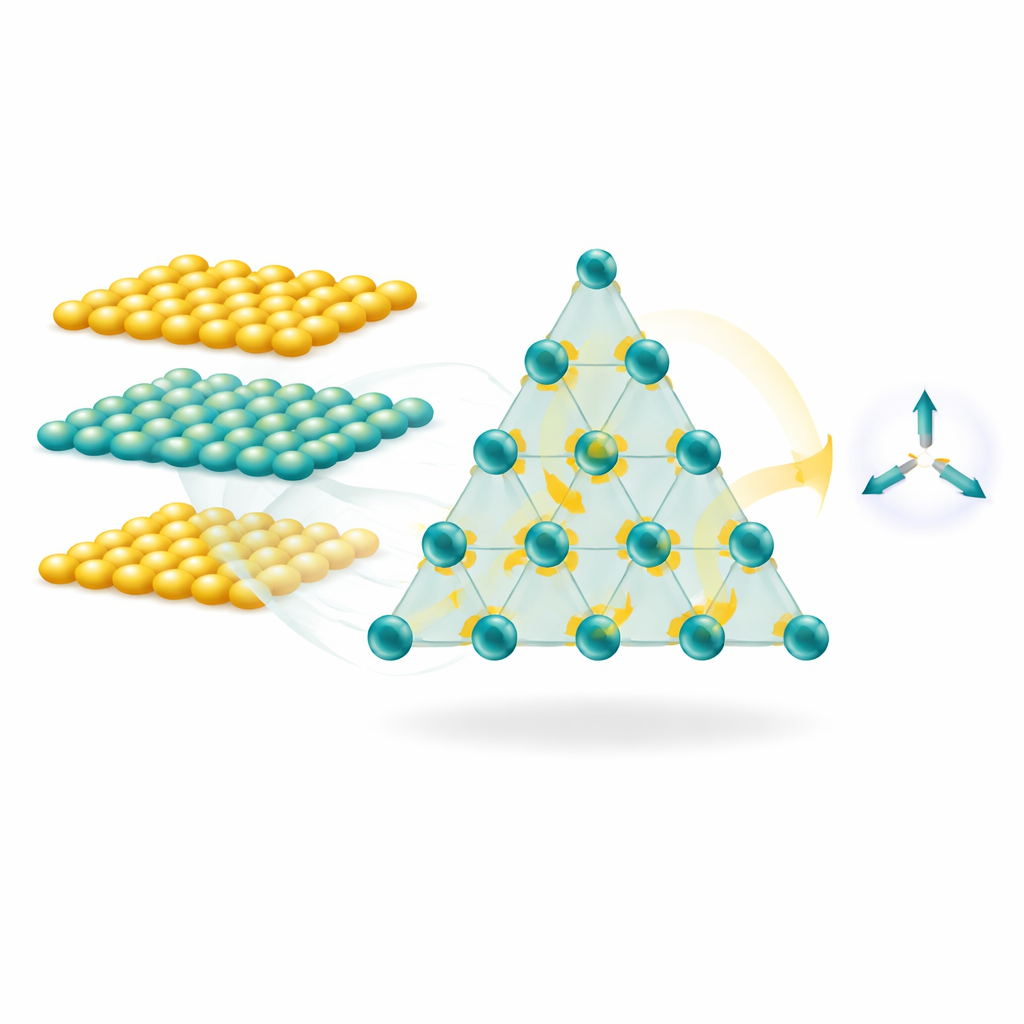
CuNdO2 is built from flat, repeating layers. In certain layers sit neodymium atoms, each carrying a tiny magnetic moment; between them lie copper layers that do not contribute magnetically. Viewed from above, the neodymium atoms form a perfect triangular grid. When neighboring moments prefer to point in opposite directions, this triangle pattern makes it impossible to satisfy every preference at once: no matter how two corners are arranged, the third one is “frustrated.” In many such triangular materials, this conflict produces unusual states, sometimes preventing any orderly pattern from forming even at very low temperatures.
Clues from Subtle Heat and Spin Signals
To see what happens in CuNdO2 as it is cooled, the researchers measured how its magnetization and heat capacity change with temperature. Both measurements showed a sharp feature at about 0.78 kelvin, less than one degree above absolute zero, signaling that the atomic magnets collectively settle into an ordered state. An independent probe, called muon spin relaxation, which senses local magnetic fields inside the sample, also recorded a clear change at the same temperature. Together, these techniques leave little doubt that some form of long-range magnetic order emerges.
A Hidden Pattern with Almost No Visible Moment
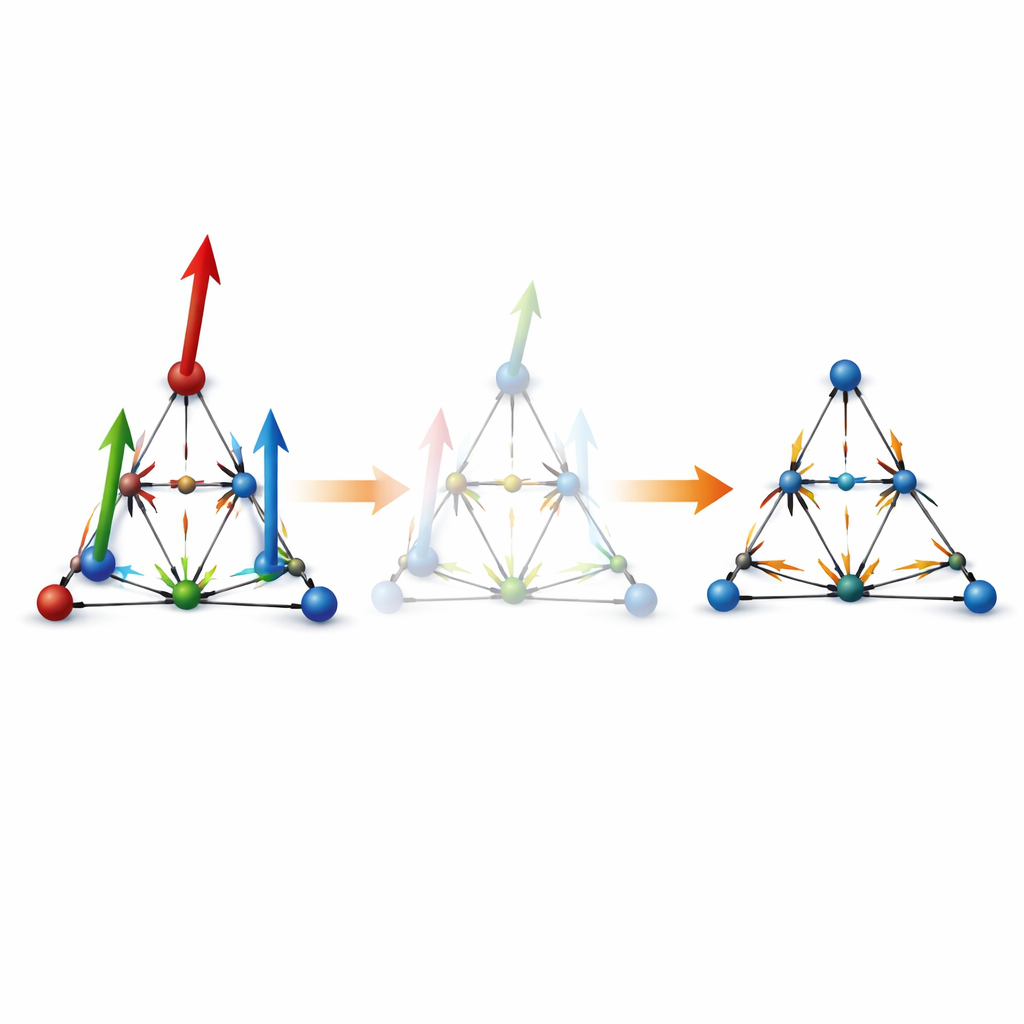
Surprisingly, a technique that normally sees magnetic order very clearly—neutron diffraction—found no new magnetic peaks below the transition temperature. That would usually suggest either the absence of order or a more exotic type of “hidden” ordering that does not involve ordinary magnetic dipoles. To solve this puzzle, the team examined how neodymium’s atomic environment shapes its magnetism, using inelastic neutron scattering to map out how the atom’s energy levels split in the crystal. This analysis revealed that each neodymium moment strongly prefers to point out of the flat layers, like a compass needle held upright (an “Ising-like” tendency), and has only a very small component lying within the plane.
How Frustration Selects a Gentle Compromise
The triangular layout makes it extremely difficult for these out-of-plane–preferring moments to arrange themselves in a way that satisfies all their antiferromagnetic couplings. The system finds a clever workaround: instead of ordering the large, vertical components, it orders the much smaller sideways components, which suffer less from the geometric conflict. Neutron measurements at very low energies uncovered a faint collective vibration of the spins—a spin wave—appearing only below the ordering temperature. By modeling these excitations with a simple interaction model on a triangular grid, the researchers concluded that the tiny in-plane parts of the moments form a well-known 120-degree pattern, where three neighboring spins point at equal angles around the circle and largely cancel one another.
Why This Almost-Invisible Order Matters
The outcome is a highly ordered magnetic state whose net visible moment is drastically reduced, falling below the detection threshold of standard diffraction techniques. CuNdO2 therefore demonstrates how strong directional preferences of atomic magnets, combined with a frustrated lattice geometry, can produce long-range order that conventional tools struggle to see. This work suggests that other rare-earth materials with similar traits may also host “vanishing” ordered moments, and that understanding their subtle spin patterns will be key to uncovering new kinds of magnetic behavior in quantum materials.
Citation: Gaudet, J., Reig-i-Plessis, D., Wen, B. et al. Vanishing ordered moment in the frustrated triangular lattice antiferromagnet CuNdO2. npj Quantum Mater. 11, 29 (2026). https://doi.org/10.1038/s41535-026-00854-y
Keywords: frustrated magnetism, triangular lattice, rare-earth magnets, quantum materials, spin anisotropy