Clear Sky Science · en
Magnon orbital Nernst effect in altermagnets
Heat, Hidden Magnetism, and a New Way to Move Information
In our everyday electronics, flowing electric charge does the work. But in many modern materials, charge is only part of the story: waves of magnetism can also carry energy and information. This paper explores an especially subtle kind of magnetic wave in crystals called altermagnets and shows how a simple temperature difference can make these waves transport tiny swirls of motion in a remarkably robust way. The effect could underpin low‑loss devices that use heat rather than electricity to drive future information technologies.
From Spintronics to “Orbitronics” with No Electric Charge
For decades, researchers have tried to harness an electron’s spin—the tiny magnetic needle associated with each particle—to build “spintronic” devices that are faster and generate less heat than conventional electronics. A newer idea, “orbitronics,” aims instead at the orbital motion of electrons, which can flow through a material much like charge or spin currents do. This work asks: can similar orbital behavior arise in magnons, the quantum packets of spin waves that ripple through magnetic materials? Magnons carry no electric charge and have no mass, but they can rotate as they travel, giving them an orbital character that, in principle, can be moved around by heat or fields.
Altermagnets: Unusual Antiferromagnets with Hidden Splitting
Altermagnets are a recently identified class of magnets that look deceptively ordinary. Like conventional antiferromagnets, neighboring atomic moments point in opposite directions, so the material has no net magnetization. Yet, because of how the atoms are arranged in the crystal, particles of opposite spin feel slightly different environments as they move. This produces a distinctive pattern of energy splitting in their bands, even without the usual relativistic effects that typically cause such behavior. The authors focus on two prototypes: RuO2, which has a so‑called d‑wave pattern confined mostly to a plane, and CrSb, which shows a three‑dimensional, g‑wave pattern. Using first‑principles electronic structure calculations combined with a standard model for magnetic interactions, they compute how magnons move and how their energies split in these crystals.
Swirling Magnons and a Sideways Heat Current
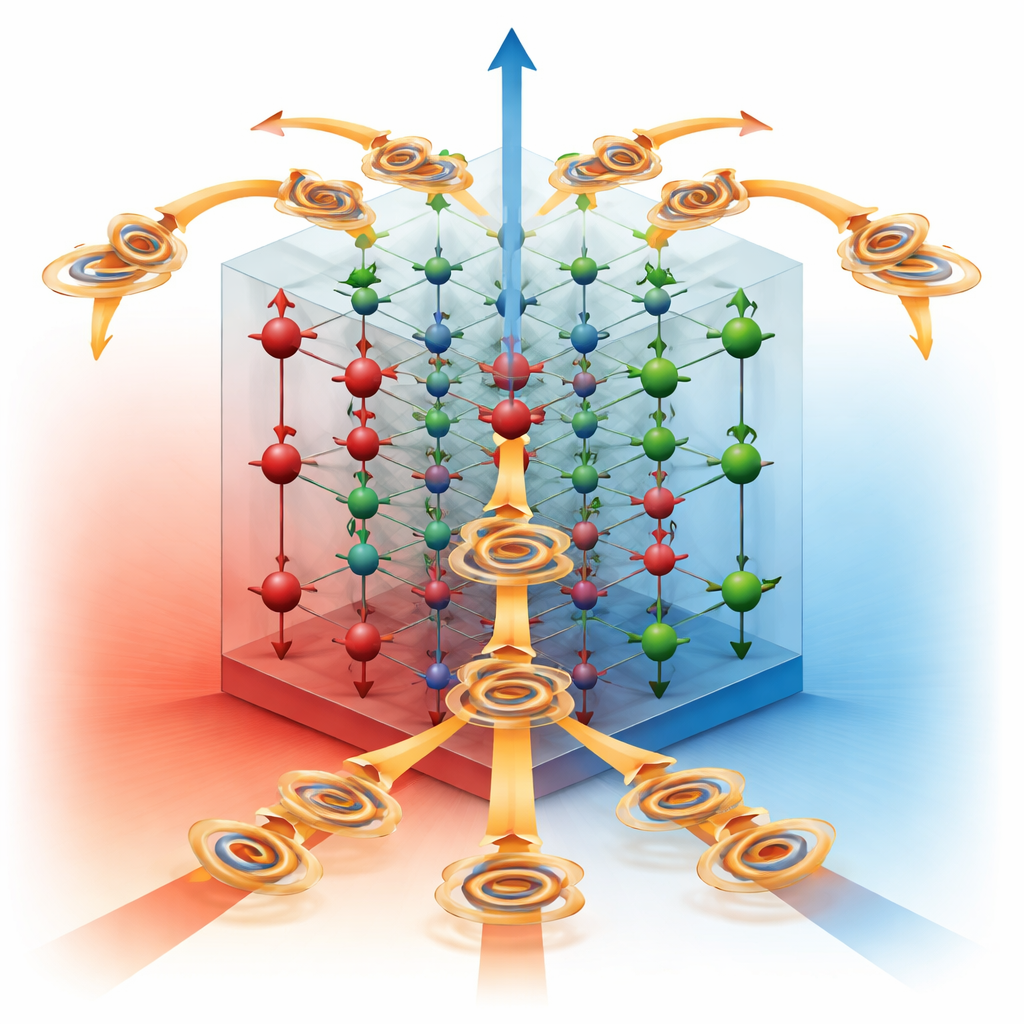
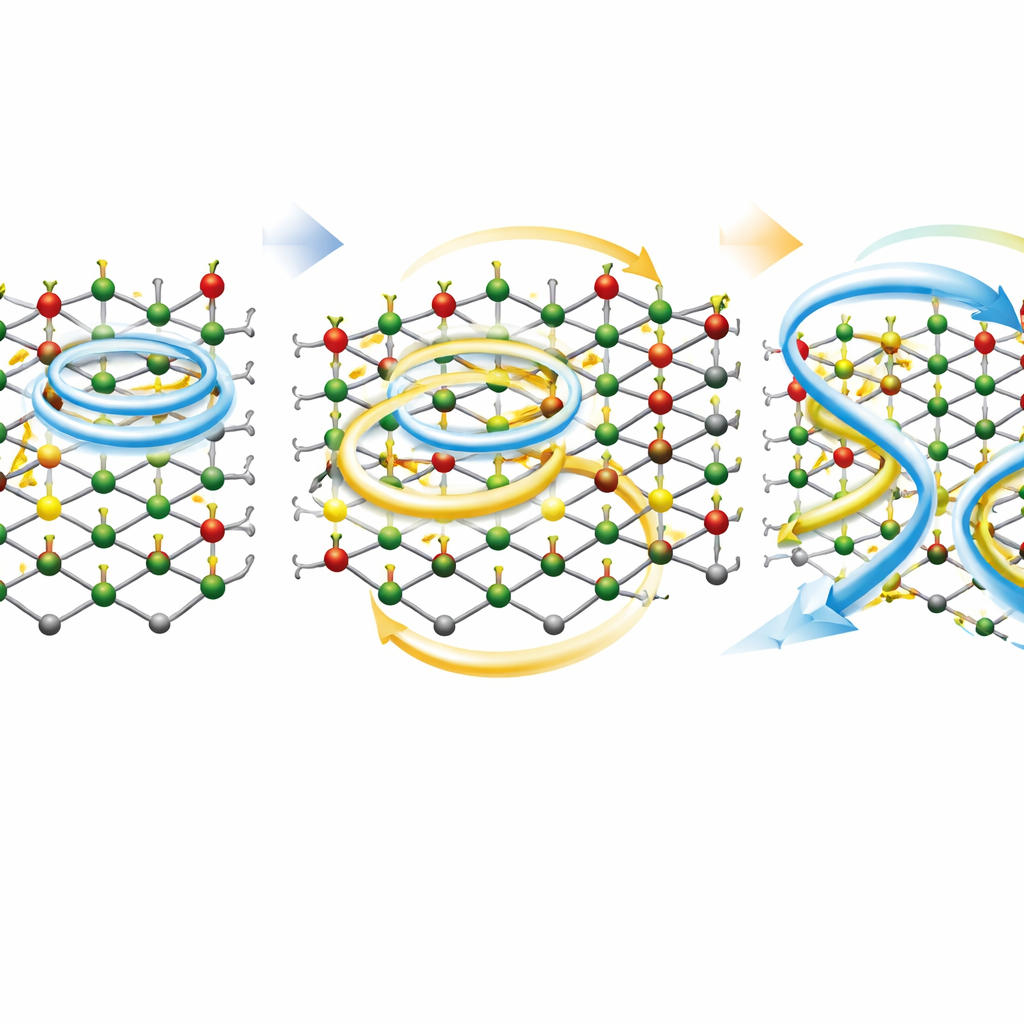
Magnons are not just simple waves; they can form localized wave packets that both drift and internally spin. That self‑rotation is quantified by a “magnon orbital moment,” a measure of how much each packet whirls around its own center. Symmetry rules imply that in perfectly calm, equilibrium conditions this swirling averages to zero across the crystal in both RuO2 and CrSb. However, when a temperature gradient is applied—hot on one side, cold on the other—these same symmetries are partially broken. The authors show that a net flow of orbital moment then emerges at right angles to the heat flow: a magnon orbital Nernst effect, the magnetic‑wave analogue of a thermoelectric effect, but involving orbital motion instead of electric charge or spin.
Why Altermagnets Are Special and Robust
By tuning the strength and directionality of the magnetic couplings in their theoretical model, the researchers demonstrate that this orbital Nernst effect exists only when the characteristic altermagnetic energy splitting of magnon bands is present. In a conventional antiferromagnet with no such splitting, the effect vanishes exactly. They further find that the resulting orbital currents depend much less on the detailed orientation of the magnetic order, on the angle of the applied temperature gradient, or on the presence of multiple magnetic domains than comparable spin‑based effects do. In other words, even if a sample is polycrystalline and magnetically disordered on a microscopic level, the orbital signal should largely survive instead of canceling out.
Potential Path to Heat‑Driven Orbital Electronics
The study concludes that magnon orbital transport in altermagnets offers a new, sturdy channel for moving information using heat rather than electric charge. Because the effect arises without needing strong relativistic interactions, it could appear in a broad range of materials. The authors suggest that these orbital currents might be detected indirectly through their ability to induce electric polarization or voltages, especially in layered structures where an altermagnet is combined with a heavy metal that enhances certain magnetic interactions. If realized experimentally, such heat‑driven orbital currents could become a practical tool both for probing hidden altermagnetism and for designing low‑dissipation orbitronic and spintronic devices.
Citation: Weißenhofer, M., Mrudul, M.S., Mankovsky, S. et al. Magnon orbital Nernst effect in altermagnets. npj Quantum Mater. 11, 25 (2026). https://doi.org/10.1038/s41535-026-00853-z
Keywords: altermagnets, magnons, orbitronics, Nernst effect, spin waves