Clear Sky Science · en
Field-tailoring quantum materials via magneto-synthesis: metastable metallic and magnetically suppressed phases in a trimer iridate
Shaping Future Materials with Gentle Magnetic Nudges
Many of tomorrow’s technologies—from quantum computers to ultra-efficient electronics—depend on materials whose atoms and electrons behave in exotic ways. But making such “quantum materials” is hard, because tiny changes during crystal growth can completely alter their properties. This study shows that even very weak magnetic fields, applied while a crystal is being grown in a hot furnace, can steer a material into a new, long-lived state that would otherwise be out of reach. It’s like lightly nudging dough in the oven and ending up with a different kind of bread.
A New Way to Grow Exotic Solids
The authors explore an approach they call magneto-synthesis: growing crystals in a furnace while weak permanent magnets outside the furnace apply a small magnetic field—less than one-tenth the strength of a typical fridge magnet. Unlike high-pressure methods, which require bulky equipment and crush the sample during growth, magneto-synthesis is contactless, scalable, and directional. The work focuses on a compound called BaIrO₃, built from clusters of three tightly linked iridium atoms known as “trimers.” These trimers act like tiny molecular building blocks inside the solid, and their internal bond lengths are crucial in deciding whether the material conducts electricity, how it magnetizes, and what quantum states it can host. 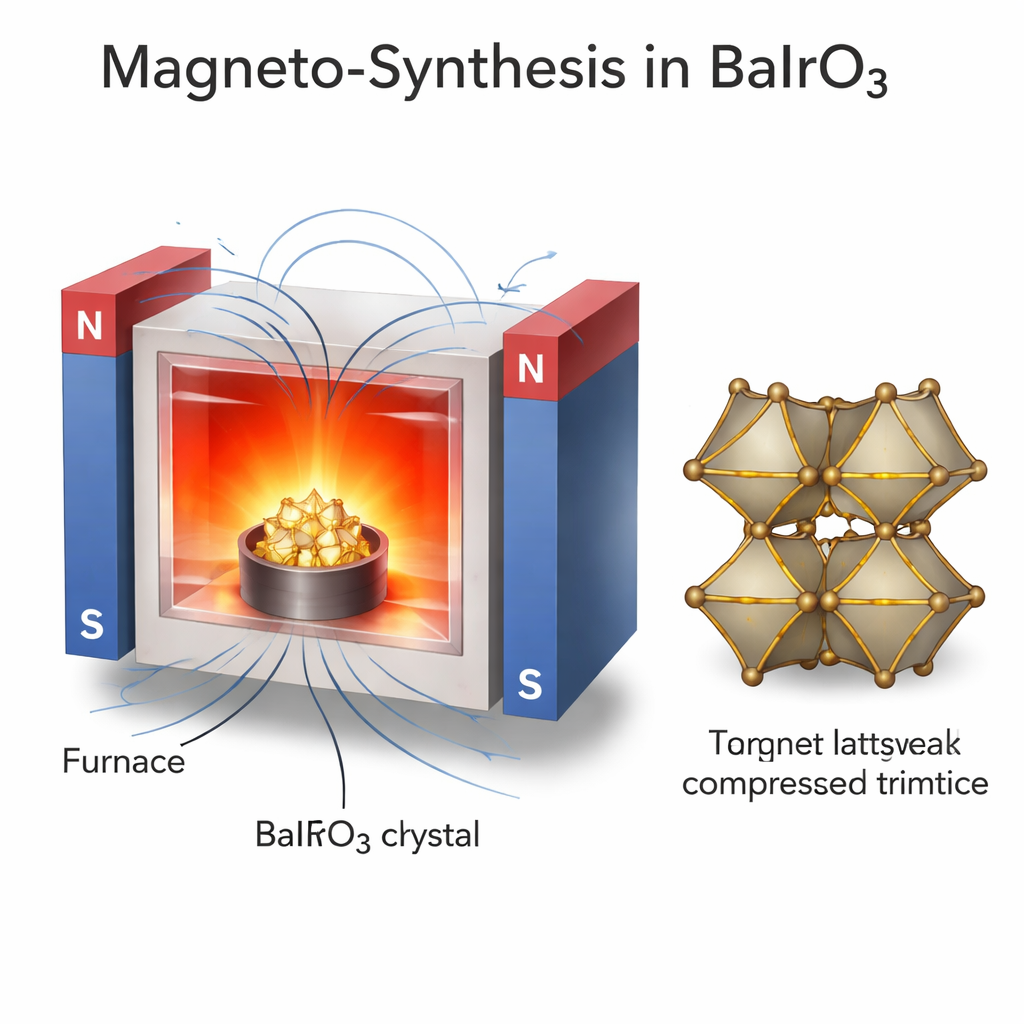
Gently Squeezing a Crystal Lattice
By growing BaIrO₃ crystals with and without a weak magnetic field, the team found that the field subtly but coherently reshaped the atomic structure. X-ray measurements show that the distance between key iridium atoms in each trimer shrank by nearly 0.7%, and the overall unit cell volume—essentially the repeating “box” of the crystal—was compressed by up to 0.85%. At the same time, one crystal axis shortened while another slightly expanded, reducing distortions in the lattice. These small shifts at the atomic level are significant for such a rigid solid and are far larger and more systematic than what would be expected from random impurities or slight chemical errors. They indicate that the magnetic field is acting as a steering wheel during growth, guiding the solid into a more compact, higher-energy arrangement.
Turning an Insulator into a Metal
The structural changes go hand in hand with dramatic shifts in how the material behaves. In crystals grown without a field, BaIrO₃ is an insulating magnet: it resists electrical current and shows long-range magnetic order below about 185 kelvin. When grown under weak magnetic fields, the same chemical compound becomes far more conductive—its electrical resistivity along one crystal direction drops by as much as ten thousand times, signaling a transition to a metallic state. At the same time, the temperature at which magnetic order sets in is steadily pushed down, and in the most strongly field-tailored crystals the long-range magnetism nearly vanishes. Heat capacity measurements, which probe how the whole bulk of the material stores energy, reveal a much larger electronic contribution in the field-grown samples, another hallmark of a strongly interacting metal. 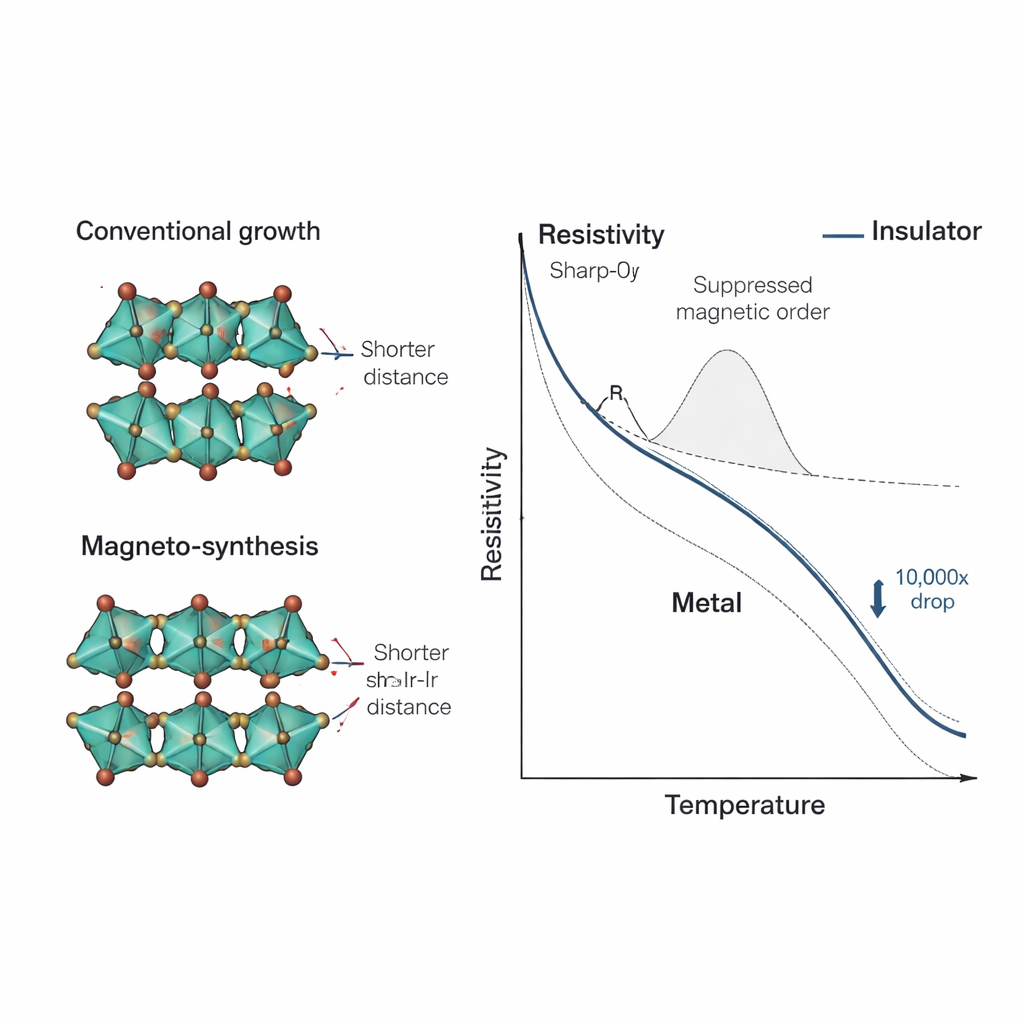
Metastable Matter: Held in a Delicate Balance
Computer calculations based on quantum mechanics back up the experimental findings. When the researchers model the field-tailored crystal structures, they find that these compressed versions of BaIrO₃ sit higher in energy than the relaxed, equilibrium structure. In other words, the field-grown crystals are metastable: they are trapped in a state that is not the absolute lowest in energy, but once formed, they persist at normal conditions. The calculations also show increased internal stress, charge rearrangement between atoms, and more electronic states available for conduction—features that match the observed metallic and magnetic behavior. Together with extensive checks ruling out impurities, this demonstrates that the weak magnetic field during growth is directly responsible for creating a new, intrinsically different phase of the material.
Why This Matters for Future Technologies
To a non-specialist, the core message is that the way we “bake” a crystal can be just as important as its recipe. This work proves that even modest magnetic fields, applied while a material forms, can reliably produce new quantum phases—turning an insulating magnet into a metallic, magnetically weakened state without changing its chemical formula. That opens a new design knob for engineers and physicists seeking materials with on-demand properties, from tunable magnetism to unusual electronic behavior central to quantum devices. As stronger field-assisted growth setups come online, magneto-synthesis could become a general tool for discovering and stabilizing exotic, otherwise unreachable states of matter.
Citation: Cao, T.R., Zhao, H., Huai, X. et al. Field-tailoring quantum materials via magneto-synthesis: metastable metallic and magnetically suppressed phases in a trimer iridate. npj Quantum Mater. 11, 21 (2026). https://doi.org/10.1038/s41535-026-00852-0
Keywords: magneto-synthesis, quantum materials, BaIrO3, metastable phases, insulator-to-metal transition