Clear Sky Science · en
Kitaev interaction and proximate higher-order skyrmion crystal in the triangular lattice van der Waals antiferromagnet NiI2
Magnetic Whirlpools in Ultra-Thin Crystals
In recent years, physicists have discovered tiny magnetic whirlpools, called skyrmions, that could store information far more densely than today’s hard drives. This paper explores whether a layered crystal known as NiI2 can host an even more exotic form of these whirlpools: “higher‑order” skyrmion crystals that might unlock new ways to process and move information using spins instead of electric charge.
From Simple Magnets to Twisting Patterns
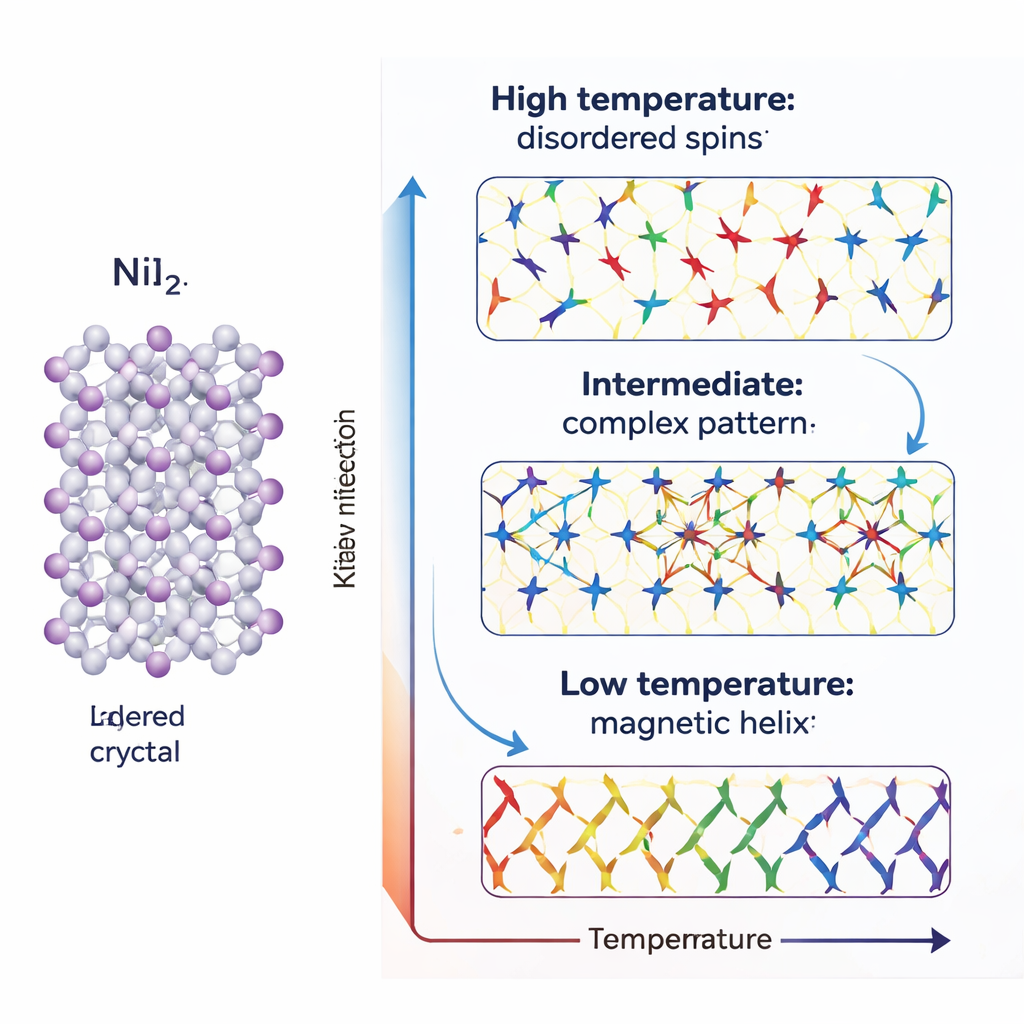
NiI2 is part of a broad family of van der Waals materials, whose atomically thin layers can be peeled apart like sheets of paper. In bulk form, NiI2 goes through two magnetic changes as it is cooled. Above about 75 kelvin (roughly −200 °C), its atomic magnets (spins) are disordered, forming a conventional paramagnet. Between 75 K and 59.5 K, the material enters an intermediate magnetic state that has been poorly understood. Below 59.5 K, it settles into a “helical” phase where the spins twist in a regular spiral through the crystal. This low‑temperature phase also makes NiI2 multiferroic, meaning that its magnetic order is tied to an electric polarization, a useful trait for future low‑power devices.
A New Route to Exotic Magnetic Whirlpools
Most skyrmion crystals seen so far in solids have a topological charge of one and only appear when an external magnetic field is applied. Theorists recently proposed that a different kind of interaction between neighboring spins, known as the Kitaev interaction, could stabilize a more intricate skyrmion crystal with topological charge two (called SkX‑2) without any magnetic field at all. NiI2 is a prime candidate because heavy iodine atoms generate strong spin‑orbit coupling, which naturally enhances this Kitaev interaction on its triangular spin lattice. Earlier calculations suggested that a single layer of NiI2 might host such a phase; this work asks whether the bulk crystal sits close to that exotic state.
Probing the Hidden Order with Neutrons
To uncover how the spins in NiI2 behave, the researchers used powerful neutron scattering techniques. Beams of neutrons were fired into carefully grown single crystals at different temperatures, and the scattered neutrons recorded how spins fluctuate in space and time. These measurements were performed in the disordered paramagnetic regime, in the mysterious intermediate phase, and in the low‑temperature helical phase. The resulting “maps” of scattering intensity were then compared to large‑scale computer simulations of spins evolving under a trial model that included conventional Heisenberg exchange, Kitaev exchange, and weaker couplings between more distant neighbors.
Building a Minimal Model of the Magnet
By using Bayesian optimization, the team tuned five key interaction strengths in their model until simulated neutron spectra closely matched the experimental data across many momentum and energy slices. The best‑fit parameters revealed a sizable antiferromagnetic Kitaev term, in agreement with independent quantum‑chemistry calculations. With these parameters fixed, the model reproduced not only the diffuse scattering in the high‑temperature paramagnet, but also the sharp, V‑shaped spin excitations in the intermediate phase and the spin‑wave–like bands in the low‑temperature helical state. This success suggests that a relatively simple “Kitaev–Heisenberg plus a few neighbors” description captures the essential physics of NiI2 across all three temperature regimes.
On the Edge of a Higher-Order Skyrmion Crystal
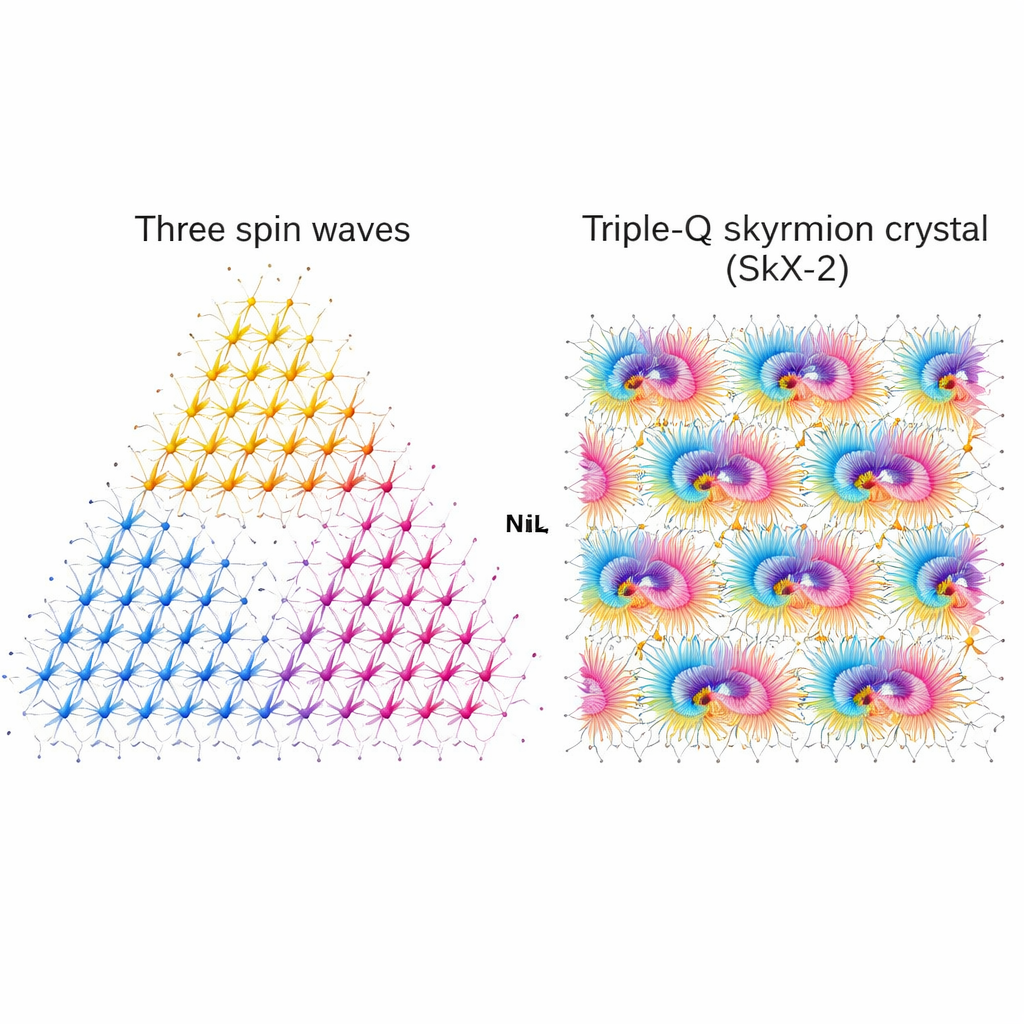
Armed with this refined model, the authors ran classical Monte Carlo simulations to see what ground state it prefers. On a slightly distorted lattice, mimicking the structural change in the real crystal at low temperature, the model favors the observed single‑wave (single‑Q) helical order. But on an ideal hexagonal lattice similar to the high‑temperature structure, the same interactions generate a richly non‑coplanar spin texture: a triple‑wave (triple‑Q) pattern that forms a lattice of higher‑order skyrmions (SkX‑2). In this state, three spin‑density waves with different directions and polarizations combine coherently, creating a repeating pattern of swirling spins with a large topological charge per whirlpool.
Why This Matters for Future Technologies
While current neutron and optical experiments cannot yet say for sure whether the intermediate phase of bulk NiI2 is a true SkX‑2 crystal or a closely related state, the evidence points to NiI2 sitting very near such a phase. This makes it a rare example of a three‑dimensional material where Kitaev interactions, rather than more familiar mechanisms, drive the formation of complex topological spin textures at finite temperature and without a magnetic field. For lay readers, the key message is that NiI2 hosts spins that are poised to form intricate, stable magnetic whirlpools in an ultra‑thin, electrically active crystal. That combination of controllable topology, electric polarization, and two‑dimensionality could be a powerful ingredient for future spin‑based electronics and information storage technologies.
Citation: Kim, C., Vilella, O., Lee, Y. et al. Kitaev interaction and proximate higher-order skyrmion crystal in the triangular lattice van der Waals antiferromagnet NiI2. npj Quantum Mater. 11, 20 (2026). https://doi.org/10.1038/s41535-026-00851-1
Keywords: magnetic skyrmions, Kitaev interaction, van der Waals magnets, multiferroics, NiI2