Clear Sky Science · en
Interplay of vibrational, electronic, and magnetic states in CrSBr
Why this strange crystal matters
Quantum technologies—from ultrafast computers to ultrasensitive sensors—depend on how tiny building blocks of matter talk to each other. In many materials, electric charges, magnetism, and atomic vibrations all interact at once, but usually in ways that are hard to disentangle and even harder to control. This study focuses on a layered crystal called chromium sulfide bromide (CrSBr), showing how its vibrations, electronic excitations, and magnetic order are tightly linked. Understanding this three‑way dance points toward new ways to read out and control magnetic states using light, a key step for future spintronics, quantum sensing, and quantum communication devices.
A layered magnet with a built‑in direction
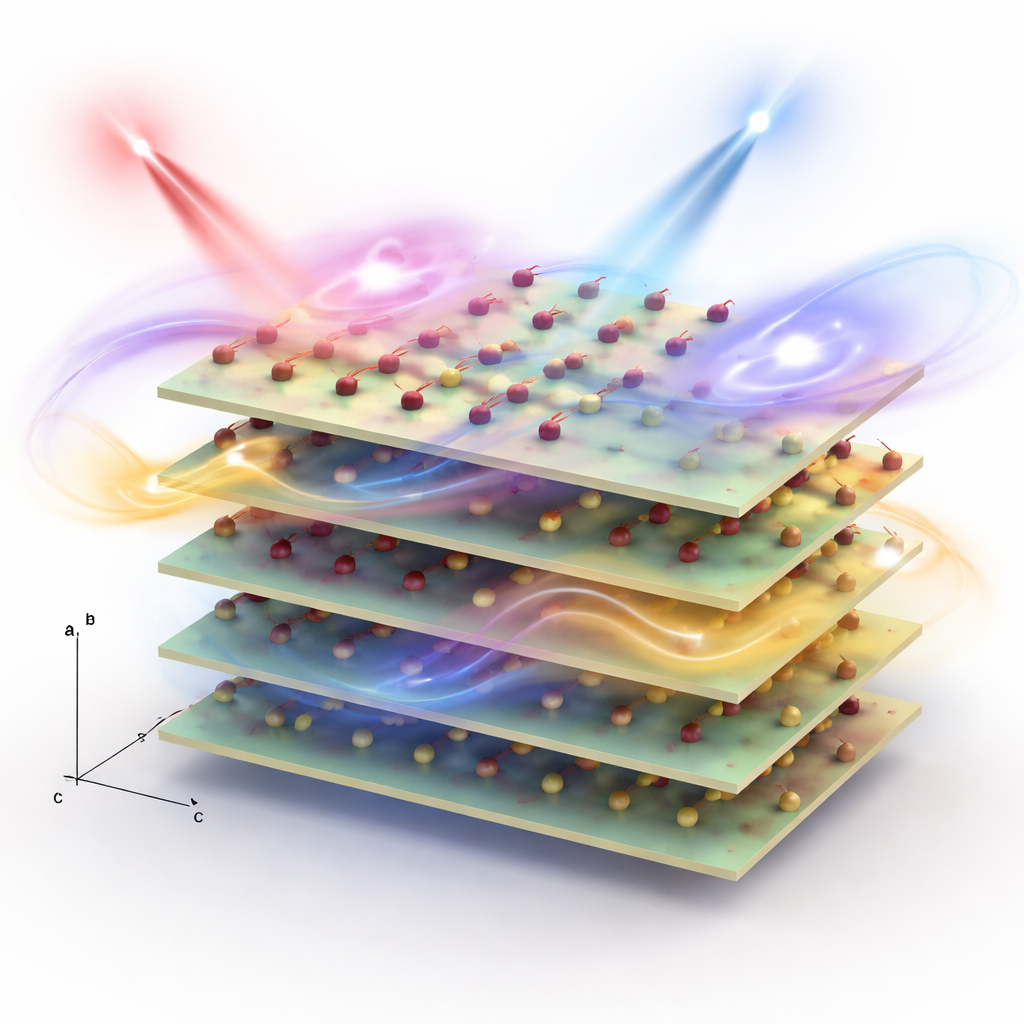
CrSBr is a so‑called van der Waals material, meaning it is built from atomically thin sheets that can be peeled apart, like pages in a book. But unlike ordinary sheets, each layer is magnetic: spins inside a layer align in the same direction (ferromagnetic), while neighboring layers tend to point in opposite directions (antiferromagnetic). The crystal is also strongly one‑sided in the plane—its properties differ sharply along two in‑plane directions, called the a and b axes. This built‑in directionality shows up in how the material absorbs and emits light, and in how its atoms vibrate. Because the spins, electrons, and vibrations are all anisotropic and layered, CrSBr is an ideal playground for studying how these ingredients influence one another as the temperature and the color and polarization of light are varied.
Listening to atomic vibrations with polarized light
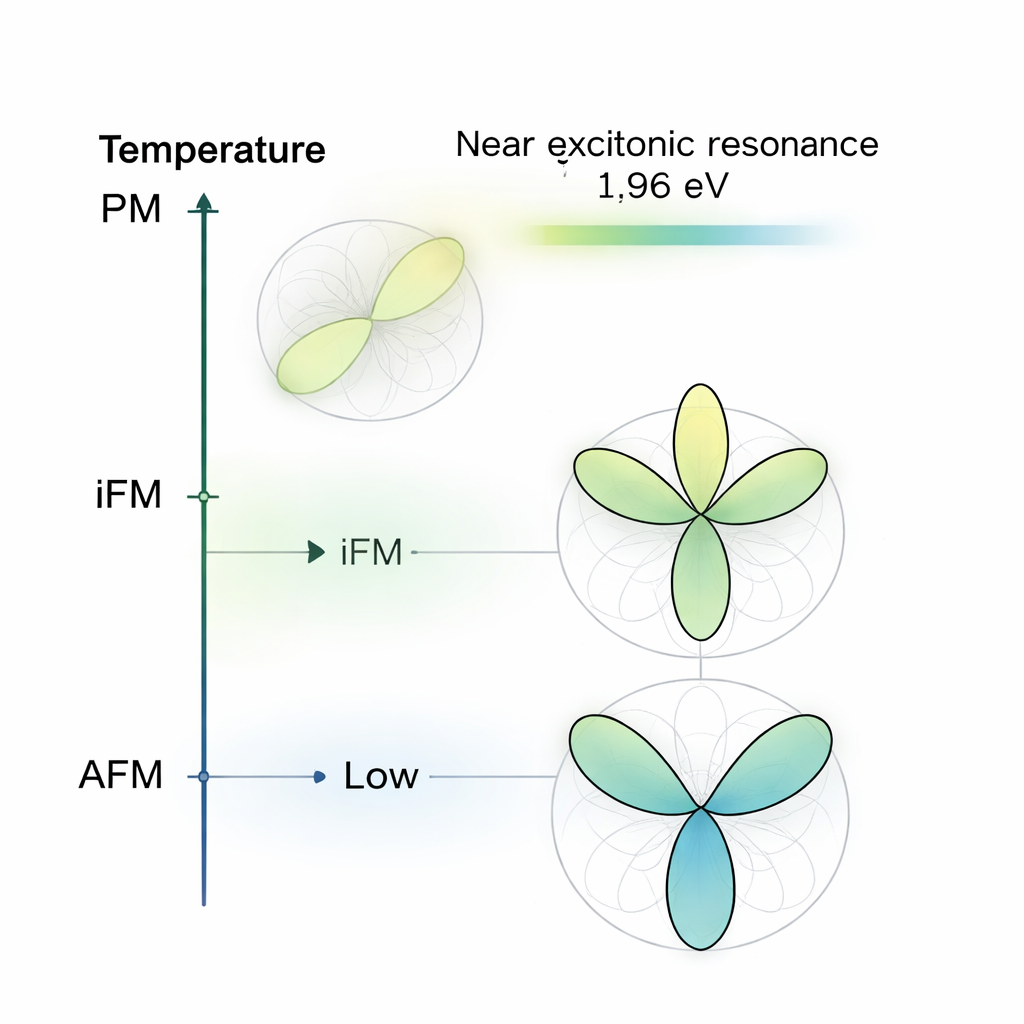
The authors use polarization‑resolved Raman spectroscopy, a technique that “listens” to atomic vibrations by shining a laser on the sample and analyzing the scattered light. By rotating the light’s polarization and cooling or heating the crystal from near absolute zero up to room temperature, they track how specific vibration modes, labeled A1g, A2g, and A3g, change. Crucially, they repeat these measurements with two laser colors: one at 2.33 electron volts (eV) and one at 1.96 eV. At 2.33 eV, the polarization patterns of the vibrations evolve smoothly with temperature, with only subtle changes near the magnetic transition temperatures. In stark contrast, when the laser energy is 1.96 eV—close to a natural electronic resonance in CrSBr—the polarization of the same vibrations changes dramatically as the system passes through the Néel temperature, where the spins lock into antiferromagnetic order.
Following excitons as the magnetism melts
To find out whether electronic states are responsible for these changes, the team combines their Raman data with two other optical probes: photoluminescence excitation (PLE) spectroscopy and differential reflectance (DR/R). These methods reveal bright excitons—bound electron–hole pairs—that act like tiny, light‑sensitive quasiparticles. In thin CrSBr flakes cooled to 4 kelvin, they observe several sharp exciton features, including one dubbed the B exciton, which couples strongly to both the crystal’s magnetism and to certain lattice vibrations. As the temperature is raised above the Néel point, the exciton‑related signatures around 1.96 eV fade or broaden until they nearly disappear. This loss of sharp excitonic features goes hand in hand with the sudden change (“kink”) in the Raman polarization ratios, indicating that the lattice vibrations are not reacting directly to the spins, but rather to excitonic states whose strength depends on magnetic order.
A three‑way coupling revealed
The researchers develop a simple theoretical picture to explain these observations. In their model, Raman scattering does not couple straight from light to phonons (vibrations), but instead proceeds through intermediate electronic or excitonic states. Magnetic order shifts and splits these intermediate states and changes how strongly they interact with light and with phonons. Near resonance—when the laser energy matches an exciton—the Raman response becomes highly sensitive to the magnetic phase. As the crystal crosses the Néel temperature, magnetic disorder reduces the exciton’s sharpness and strength, which in turn reshapes the Raman tensor that governs polarization. Different vibration modes couple to different excitons, so each mode shows its own characteristic temperature fingerprint, even though their frequencies change only smoothly with temperature.
What it means for future quantum devices
For a non‑specialist, the main message is that CrSBr offers a controllable link between light, vibrations, and magnetism: by choosing the right laser color and polarization, one can read out or influence the magnetic state indirectly through excitons. This indirect “spin‑phonon” coupling, mediated by electronic excitations, is more flexible than a purely magnetic interaction and could be exploited in ultra‑thin magnetic sensors, light‑controlled memory elements, or quantum communication interfaces. More broadly, the work shows how carefully designed optical experiments can untangle complex quasi‑particle interactions in quantum materials, guiding the design of devices where magnetism is manipulated and detected purely with light.
Citation: Markina, D.I., Mondal, P., Krelle, L. et al. Interplay of vibrational, electronic, and magnetic states in CrSBr. npj Quantum Mater. 11, 11 (2026). https://doi.org/10.1038/s41535-026-00850-2
Keywords: CrSBr, spin-phonon coupling, excitons, Raman spectroscopy, 2D magnets