Clear Sky Science · en
Interlayer pairing in bilayer nickelates
Why a New Superconductor Matters
Superconductors, materials that conduct electricity with zero resistance, hold promise for ultra-efficient power lines, powerful magnets, and faster electronics. A recently discovered nickel-based superconductor, La3Ni2O7 under high pressure, operates at temperatures near 80 kelvin—much higher than most conventional superconductors. This paper digs into why this material superconducts at such high temperatures, focusing on how electrons in two closely spaced layers manage to pair up and move without energy loss.
Layers Working Together
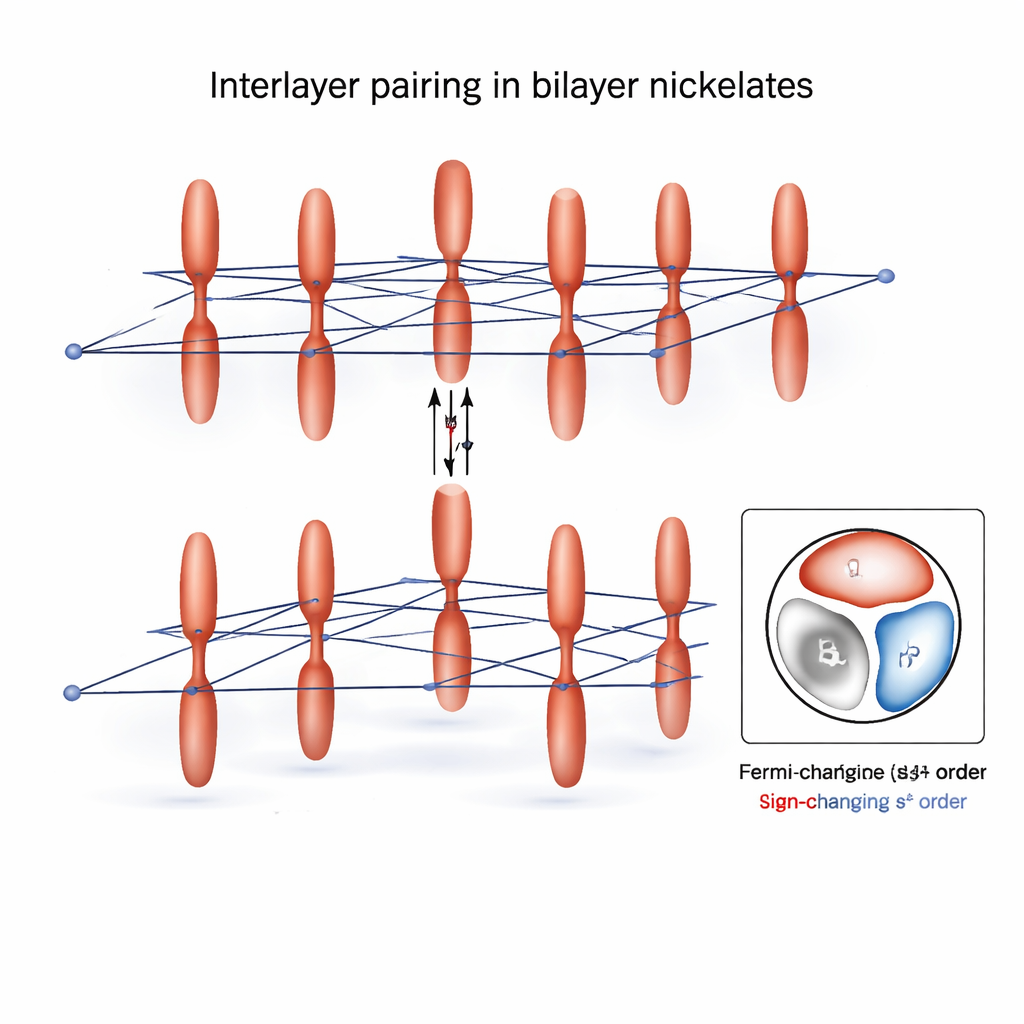
La3Ni2O7 is built from two nickel-oxide layers stacked closely together, forming what physicists call a bilayer. In each nickel atom, two types of electron states (or orbitals) are important. The authors use a detailed theoretical model that keeps both of these orbitals and the bilayer structure, then simulate how electrons move and interact. Instead of relying on approximate “weak” or “strong” interaction limits, they employ a demanding numerical technique—dynamical cluster quantum Monte Carlo—to treat electron interactions realistically in two dimensions. This allows them to test which kind of superconducting state naturally emerges from the underlying physics of the bilayer nickelate.
A Special Kind of Electron Pairing
The calculations show that the system favors an s± (pronounced “s plus-minus”) superconducting state at temperatures around 100 kelvin, close to the experimentally observed transition near 80 kelvin. In an s± state, the superconducting “wave” that describes paired electrons has opposite signs on different parts of the Fermi surface (the surface in momentum space that separates filled from empty electron states). The authors find that these pairs form mainly between electrons sitting directly above and below each other in the two layers, and primarily within one particular orbital, labeled d3z2−r2. This result means that the most important pairs are interlayer and local: they connect neighboring sites across the two layers rather than between distant sites in the same layer.
Magnetism as the Glue
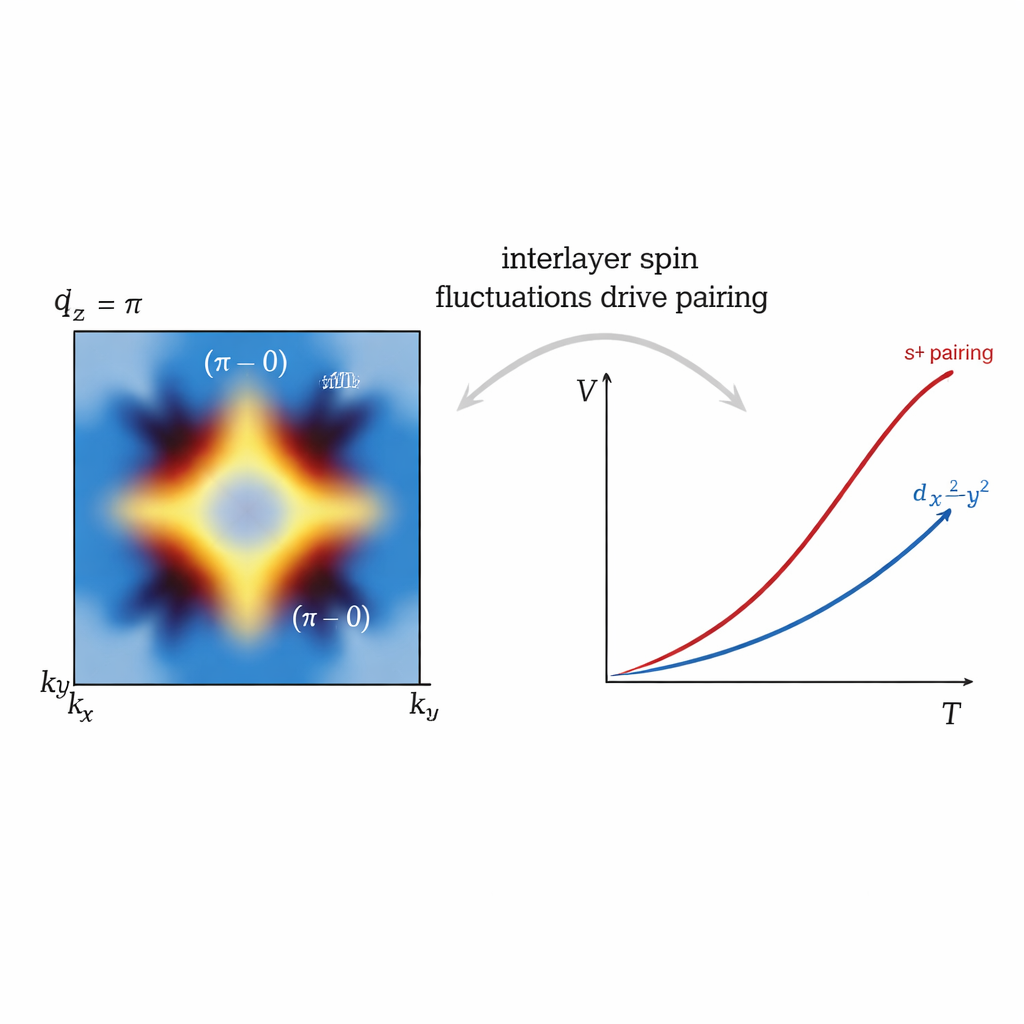
To understand what binds these pairs, the authors examine how the electrons’ magnetic moments fluctuate. They compute the magnetic susceptibility, which measures how strongly electrons respond to magnetic disturbances at different wavevectors. As the temperature is lowered, the strongest signal appears at a pattern corresponding to stripes in the plane and alternating alignment between layers. Crucially, these magnetic fluctuations are again dominated by the same d3z2−r2 orbital that hosts the strongest pairing. By comparing how the strength of these spin fluctuations grows with how the effective pairing interaction grows, they show that the two track each other closely. This strongly suggests that interlayer magnetic fluctuations act as the “glue” that binds electrons into superconducting pairs.
Simplifying a Complex Material
Although the real material has two active orbitals, the authors’ results reveal that one of them—the d3z2−r2 orbital—is chiefly responsible for the superconductivity. The other orbital, dx2−y2, plays a supporting role, contributing to some secondary pairing patterns but not driving the main instability. This finding backs up a simpler theoretical picture in which La3Ni2O7 can be effectively modeled as a bilayer system with a single dominant orbital. Earlier, more approximate studies had proposed such a model; this work provides the first non-perturbative confirmation using a realistic two-orbital description.
What This Means for Future Materials
By pinpointing that high-temperature superconductivity in La3Ni2O7 arises from interlayer pairing in a single key orbital, driven by strong spin fluctuations between the layers, the study offers a clear design principle: enhance interlayer coupling and magnetic fluctuations in the right orbital to raise the superconducting transition temperature. Since similar simple bilayer models are known to produce even higher transition temperatures in theory, this suggests that carefully tuning the electronic structure of nickelates—through pressure, chemical changes, or layering in engineered materials—could push superconductivity to even higher temperatures, bringing practical applications a step closer.
Citation: Maier, T.A., Doak, P., Lin, LF. et al. Interlayer pairing in bilayer nickelates. npj Quantum Mater. 11, 19 (2026). https://doi.org/10.1038/s41535-026-00849-9
Keywords: high-temperature superconductivity, bilayer nickelates, interlayer pairing, spin fluctuations, Hubbard model