Clear Sky Science · en
Optical diode effect at telecom wavelengths in a polar magnet
Light That Knows Which Way It’s Going
Modern internet traffic depends on light zipping through long glass fibers, but today’s networks mostly treat light the same whether it travels forward or backward. This paper explores a special crystal that acts more like an electrical diode, letting light pass more easily in one direction than the other—right at the wavelengths used for telecom. That kind of one-way light control could make future communications faster, more secure, and more energy-efficient.
A Crystal Built for One-Way Light
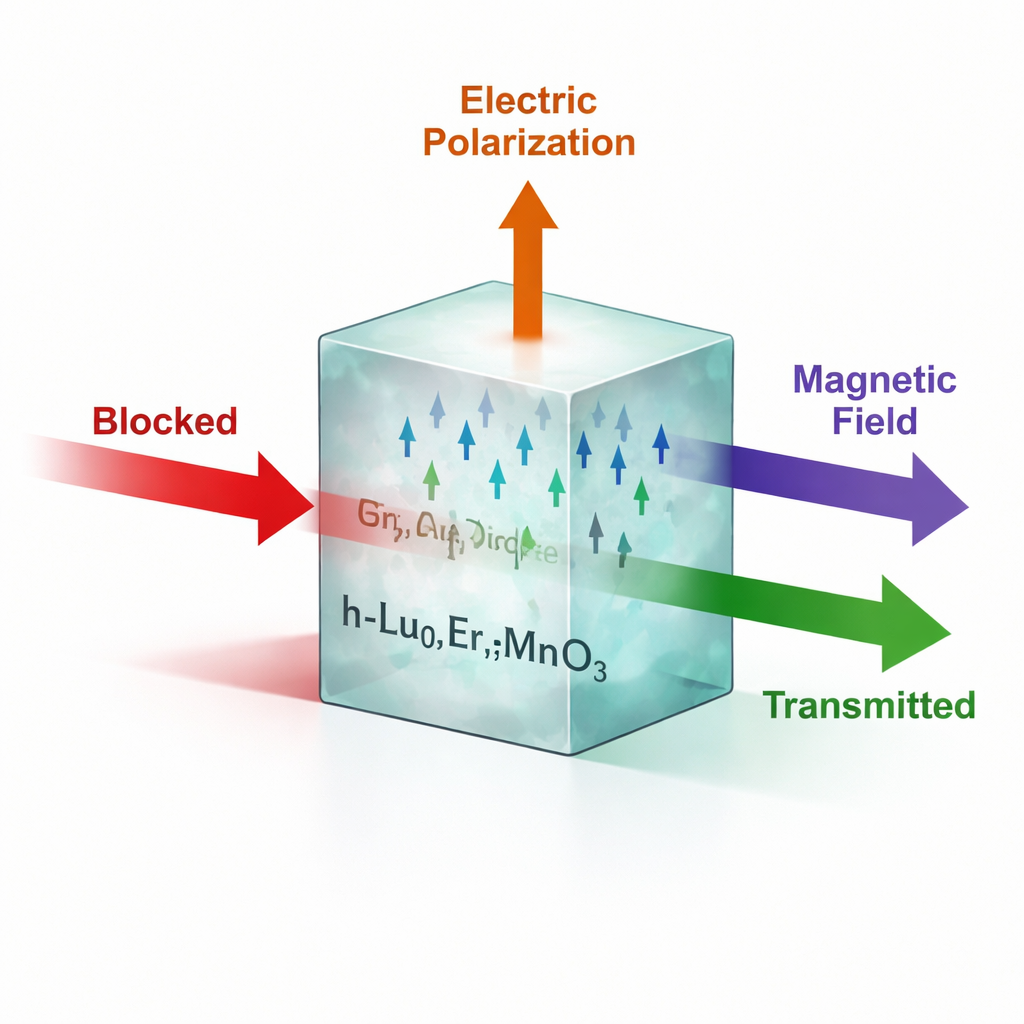
The researchers focus on a carefully engineered material with the formula h-Lu0.9Er0.1MnO3. In simple terms, it is a polar magnet: its atoms are arranged so the crystal has a built-in electric polarization, and some of its atoms carry ordered magnetic moments. A small amount of erbium (Er) is mixed into a host made of lutetium (Lu), manganese (Mn), and oxygen (O). Erbium is already a workhorse element in fiber-optic amplifiers, especially near 1550 nanometers—the sweet spot for low-loss data transmission. Here, the team wants to know whether the tiny, sharp optical transitions of Er ions inside this polar magnetic crystal can be harnessed to create a strong optical diode effect across standard telecom bands.
How One-Way Absorption Works
The key phenomenon is called nonreciprocal directional dichroism: the crystal absorbs light differently depending on whether the beam travels “forward” or “backward.” This only happens in materials that simultaneously break two fundamental symmetries—spatial inversion and time reversal—which this crystal does through its polar structure and magnetic order. The authors align three ingredients at right angles to one another: the direction of light, the built-in electric polarization, and an applied magnetic field. In this geometry, the material develops a so-called toroidal moment, a subtle combination of electric and magnetic effects that makes light propagation direction matter. When erbium’s internal energy levels—its crystal field excitations—interact with this environment, they can absorb forward-going and backward-going light by slightly different amounts.
Measuring the Effect at Telecom Wavelengths
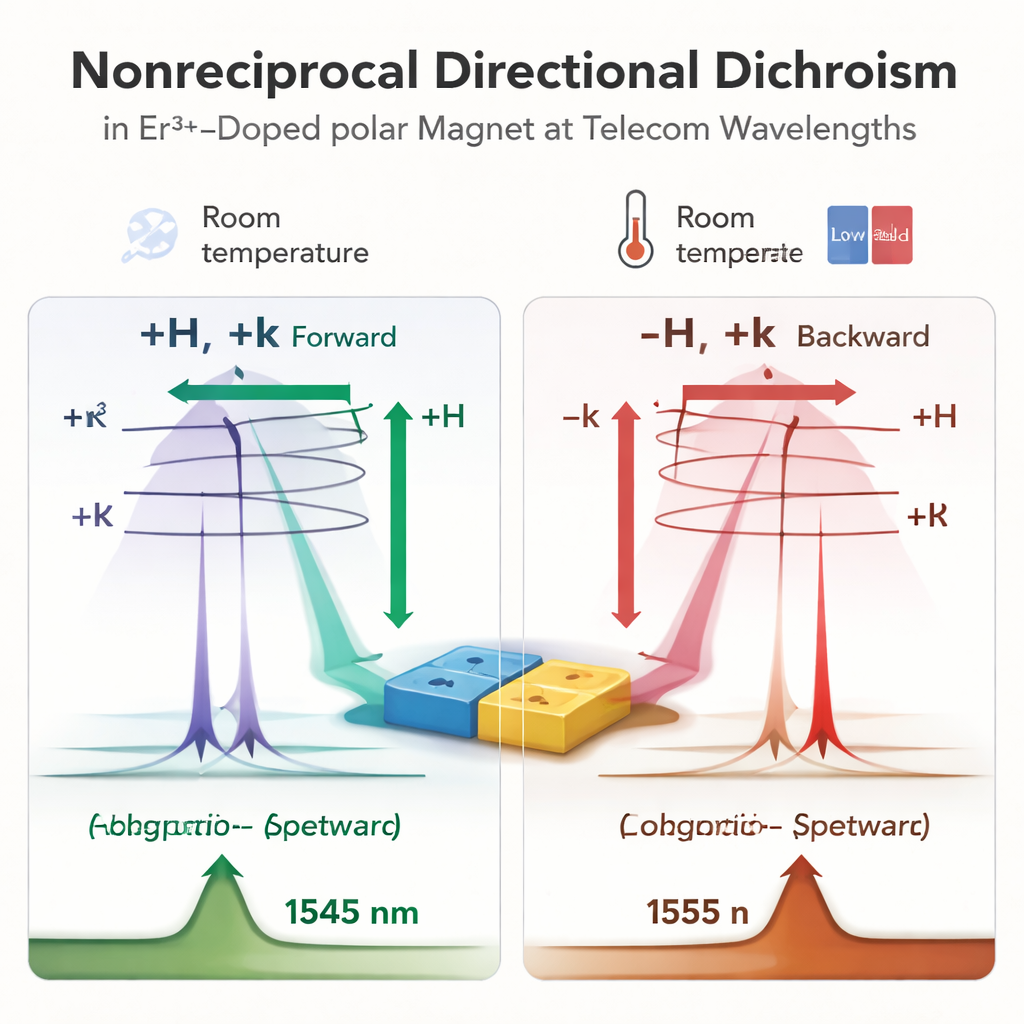
To probe this behavior, the team shines broadband infrared light through single crystals of h-Lu0.9Er0.1MnO3 and measures how strongly different wavelengths are absorbed while the magnetic field is swept up to very high values. They focus on the E-, S-, and C-bands used in optical communications, where erbium transitions between two sets of internal levels produce a cluster of sharp lines. By reversing either the magnetic field direction or the direction of light travel, they can extract the nonreciprocal absorption—the difference between the two cases. They find that the erbium peaks shift in energy with field and show clear regions where lines cross or avoid each other, revealing how the magnetic environment reshapes the internal energy landscape of the ions.
One-Way Light at Modest Fields and Room Temperature
A central surprise is how robust the one-way effect is. At very low temperatures, where the manganese spins are well ordered, the nonreciprocal signal becomes especially large, hinting that a special magnetic phase called altermagnetism may boost the effect by splitting spin states in an unusual way. But even as the temperature is raised and the magnetic order of manganese is lost, the erbium ions continue to show measurable direction-dependent absorption. At room temperature and in relatively low fields—on the order of 1.2 tesla—the authors still detect a few percent difference in absorption between forward and backward propagation near key telecom wavelengths. This means the effect does not require extreme conditions and could, in principle, be engineered into practical devices.
Why This Matters for Future Communications
From a layperson’s perspective, the main achievement is demonstrating that the same erbium ions already used to boost signals in fiber networks can also support a built-in optical “check valve” inside a solid crystal. Because these ions respond strongly to small changes in their environment, only modest magnetic fields are needed to switch the one-way behavior on or off, and the effect persists at room temperature. This work suggests a path toward compact optical isolators, modulators, or secure links that rely on the material’s internal structure rather than bulky magnets or complicated device geometries, potentially leading to lower loss and lower power consumption in next-generation telecom systems.
Citation: Smith, K.A., Gu, Y., Xu, X. et al. Optical diode effect at telecom wavelengths in a polar magnet. npj Quantum Mater. 11, 18 (2026). https://doi.org/10.1038/s41535-026-00848-w
Keywords: optical diode, telecom wavelengths, nonreciprocal light, erbium-doped materials, polar magnets