Clear Sky Science · en
Surface wet-etched Y3Fe5O12 films with perpendicular magnetic anisotropy for ultrahigh density spintronic device applications
Why cooling tiny memory bits matters
As our phones, laptops, and data centers cram ever more computing power into smaller spaces, one stubborn problem keeps getting worse: waste heat. Today’s chips rely on electric currents that generate heat as they flow through metal wires, limiting how small and fast devices can become. A new class of devices called spintronic memories aims to dodge this problem by using the magnetic state of tiny bits instead of shuttling large currents. This paper explores how to make one of the most promising spintronic materials both more energy efficient and better at getting rid of heat.
A special magnetic glass for cool computing
At the heart of this work is a material called yttrium iron garnet, or YIG, grown as an ultra-thin film. YIG is a magnetic insulator, meaning it can carry information in the form of tiny ripples in magnetism (called spins) without allowing electric current to flow. That makes it ideal for low-power devices. Even better, the researchers engineered their YIG films so that their magnetization naturally points straight up or down, a feature known as perpendicular magnetic anisotropy. This “up or down” preference is perfect for packing memory bits densely in three dimensions, much like stacking apartment floors instead of spreading houses across a field.
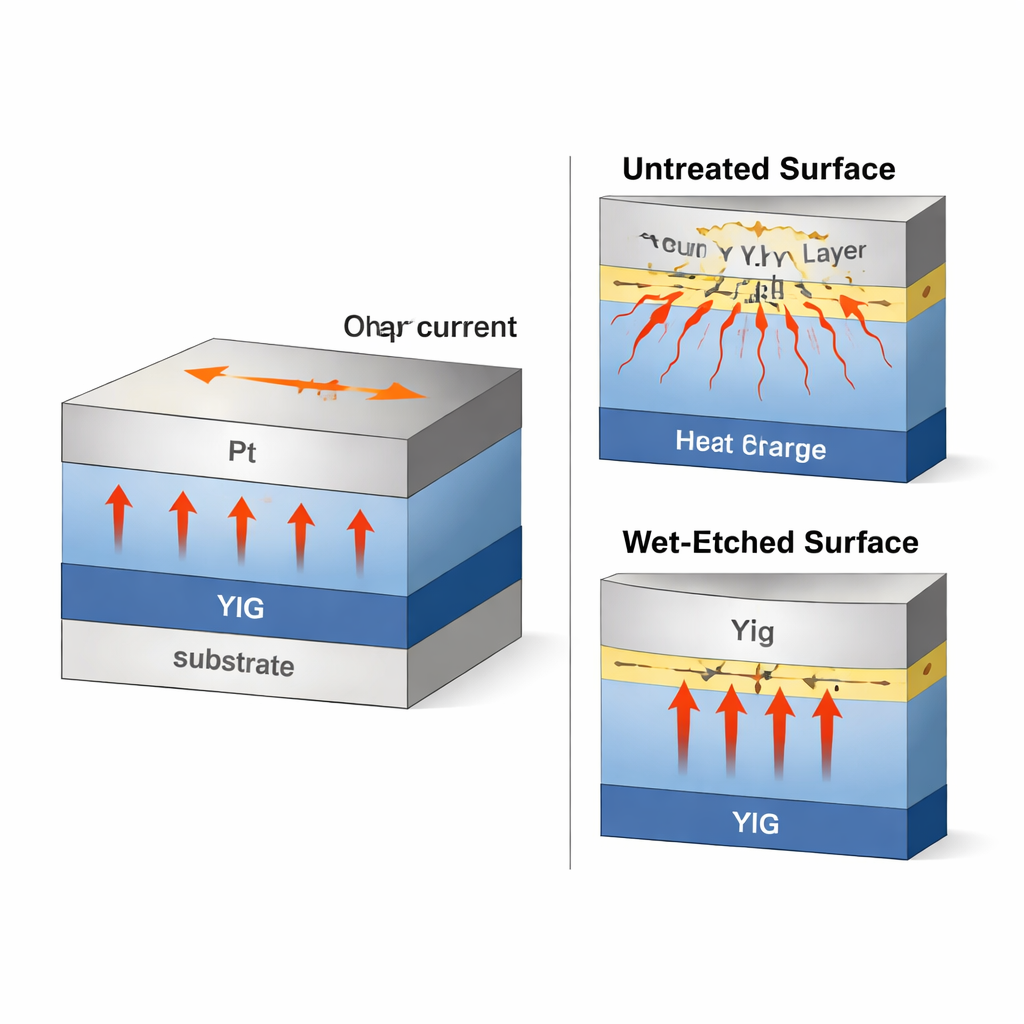
However, there is a catch. When these YIG films are made and then heated to improve their crystal structure, a thin, poorly ordered layer forms on the top surface. This defective layer acts like a foggy window between the YIG and the metal layer—platinum (Pt)—that sits on top and delivers control signals. The fog not only blocks efficient transfer of spin signals from YIG into Pt, it also hinders the escape of heat generated in the metal layer, threatening both speed and reliability.
A gentle acid bath that cleans, not destroys
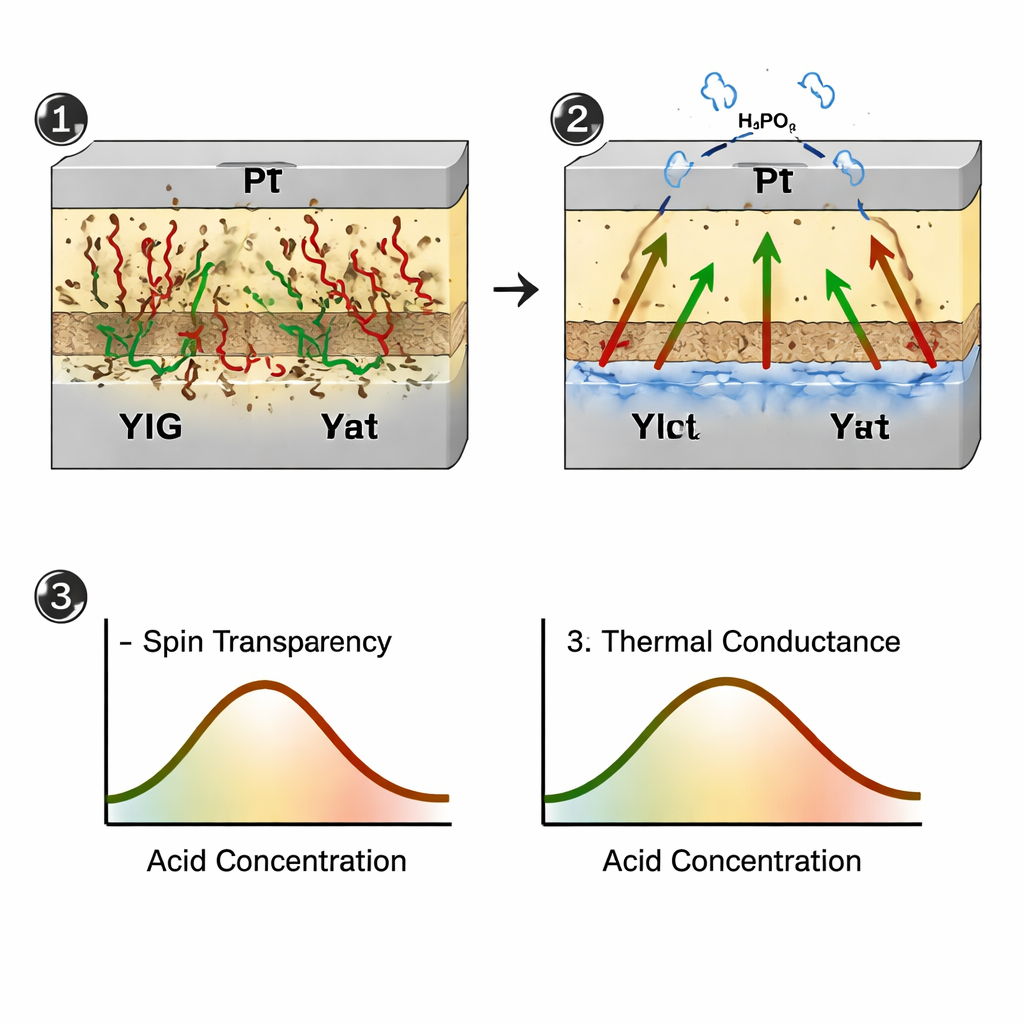
To solve this, the team tried a surprisingly simple fix: a mild bath in phosphoric acid. Instead of blasting the surface with energetic ions or very strong acids, they used a “soft” wet-etching process that nibbles away only a fraction of a nanometer from the YIG surface over an hour. By tuning the acid concentration, they could subtly reshape the topmost layer without thinning or roughening the entire film. Measurements showed that even at the strongest treatment used, the total YIG thickness shrank by less than one billionth of a meter, and its key magnetic properties remained essentially unchanged. In other words, the bulk of the material stayed pristine, while only the problematic surface layer was altered.
Detailed tests revealed what this gentle clean-up accomplished. By studying how the YIG’s magnetic resonance changed when capped with platinum, the researchers extracted a quantity that tells how easily spins cross the interface—its spin mixing conductance. With an optimal acid strength, this measure of spin transparency increased by about 70 percent compared with untreated samples. At the same time, the ability of the interface to conduct heat almost doubled. Push the chemistry too far, however, and both spin and heat transport degraded, showing that there is a “just right” level of etching that clears the fog without damaging the window.
Cooler, easier-to-switch memory bits
To see what these microscopic improvements mean for real devices, the team fabricated tiny test structures patterned into Hall bars—wiring layouts that let them read changes in resistance as the magnetization flips. In the best etched samples, the signal used to read out the magnetic state grew nearly eightfold, making it much easier to distinguish a digital “0” from a “1.” Even more important for applications, the current needed to switch the YIG’s magnetization using spin–orbit torque dropped to around six million amps per square centimeter—low for this type of device. At the same time, the platinum’s resistance increased less under heavy current, a clear sign that heat was escaping more efficiently through the cleaned interface rather than building up locally.
What is really happening at the surface
Microscopy and chemical analysis helped explain why the mild acid bath works so well. High-resolution electron images showed that, before etching, the YIG surface beneath the platinum contained a thin, poorly crystallized region, whereas the bottom interface with the underlying substrate was nearly perfect. After etching, this disordered top region became noticeably thinner. X-ray photoelectron measurements further revealed that this bad layer had too much yttrium and iron atoms in the wrong oxidation state, signs of a non-ideal composition created during high-temperature processing. Such a layer likely scatters both spin excitations and heat-carrying vibrations, acting like a tangled thicket that blocks smooth traffic. The acid treatment selectively removes much of this defective material, bringing the surface composition closer to that of ideal YIG.
Toward denser, cooler spintronic chips
For non-specialists, the bottom line is that the authors have found a simple chemical step that makes an already attractive magnetic material far more practical for future memory chips. By gently “polishing” the surface at the atomic scale with phosphoric acid, they open a clearer pathway for both information (in the form of spins) and heat to cross between the magnetic insulator and the metal control layer. This means memory bits that switch with less energy and run cooler, two requirements for packing far more data into tiny footprints without melting the chip. Such advances bring spintronic memory—based on magnetism rather than moving charges—closer to reality in ultrahigh-density, energy-efficient electronics.
Citation: Chen, S., Yuan, M., Guo, Q. et al. Surface wet-etched Y3Fe5O12 films with perpendicular magnetic anisotropy for ultrahigh density spintronic device applications. npj Quantum Mater. 11, 17 (2026). https://doi.org/10.1038/s41535-026-00847-x
Keywords: spintronics, magnetic memory, yttrium iron garnet, heat dissipation, thin films