Clear Sky Science · en
Simulating sparse SYK model with a randomized algorithm on a trapped-ion quantum computer
Peering into Quantum Chaos with Real Machines
Some of the strangest ideas in modern physics suggest that the behavior of certain exotic materials is deeply linked to the physics of black holes. The Sachdev–Ye–Kitaev (SYK) model is a mathematical playground where this connection can be explored. But because this model is wildly chaotic, even powerful supercomputers quickly lose track of its motion. This study shows how a real trapped‑ion quantum computer, together with a clever randomized algorithm, can start to track that chaos and hints at what will be needed to tackle far larger problems in the future.
A Toy Universe with Wild Behavior
The SYK model describes many interacting quantum particles whose forces are random and strongly coupled. Physicists love it because it captures the messy behavior of “strange metals” and, at low energies, can be related to a simple theory of gravity in two dimensions. However, that same randomness and strong interaction make it extremely hard to simulate over time on ordinary computers. The number of interaction terms grows rapidly with system size, and each term couples distant particles, so straightforward digital simulations on noisy quantum hardware would demand circuits that are far too deep and complex.
Making the Model Sparser and Smarter
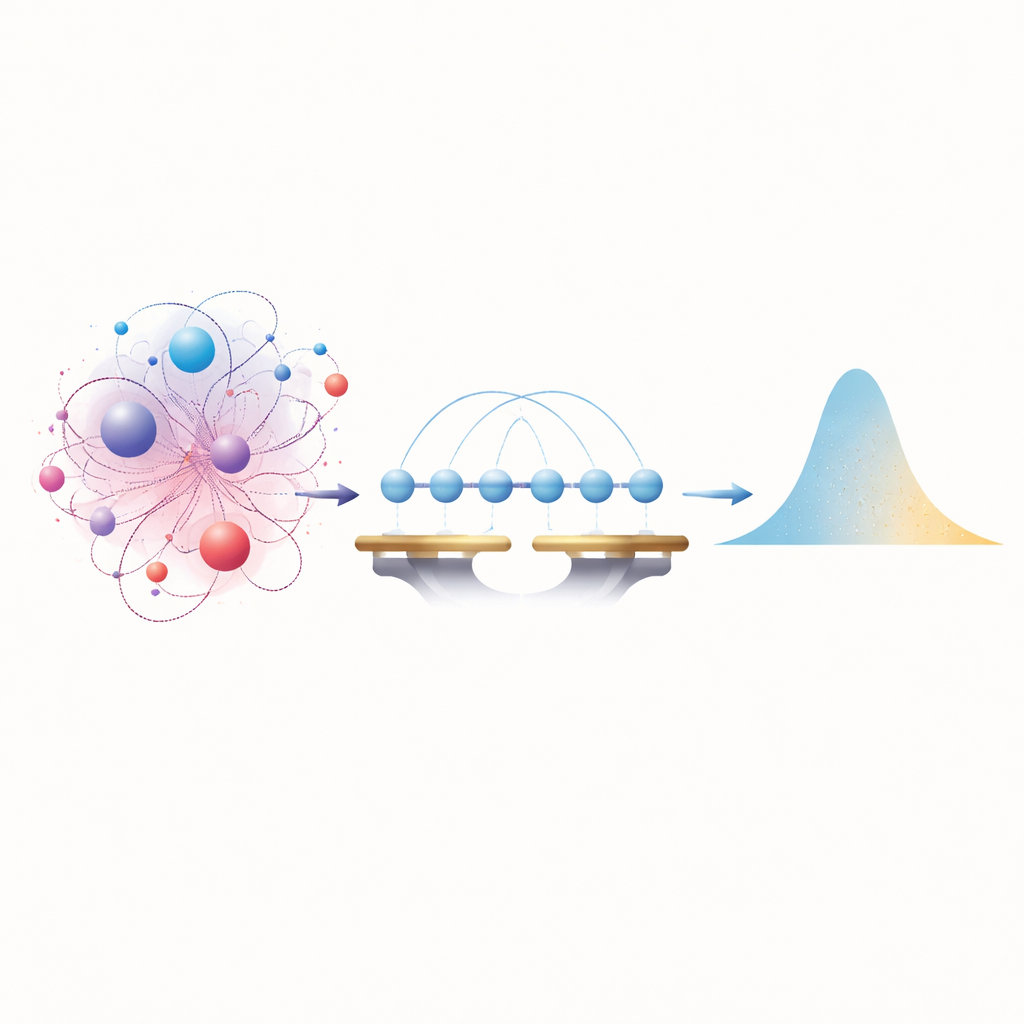
To bring the problem within reach, the authors work with a “sparse” version of the SYK model in which only a fraction of all possible interactions are kept. This thinning is done carefully so that the model still displays the hallmarks of quantum chaos that connect it to gravity-inspired physics. They then translate the model into operations on qubits using a standard mapping and choose parameters corresponding to 24 original particles, which require 12 qubits. Rather than using the usual time‑slicing (Trotter) approach, which introduces discretization errors and many gates, they employ a randomized method called TETRIS (Time Evolution Through Random Independent Sampling). TETRIS builds each circuit by randomly choosing which interaction terms to apply and how often, in such a way that the average over many runs reproduces the true continuous time evolution without this discretization error.
Watching a Quantum Echo Fade
The key quantity they measure is the Loschmidt amplitude, which tracks how likely it is for the system to return to its starting state after evolving for some time. In chaotic systems this “echo” tends to decay and, unlike in more orderly models, does not revive at later times. Using Quantinuum’s trapped‑ion device, which offers high‑quality operations and all‑to‑all connectivity between 20 qubits, the team prepares an initial all‑zero state plus an extra “helper” qubit and runs many randomly generated TETRIS circuits. They develop an error‑mitigation strategy called echo verification that checks the measurement outcomes of the system qubits and discards shots that are clearly corrupted by bit‑flip errors, as well as a second method (Large Gate Angle Extrapolation) that compares shallow and deeper versions of the same randomized circuits to estimate what the result would have been in the absence of noise.
Beating Standard Approaches and Testing Noise
By combining sparsification, TETRIS, and these mitigation tools, the experiment successfully follows the decay of the Loschmidt amplitude for the sparse SYK model up to times where the signal is close to zero and shows no revival, as expected for a chaotic system. The authors directly compare their randomized method to standard Trotter decompositions and find that, for the sizes and times of interest, TETRIS can achieve the same accuracy with fewer two‑qubit gates and no built‑in discretization error. They also introduce a new way to gauge hardware noise called a “mirror‑on‑average” benchmark. Instead of exactly inverting a circuit, they run two independently sampled TETRIS circuits whose average effect mimics doing nothing. The resulting decay in a simple ancilla measurement tracks the degradation seen in local observables more faithfully than traditional mirror‑circuit benchmarks, which tend to overestimate noise.
What This Means for Future Quantum Experiments
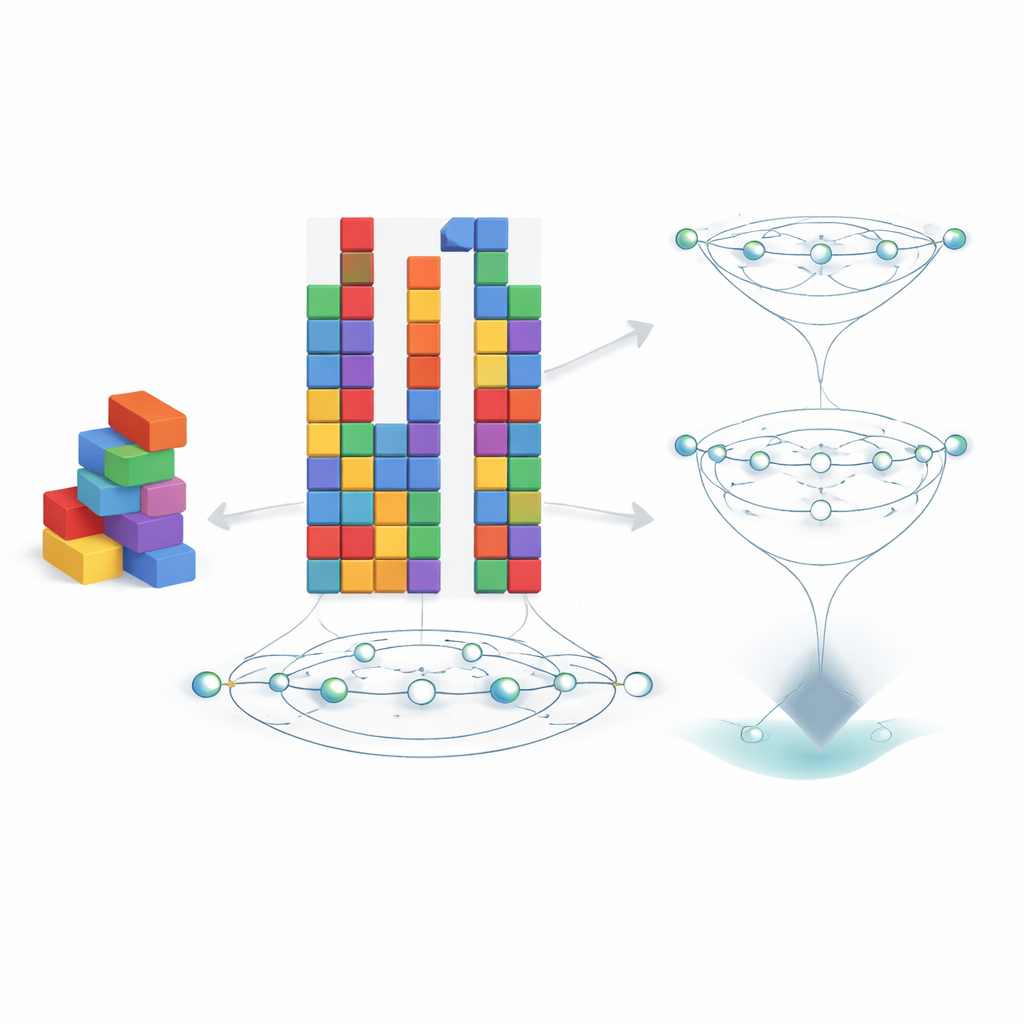
Looking ahead, the authors estimate the resources needed to tackle more ambitious quantities, such as out‑of‑time‑ordered correlators that diagnose how quickly information spreads and chaos grows. Their calculations show that fully exploring these questions in systems large enough to probe quantum‑gravity‑like behavior will require millions of two‑qubit gates and hours‑long coherent operation times per circuit, even with optimized encodings and parallelization. Nonetheless, this work demonstrates that carefully designed randomized algorithms, tailored error mitigation, and realistic resource estimates can turn abstract theories of quantum chaos and “gravity in the lab” into concrete experimental programs—and chart a clear path for what improvements future quantum hardware and algorithms must deliver.
Citation: Granet, E., Kikuchi, Y., Dreyer, H. et al. Simulating sparse SYK model with a randomized algorithm on a trapped-ion quantum computer. npj Quantum Inf 12, 43 (2026). https://doi.org/10.1038/s41534-026-01206-1
Keywords: quantum chaos, SYK model, trapped-ion quantum computer, Hamiltonian simulation, error mitigation