Clear Sky Science · en
Symbolic analysis of Grover search algorithm via Chain-of-Thought reasoning and quantum-native tokenization
Teaching Computers to Read Quantum Circuits
Quantum computers promise dramatic speedups for certain tasks, but their programs are notoriously hard for humans to understand. Today’s tools can calculate what a quantum circuit will output, yet they rarely explain why it works. This paper introduces GroverGPT+, a specialized AI model designed to "read" the code of a famous quantum search algorithm, Grover’s algorithm, and explain its logic in clear, step-by-step form—much like a skilled teacher guiding a student through a complex puzzle.
From Number Crunching to Understanding
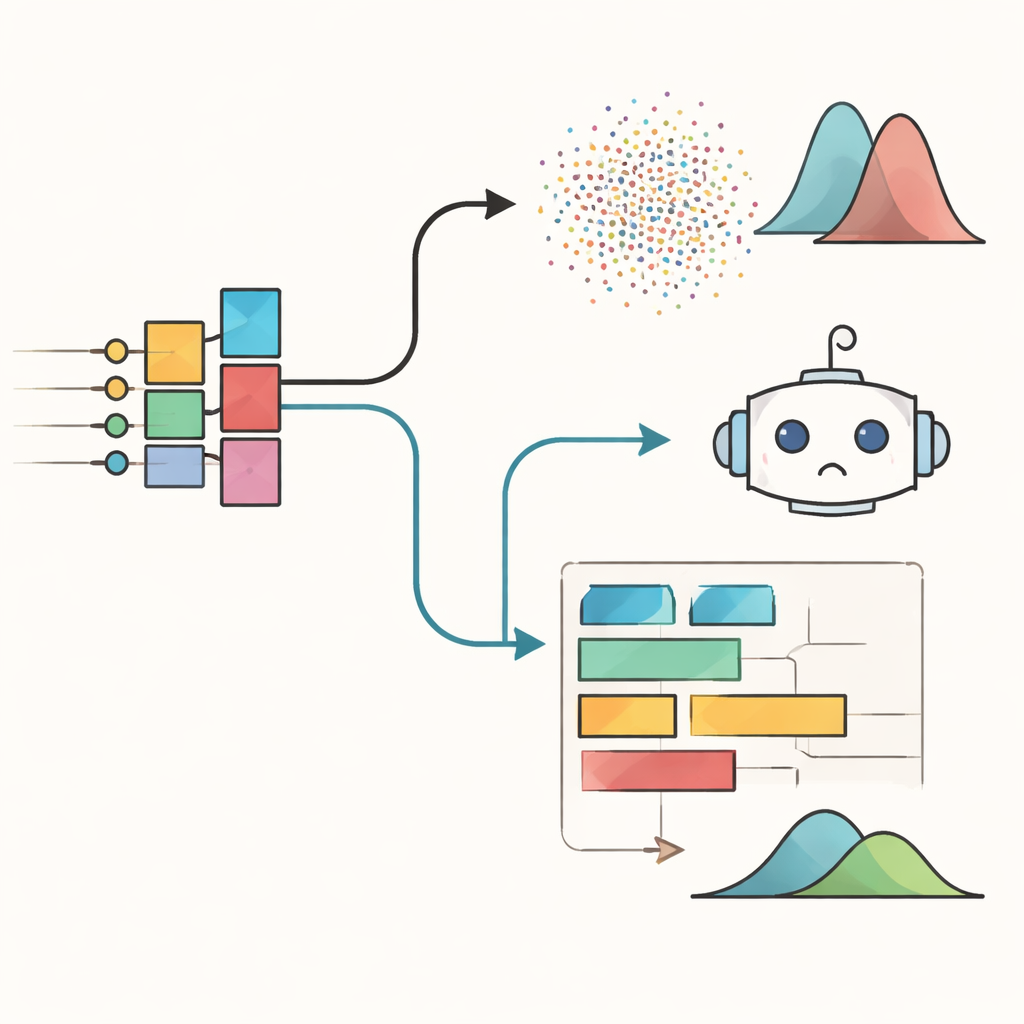
Most existing software for quantum computing focuses on raw calculation. Feed in a circuit and these simulators will track an enormous cloud of quantum probabilities to predict measurement outcomes. The process is powerful but opaque: the software multiplies large matrices, returns final probabilities, and leaves it to human experts to infer how the algorithm is structured. In contrast, GroverGPT+ is built to perform symbolic analysis. It takes the same low-level description of a circuit, written in a quantum assembly language called QASM, and aims to describe the high-level roles of different parts of the circuit—especially the "oracle" that encodes which answers are considered correct in Grover’s search.
A Quantum-Savvy Language Model
Under the hood, GroverGPT+ is a large language model—a neural network architecture originally developed for understanding and generating natural language. To make it fluent in the "language" of quantum circuits, the authors introduce two key adaptations. First, they design a quantum-native tokenizer that breaks QASM code into meaningful chunks, such as individual gates and qubit identifiers, instead of arbitrary text fragments. This compact, structure-aware encoding helps the model see entire operations at a glance. Second, they train the model with Chain-of-Thought supervision: it is taught not only the right final answers, but also detailed reasoning traces that walk through how to extract the oracle, identify the marked states, and predict the probability of each possible outcome.
Putting GroverGPT+ to the Test
To rigorously evaluate the system, the authors use Grover’s algorithm as a controlled laboratory. Grover’s search has clean mathematical properties: for any given number of qubits and marked states, experts can write down exactly which states are special and how likely the algorithm is to find them. The team generates many circuits with different sizes and different numbers of target solutions, then asks GroverGPT+ to identify the marked states and reconstruct the output probabilities. They measure success in two ways: search accuracy, which checks whether the model’s top predictions match the true marked states, and classical fidelity, which compares the full probability distribution to that of an ideal simulator.
Accurate, Stable, and Surprisingly Scalable
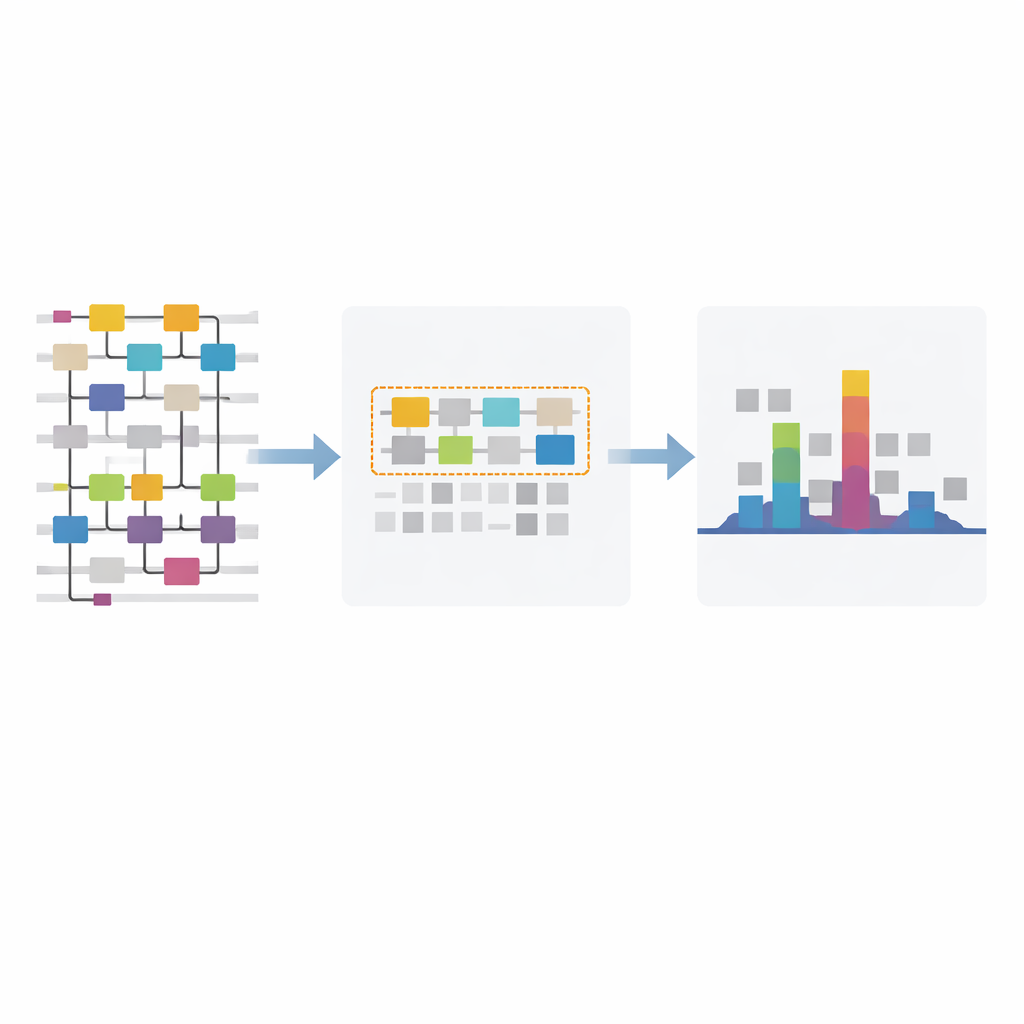
Across circuits with up to seven qubits—the range it is trained on—GroverGPT+ consistently locates the correct target states and reproduces the correct probability patterns, achieving search accuracy and fidelity close to one with very little variation. Off-the-shelf language models, in contrast, show much lower and less stable performance. The authors then probe how well GroverGPT+ generalizes beyond its training regime. When given slightly larger full circuits with eight or nine qubits, its accuracy remains high, with only a modest drop. When given a more compact input that includes only the oracle portion of the circuit, it continues to perform well even up to thirteen qubits. Just as striking, the time it takes the model to analyze a circuit grows only gently with circuit size, staying within about an order of magnitude of the smallest cases—far better than the exponential growth of full quantum state simulation.
A New Lens on Quantum Algorithm Complexity
These results suggest that AI models like GroverGPT+ can become valuable companions for quantum researchers, educators, and students. Instead of replacing numerical simulators, they offer a different function: turning low-level circuit code into high-level explanations of what the algorithm is doing and why it works. The authors go further and propose a conceptual shift. If some quantum algorithms are easy for an AI reasoner to learn and explain while others are not, that difference might reveal something about their underlying conceptual complexity, beyond traditional resource counts like gate numbers. In this view, GroverGPT+ is not just a tool for debugging, but an early prototype of an AI "scientific instrument"—one that helps probe the structure and intelligibility of quantum algorithms themselves.
Citation: Chen, M., Cheng, J., Li, P. et al. Symbolic analysis of Grover search algorithm via Chain-of-Thought reasoning and quantum-native tokenization. npj Quantum Inf 12, 48 (2026). https://doi.org/10.1038/s41534-026-01195-1
Keywords: quantum algorithms, Grover search, large language models, symbolic analysis, quantum computing tools