Clear Sky Science · en
Unveiling clean two-dimensional discrete time crystals on a digital quantum computer
A New Kind of Crystal That Ticks in Time
Crystals usually make us think of sparkling minerals, where atoms line up in repeating patterns in space. This study explores a stranger idea: patterns that repeat in time instead of space, called “time crystals.” Using one of IBM’s newest quantum processors with 133 quantum bits, the authors create and probe such a time crystal in two dimensions, watching it keep a steady rhythm even as it is pushed far from equilibrium. Their results showcase both a novel phase of matter and the growing power of today’s quantum computers to explore physics that strains classical simulations.
Why Time Can Form a Pattern
In many-body physics, driving a system with a repeated “kick” usually heats it up until it looks completely random, like water brought to a boil. Yet theory predicts that under certain conditions, a driven quantum system can settle into a pattern that repeats only every second, third, or nth kick. This behavior, called a discrete time crystal, breaks the regular time-translation of the driving itself. Earlier realizations often relied on disorder—built-in randomness—to lock in this behavior, or on extremely rapid driving that keeps heating in check. The present work instead focuses on a “clean” system, with no disorder, driven at realistic speeds, arranged in a two-dimensional lattice where each qubit talks to only a few neighbors.
Building a Quantum Lattice That Beats Like a Clock
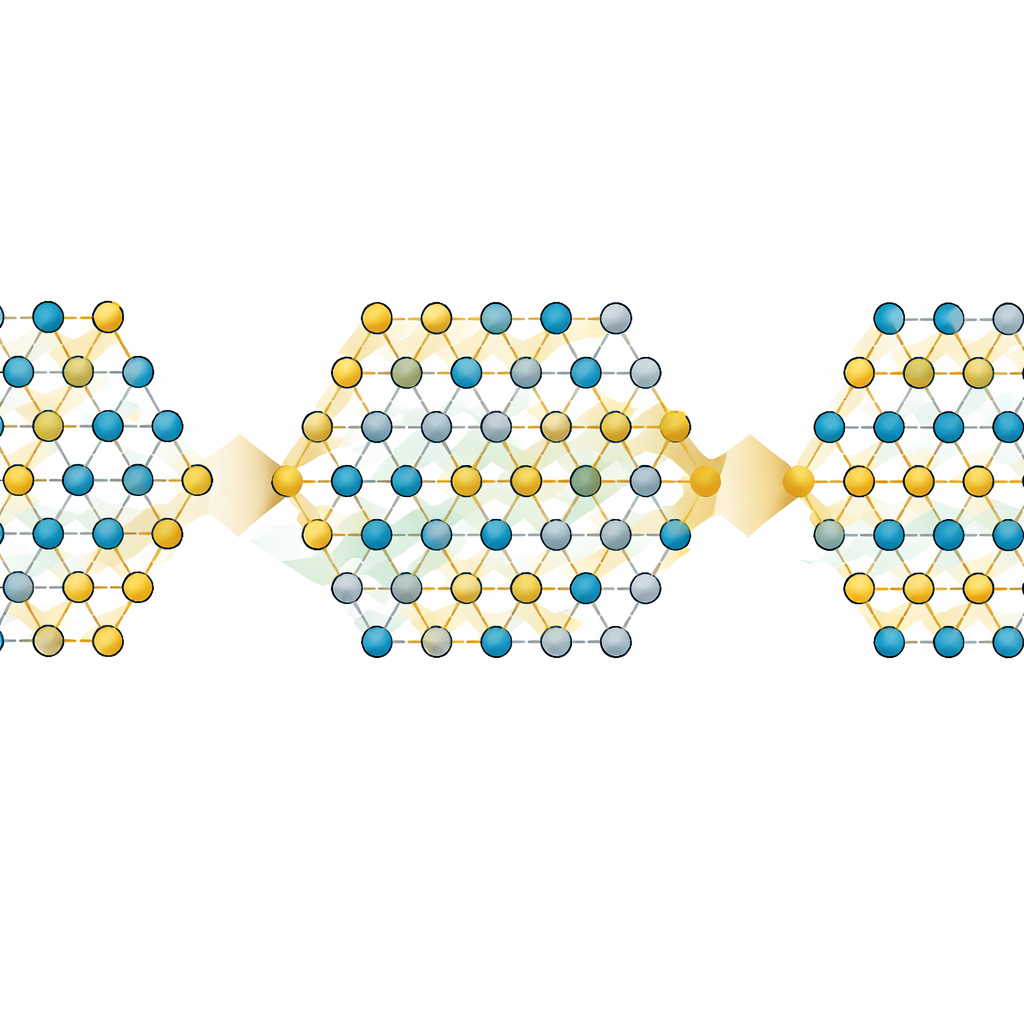
The team programs a so‑called kicked Ising model onto IBM’s 133‑qubit heavy‑hexagon chip. Each cycle of the drive is implemented as a sequence of simple quantum gates: single‑qubit rotations that act like magnetic fields pushing spins sideways or along their preferred axis, and two‑qubit gates that couple neighboring spins. Starting from a simple striped pattern of “up” and “down” qubits, they repeat this cycle up to 100 times and measure the average magnetization—a measure of how many spins point up versus down—in a central region. Because the hardware is noisy, they introduce a straightforward error‑mitigation step: they compare against a special, exactly understood setting where the ideal signal is known and use the measured decay in that case to rescale all other data. This correction, based on a global noise model, restores the magnetization oscillations that would otherwise fade too quickly.
Watching a Time Crystal Survive and Change
To validate their results, the authors compare the quantum‑hardware data to two types of classical simulations: exact state‑vector calculations for a smaller 28‑qubit subset, and advanced two‑dimensional tensor‑network methods for the full 133‑qubit lattice. For evolution times up to about 50 drive cycles, the corrected quantum data agree strikingly well with both classical approaches, lending confidence that the hardware is faithfully tracking the system’s true dynamics. Pushing further in time, they see robust period‑doubling oscillations in magnetization that last for at least 100 cycles for a broad range of driving strengths. This long‑lived, subharmonic response signals the presence of a clean prethermal time crystal: the system remains in a relatively ordered, non‑thermal plateau where information has not yet scrambled throughout the lattice, and heating to a featureless high‑temperature state is delayed.
When the Rhythm Gains a Second Beat
The story becomes richer when the researchers add a longitudinal field, which gently biases spins along one direction and explicitly breaks an internal symmetry of the model. The time‑crystal rhythm remains, but the amplitude of the oscillations now slowly waxes and wanes, creating a longer‑period “beat” on top of the basic two‑step pattern. By performing a numerical version of a spectral analysis—a discrete Fourier transform—on the observed magnetization, the team finds not just a strong peak at half the drive frequency, but also side peaks at nearby, smoothly tunable frequencies. These extra components do not line up neatly with the drive period and are effectively incommensurate, revealing an incommensurately modulated time‑crystal response in which a slow envelope modulates the underlying tick‑tock.
Quantum Computers as Microscopes for Exotic Dynamics
In the parameter regime where the time crystal crosses over to this modulated behavior and eventually to full thermalisation, classical tensor‑network simulations begin to struggle: increasing entanglement forces their approximations to break down at long times. Yet the quantum processor continues to produce data out to 100 cycles, pushing beyond what current classical tools can reliably handle. The authors conclude that clean two‑dimensional time crystals and their incommensurate cousins can be realised on today’s gate‑based quantum hardware, without relying on disorder or ultra‑fast drives, and that such processors now offer a practical laboratory for probing complex quantum dynamics in regimes where conventional computation reaches its limits.
Citation: Shinjo, K., Seki, K., Shirakawa, T. et al. Unveiling clean two-dimensional discrete time crystals on a digital quantum computer. npj Quantum Inf 12, 41 (2026). https://doi.org/10.1038/s41534-026-01193-3
Keywords: discrete time crystal, Floquet dynamics, quantum simulation, tensor networks, superconducting qubits