Clear Sky Science · en
An automated geometric space curve approach for designing dynamically corrected gates
Building Better Quantum Steps
Quantum computers promise to solve problems far beyond the reach of today’s machines, but they are painfully sensitive to tiny errors. Every operation on a qubit must be exquisitely precise, yet real hardware is noisy and imperfect. This paper introduces a new way to design those operations so that they automatically shrug off much of that noise. By turning the problem into one of drawing and shaping curves in space, the authors show how to craft quantum “moves” that hit their target exactly while being far less disturbed by imperfections in the device.
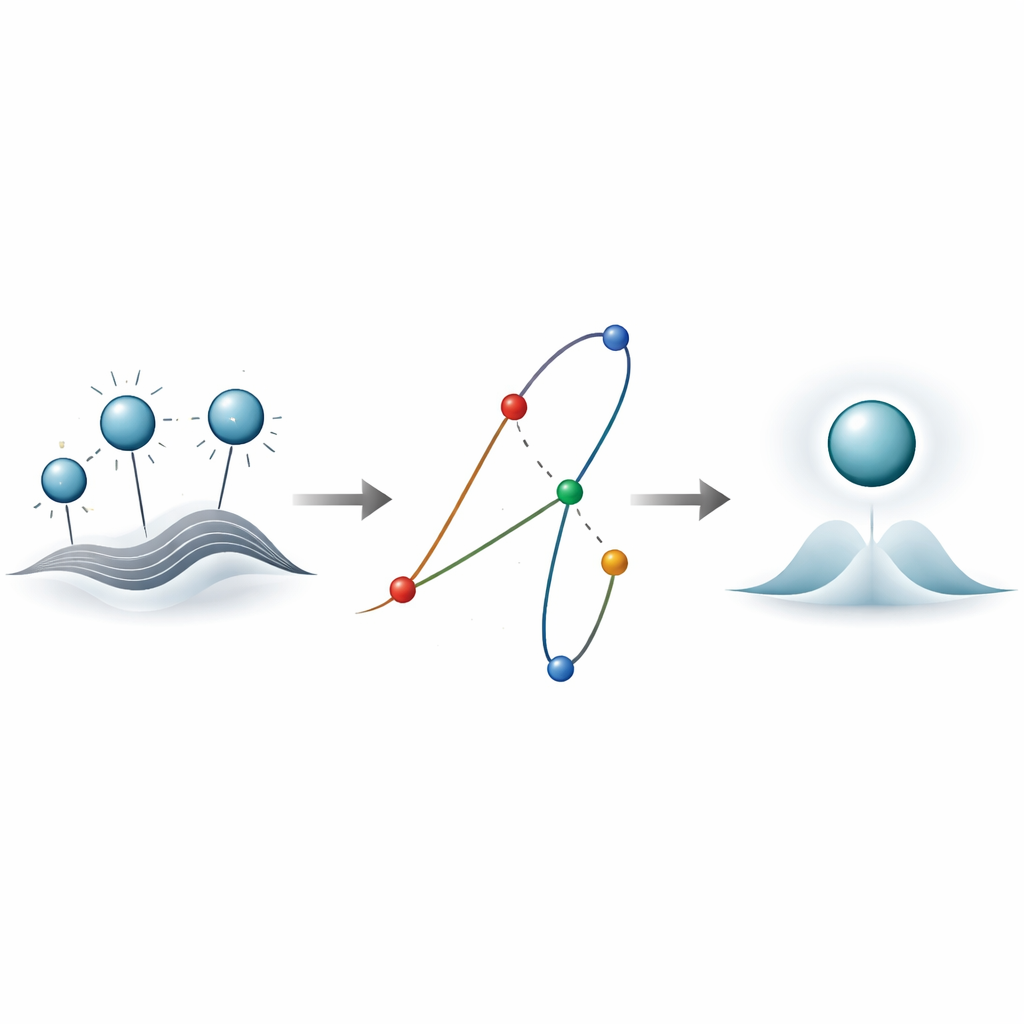
Why Quantum Operations Are Hard to Get Right
In a quantum computer, logical steps are carried out by “gates,” which are just carefully timed pulses sent to the qubits. Many different pulses can produce the same ideal gate, but only a few will do so reliably when the hardware is noisy. Conventional design methods juggle two demands at once: they must make the pulse yield the right gate and make it insensitive to noise. This is usually done by cramming both goals into a single mathematical cost function. The optimizer then has to compromise between accuracy and robustness, often getting stuck in less-than-ideal solutions and sometimes producing pulses that are awkward to implement in the lab.
Drawing Quantum Motion as Space Curves
The authors build on a geometric idea known as Space Curve Quantum Control. Instead of tracking the full quantum equations directly, they map the evolution of a single qubit onto a curve in three-dimensional space. In this picture, time corresponds to the distance along the curve, the bending of the curve relates to how strong the driving pulse is, and the twisting of the curve captures phase-like effects. A remarkable feature of this mapping is that some global requirements become simple geometric conditions. For example, if the curve closes on itself, the resulting gate is automatically protected against a common type of noise that randomly shifts the qubit’s energy (so-called dephasing). This turns an abstract control problem into a tangible question: what curves should we draw?
From Control Points to Noise-Resistant Pulses
To answer that question efficiently, the authors use Bézier curves, familiar from computer graphics and font design. A Bézier curve is fully determined by a small set of control points, and its shape and smoothness can be tuned just by moving those points. The key innovation of the BARQ method (Bézier Ansatz for Robust Quantum control) is to choose a few of these control points so that the beginning and end of the curve encode the exact desired gate, while also forcing the curve to close and the driving pulse to start and end gently at zero. This means the ideal gate is guaranteed by construction, and first-order protection against dephasing noise is built in from the start. The remaining control points are then adjusted numerically only to improve robustness to other errors and to shape the pulse into something experimentally friendly.
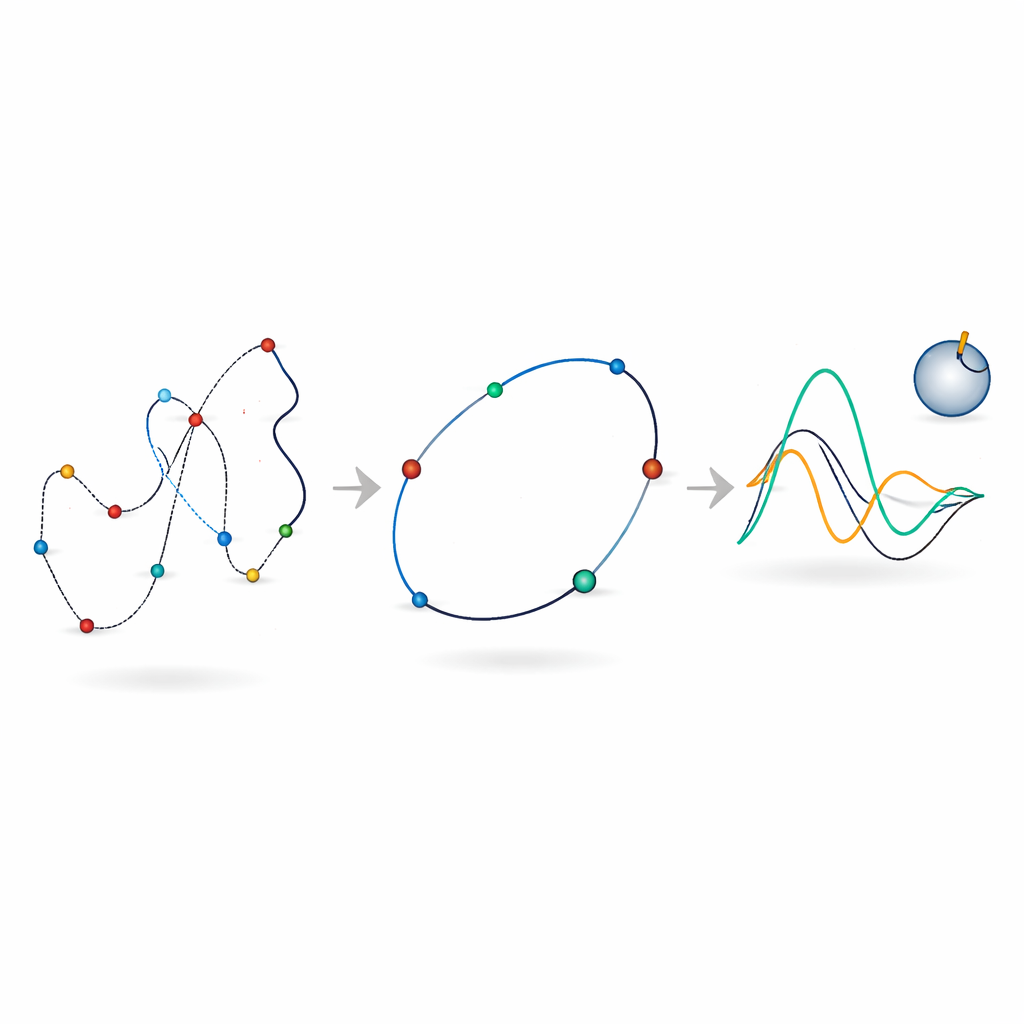
Peering Inside the New Design Method
BARQ also introduces a trick called total torsion compensation. In the geometric language, a final rotation of the qubit around one axis is tied to how much the curve has twisted overall. Instead of forcing the curve to produce exactly the right total twist—a global and hard-to-handle condition—the method allows any twist and then compensates by shifting the frequency of the driving field by a constant amount. This keeps all the difficult optimization work local to the shape of the curve while still delivering the exact final gate when noise is absent. The authors demonstrate the approach by designing two standard single-qubit gates, the X and Hadamard gates. Their optimized curves yield smooth pulses that suppress both static dephasing noise and errors in the strength of the drive, and they show through simulations that these pulses also perform well against slowly fluctuating noise.
What This Means for Future Quantum Machines
In plain terms, the paper shows how to pre-wire many desirable features into the pulse design, so that the computer only has to search over what is truly uncertain: how best to fight noise beyond the first layer of protection and how to match experimental constraints. Because the target gate is fixed exactly, there is no longer a tug-of-war between “doing the right operation” and “doing it robustly.” This cleaner landscape makes it easier to find high-quality solutions and to tailor pulses to real devices. The method is packaged in open-source software, offering experimental teams a geometric toolkit for sculpting reliable quantum gates—an important step toward turning fragile qubits into a practical computing resource.
Citation: Piliouras, E., Lucarelli, D. & Barnes, E. An automated geometric space curve approach for designing dynamically corrected gates. npj Quantum Inf 12, 46 (2026). https://doi.org/10.1038/s41534-026-01190-6
Keywords: quantum control, error-robust gates, geometric pulse design, space curve quantum control, quantum noise suppression