Clear Sky Science · en
Efficient witnessing and testing of magic in mixed quantum states
Why Quantum “Magic” Matters
As quantum computers move from theory to laboratories, a key question looms: how do we know when a quantum device is truly doing something no ordinary computer can match? Physicists call the special kind of quantum complexity needed for this advantage “magic.” This paper introduces a practical way to detect and quantify that magic even when real-world noise makes quantum states messy and imperfect, opening the door to benchmarking future quantum machines and designing more secure quantum encryption schemes.
From Ideal Quantum States to Noisy Reality
In an ideal world, quantum computers would manipulate perfectly pure quantum states, and researchers already have reliable tools to measure magic in such pristine settings. Real devices, however, always suffer from noise: interactions with the environment blur the quantum state into a mixture, adding entropy and washing out delicate quantum features. For these noisy mixed states, existing magic measures are either too computationally expensive or only work for very special cases. This gap has made it difficult to tell whether experiments and many-body quantum systems actually possess the kind of magic needed for quantum advantage.

A New “Witness” for Quantum Magic
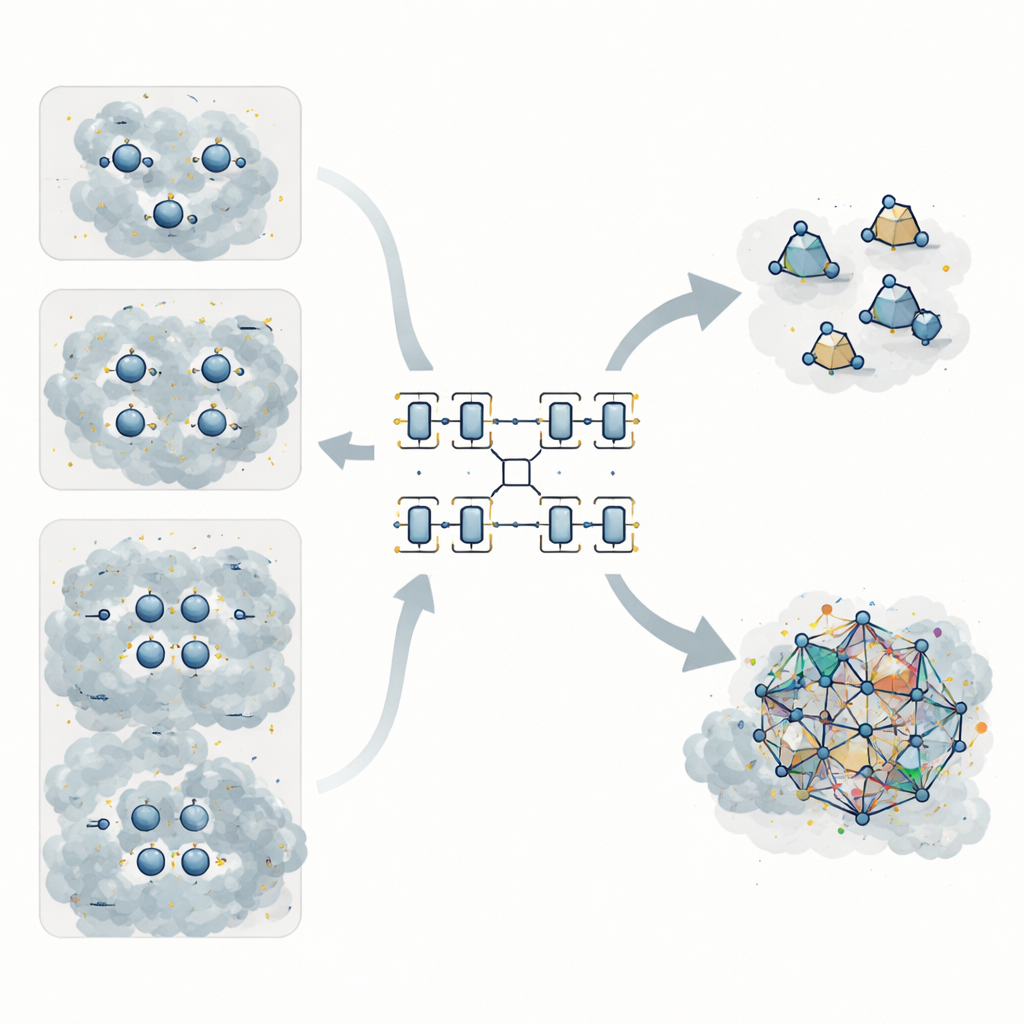
The authors propose a new set of magic witnesses built from quantities called stabilizer Rényi entropies, which can be estimated by running short, shallow circuits and performing simple two-qubit measurements on multiple copies of a state. These witnesses are nonlinear functions of the state that behave in a clear way: whenever the witness value is positive, the state is guaranteed to have magic rather than being a simple stabilizer state that a classical computer can efficiently simulate. Importantly, the size of the witness does not just say “magic is present” or “absent”; it also gives quantitative bounds on established measures of magic, telling us whether a state has only a modest amount of complexity or a parametrically large one.
Testing Quantum Power and Counting Noisy T-Gates
Building on these witnesses, the authors design algorithms that can test whether an unknown quantum state has low or high magic, as long as its entropy is not too large. Specifically, when the 2-Rényi entropy grows at most logarithmically with the number of qubits—a regime that includes many physically relevant states—the number of experimental samples needed remains polynomial rather than exploding exponentially. This makes it possible to efficiently certify how many valuable “T-states” (a standard magic resource for universal quantum computation) are present even after they pass through quite general classes of noisy processes. The work shows that magic can persist even under depolarizing noise whose strength is extremely high, and that there is a noise-dependent circuit depth up to which random circuits on today’s noisy devices can reliably generate and reveal magic.
Probing Many-Body Systems and Quantum Cryptography
The same witness can be efficiently computed for a broad class of many-body quantum states described by matrix product states, a standard tool in condensed-matter physics. This lets the authors study how magic behaves in subsystems carved out of large, entangled ground states, such as those of the transverse-field Ising model, and they find that significant magic can survive even when entanglement and noise are present. On the cryptography side, the paper links the efficiency of testing magic to the difficulty of faking it. It shows that to make low-magic states look, to any efficient observer, like high-magic ones, one must pay a price in entropy. If entropy is too small, the gap between the apparent and actual magic cannot be made arbitrarily large, placing concrete limits on how well magic can be hidden from an eavesdropper.
What This Means for the Future of Quantum Tech
Overall, the authors demonstrate that quantum magic in realistic, noisy settings is both more robust and more accessible to measurement than previously thought. Their witnesses turn the abstract idea of nonclassical computational power into something that can be efficiently checked in the lab, used to certify noisy resource states, and incorporated into the design of cryptographic protocols. At the same time, the work reveals that entropy itself is a valuable ingredient in hiding quantum resources: to fully conceal magic from prying eyes, one needs states with very high entropy. Together, these insights offer practical tools for characterizing the complexity of noisy quantum systems and clarifying the trade-offs between power, noise, and security in next-generation quantum technologies.
Citation: Haug, T., Tarabunga, P.S. Efficient witnessing and testing of magic in mixed quantum states. npj Quantum Inf 12, 40 (2026). https://doi.org/10.1038/s41534-026-01189-z
Keywords: quantum magic, noisy quantum computation, stabilizer entropy, quantum cryptography, magic state distillation