Clear Sky Science · en
Kinetic-inductance-incorporated quantization for accurate Hamiltonian prediction in superconducting circuits
Why this matters for future quantum computers
As engineers race to build bigger and more reliable quantum computers, they must know exactly how each tiny circuit on a chip will behave before it is ever fabricated. This paper tackles a hidden effect in superconducting materials that has been quietly sabotaging those predictions, and offers a practical way to fix it—helping designers build larger, more accurate quantum processors with fewer trial‑and‑error cycles.
The hidden inertia inside superconducting wires
Superconducting quantum chips are patterned from ultra-thin metal films cooled close to absolute zero. In traditional models, these films are treated as perfect conductors: electric fields are forced to vanish at their surfaces, and electromagnetic waves are not allowed to enter. Real superconductors, however, are more subtle. Their electrons pair up into "supercurrents" that can store energy through inertia, an effect known as kinetic inductance. In thin or disordered films, this extra inductance can be large enough to noticeably shift the natural tones (frequencies) of resonators and the interaction strengths between qubits and their readout circuits.
Turning thin films into effective boundary elements
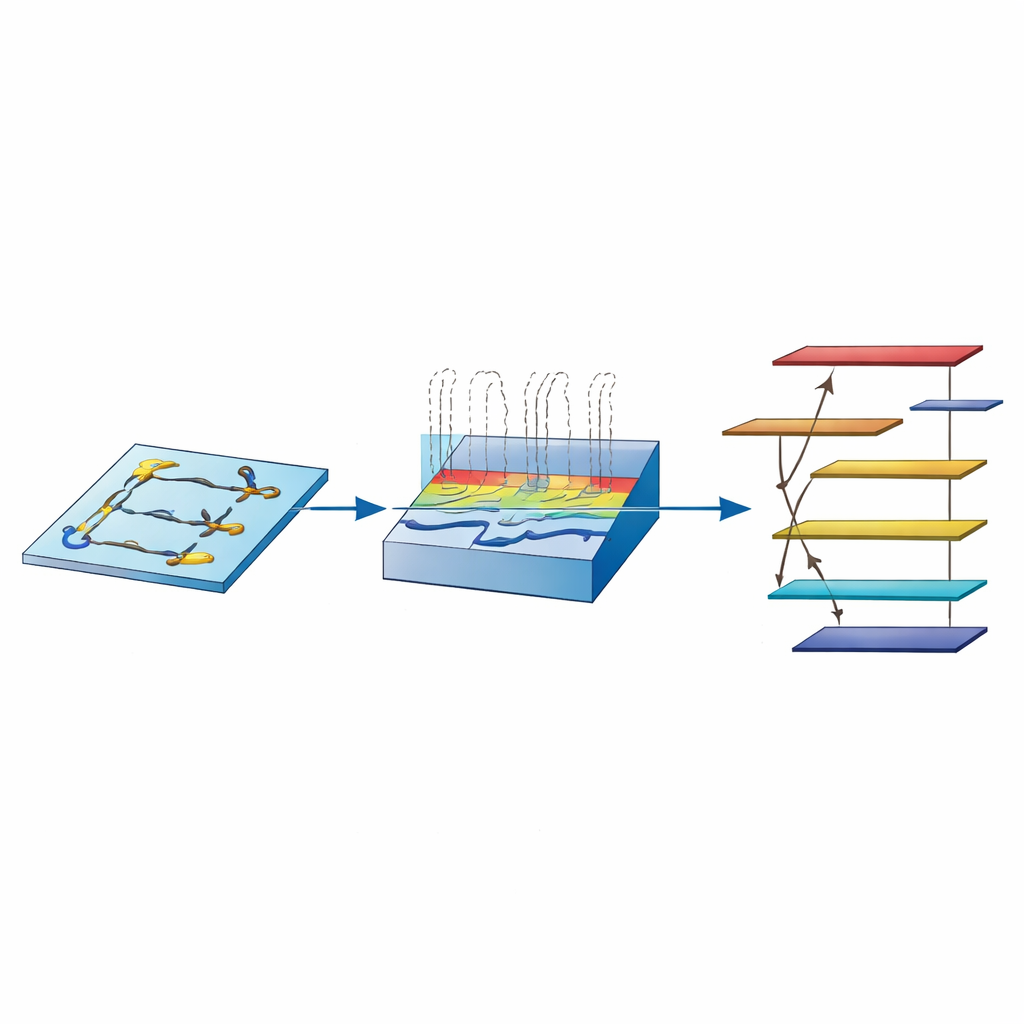
The authors introduce a method called kinetic-inductance-incorporated circuit quantization (KICQ), which upgrades existing simulation and quantization tools rather than replacing them. They compute a material-specific quantity, the surface impedance, that captures how electromagnetic fields penetrate a superconducting film and how much energy is stored or lost there. Instead of meshing every nanometer of the film, they impose this surface impedance as a special boundary condition in a three-dimensional simulator. This keeps the computational cost similar to standard approaches while allowing the simulator to “feel” the kinetic inductance of the film.
From field simulations to quantum energy levels
Once the electromagnetic fields are simulated with this more realistic boundary, the results are fed into standard quantization frameworks used in the field, such as black-box quantization and energy participation ratio methods. These methods translate classical field patterns into a quantum Hamiltonian—a mathematical object that encodes the energy levels of qubits and resonators and their mutual shifts. The crucial quantity is the tiny quantum fluctuation of phase across each Josephson junction, which depends sensitively on how much inductance sits in the surrounding metal traces. By including kinetic inductance as an extra series element in the effective circuit, KICQ alters these fluctuations just enough to correct frequency and interaction predictions.
Putting the method to the test on real devices
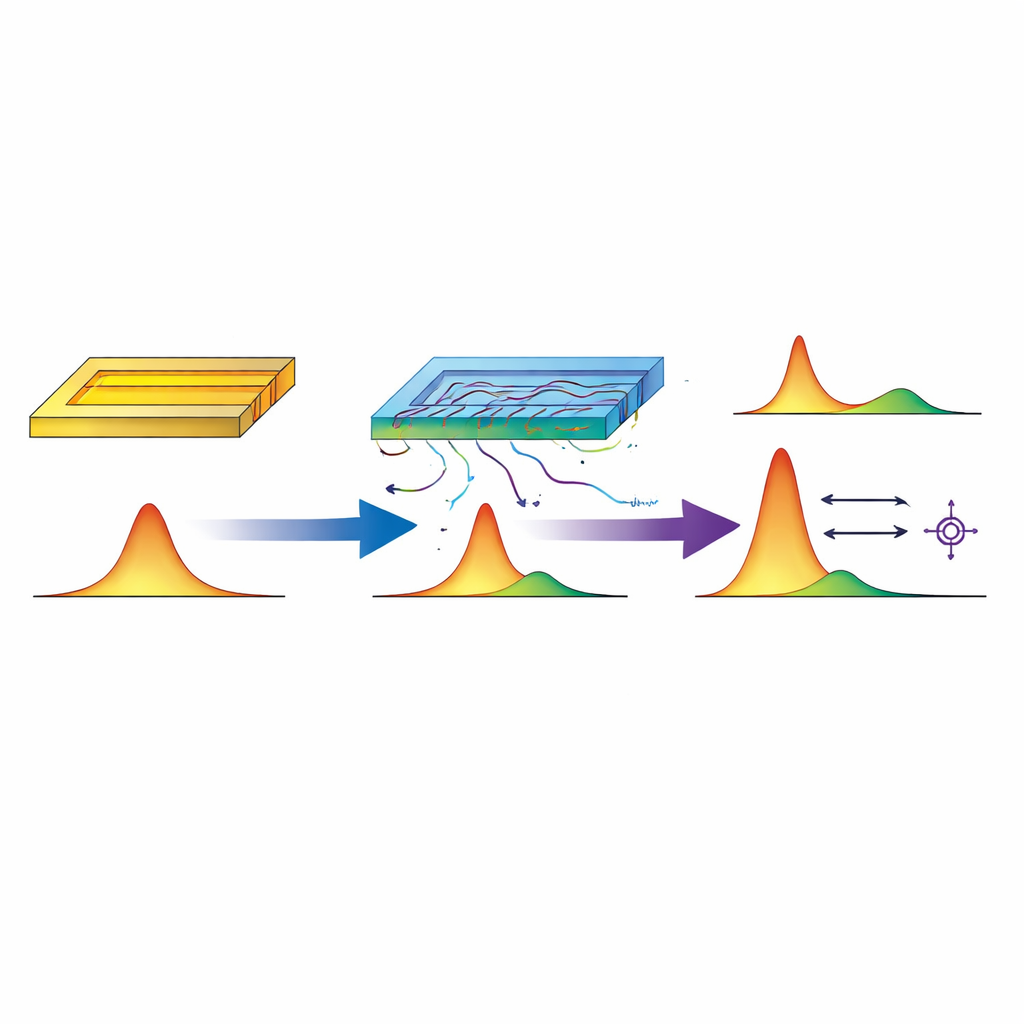
To see whether KICQ makes a practical difference, the team fabricated planar quantum chips using very thin, strongly disordered niobium films—exactly the kind of material where kinetic inductance is expected to be large. They characterized two devices: one with two qubits and their readout resonators, and another with eight such qubits and resonators. In both cases, conventional models that ignored kinetic inductance predicted resonator frequencies hundreds of megahertz too high and substantially underestimated the small frequency shifts that arise when qubits and resonators talk to each other. When the same layouts and junction parameters were analyzed with KICQ, the average error in mode frequencies dropped to roughly one percent, and the error in cross-Kerr shifts (key for qubit readout and some error-correcting codes) shrank from about forty percent to around eleven percent.
Implications beyond a single chip
The authors emphasize that kinetic inductance is not an exotic curiosity limited to disordered niobium. Recent experiments with commonly used materials such as aluminum and tantalum show that even relatively clean films can experience frequency shifts of tens of megahertz from this effect. KICQ therefore offers a general recipe: treat superconducting films as realistic surfaces with their own electromagnetic response, extract a surface impedance from material parameters or calibration, and fold that into existing design workflows. The same strategy can be applied to three-dimensional cavities, traveling-wave amplifiers, and other superconducting devices where accurate frequency placement and coupling strengths are crucial.
Bottom line: more reliable blueprints for quantum hardware
For non-specialists, the takeaway is that quantum chips are sensitive not only to their visible shapes but also to subtle properties of the metals they are made from. The KICQ method gives designers a more faithful way to connect a chip’s drawing and material recipe to its eventual quantum behavior, without adding heavy computation. By closing a long-standing gap between theory and experiment for thin-film superconducting circuits, this work moves the field closer to engineering large-scale quantum processors that behave as predicted the first time they are turned on.
Citation: Park, S.H., Choi, G., Kim, E. et al. Kinetic-inductance-incorporated quantization for accurate Hamiltonian prediction in superconducting circuits. npj Quantum Inf 12, 58 (2026). https://doi.org/10.1038/s41534-026-01187-1
Keywords: superconducting qubits, kinetic inductance, quantum circuit modeling, surface impedance, circuit quantization