Clear Sky Science · en
Robust spin-qubit control in a natural Si-MOS quantum dot using phase modulation
Making Quantum Bits Less Fragile
Quantum computers promise to solve problems that overwhelm today’s machines, but their basic building blocks—qubits—are notoriously delicate. This study shows how to make a particular kind of qubit, built in standard silicon chip technology, far more resistant to the background “noise” that normally scrambles its state. For readers, it’s a glimpse of how clever control techniques, not just better materials, can push quantum hardware closer to practical, large-scale machines.
Silicon Qubits on Everyday-Style Chips
Many leading quantum prototypes rely on exotic materials or ultracold superconducting circuits. By contrast, the qubits in this work live in tiny “quantum dots” etched into silicon using the same kind of processes used to make modern computer processors. Each quantum dot hosts a single electron whose spin (roughly, a tiny magnetic arrow pointing up or down) stores quantum information. This approach is appealing because it could piggyback on the huge industrial ecosystem already optimized for silicon chips. The catch is that standard, “natural” silicon contains a small fraction of atoms with their own magnetic moments, and the surrounding circuitry produces electrical noise, both of which jostle the electron spin and limit how long it stays well behaved.
Turning Noise into Something You Can Average Away
Instead of fighting noise only by purifying materials or endlessly recalibrating devices, the authors focus on the way they drive the qubit with microwaves. Typically, a microwave signal makes the electron spin wobble in a controlled way, implementing logic operations. But when the qubit just sits idle and no signal is applied, slow drifts in the environment cause its quantum phase to wander, erasing stored information. The key idea here is to keep the qubit under an intelligently shaped microwave drive almost all the time. By carefully modulating the phase of the microwave signal—how far its wave pattern is shifted in time—they create a situation where the qubit’s natural tendency to wander gets continually refocused and averaged out.
Building a More Stable “Protected” Qubit
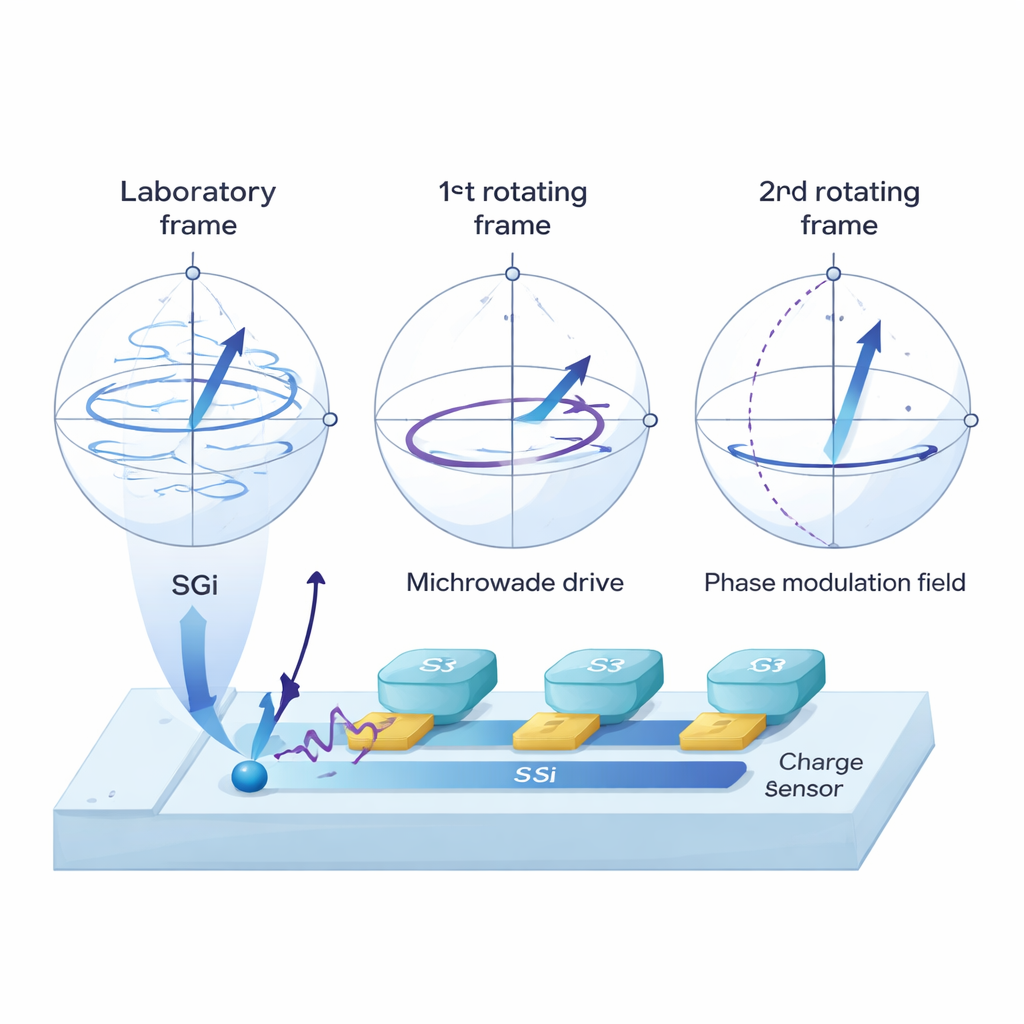
The team uses a method called concatenated continuous driving, implemented purely through phase modulation of the microwaves. Conceptually, they move step by step into new “frames” of reference where the qubit sees effective magnetic fields that open protective energy gaps. In the first frame, the usual microwave drive makes the qubit less sensitive to small errors in its natural resonance frequency. In a second, nested frame, the added phase modulation shields it from fluctuations in how strongly it is being driven. Taken together, this double-layer protection defines a new, “protected” version of the qubit that is much less perturbed by its surroundings. The researchers then show how to perform all the needed logic operations by switching how the modulation is applied, without giving up this protection.
From Theory to Measured Performance
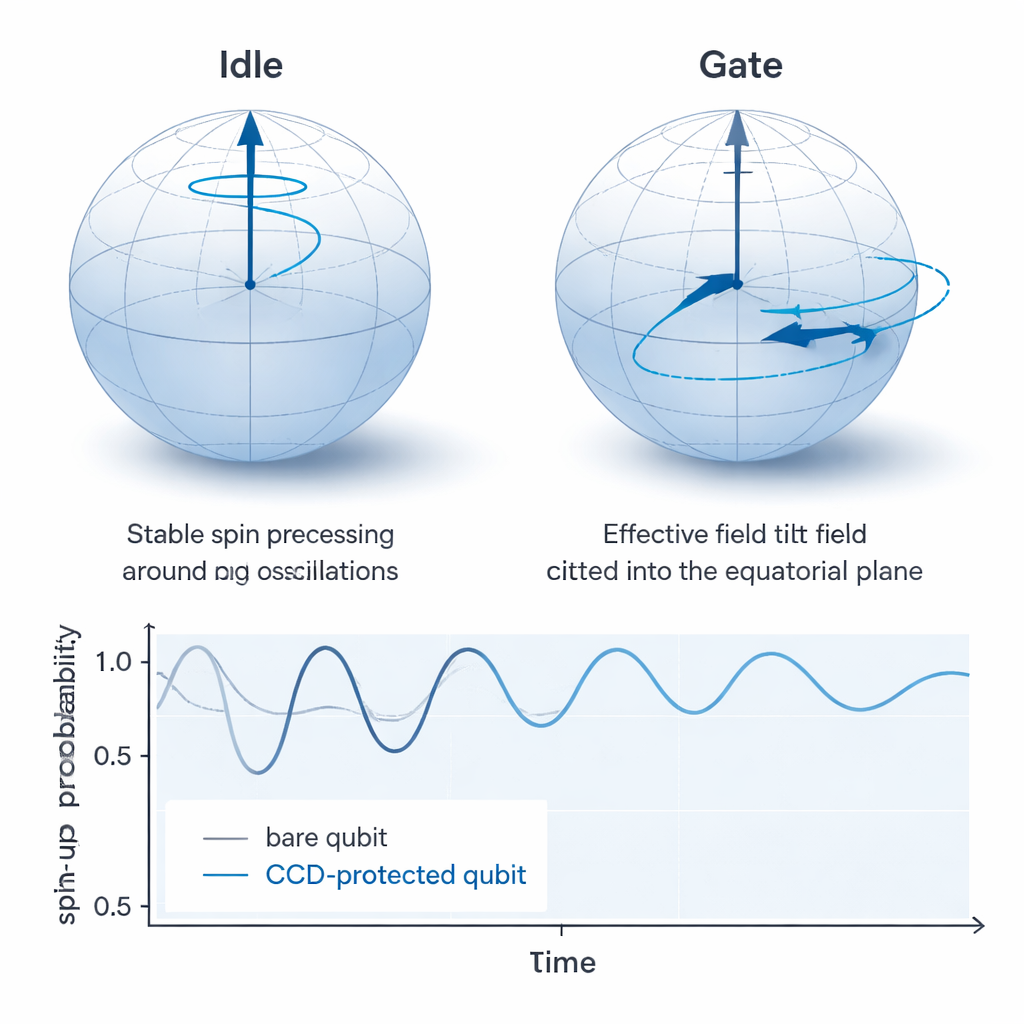
To test the scheme, the authors built a silicon device with a small array of quantum dots and a nearby charge sensor to read out the spin state. They measured how long the spin’s controlled oscillations persisted under different driving patterns. Without protection, these oscillations faded in about a millionth of a second. With the phase-modulated drive, they extended beyond two hundred microseconds—more than a hundredfold improvement. When they defined and manipulated the protected qubit basis directly, they saw similarly long-lived behavior in tests that mimic storing and retrieving quantum information. Finally, using a standard technique called randomized benchmarking, they measured how accurately a large set of single-qubit logic gates could be performed, and compared conventional control to their new method.
Closer to Fault-Tolerant Quantum Chips
The results are striking: gate operations that previously achieved about 95% accuracy reached around 99% using the protected-qubit scheme, even though the device was built from ordinary, noisy silicon. That level is close to the threshold needed for powerful error-correcting codes that can, in principle, turn imperfect qubits into a reliable quantum computer. Importantly, this boost in performance comes without constant feedback and recalibration, and it should work well in architectures where many qubits are driven by global microwave fields. For non-specialists, the take-home message is that smarter “rhythms” of control—rather than just cleaner materials—can make fragile quantum bits far more robust, helping bridge the gap between laboratory demonstrations and practical quantum processors.
Citation: Kuno, T., Utsugi, T., Ramsay, A.J. et al. Robust spin-qubit control in a natural Si-MOS quantum dot using phase modulation. npj Quantum Inf 12, 39 (2026). https://doi.org/10.1038/s41534-026-01185-3
Keywords: silicon spin qubits, quantum control, phase modulation, quantum coherence, fault-tolerant quantum computing